Clinical Knowledge › Internal medicine › Rheumatology and immunology › Inflammatory arthritis and spondyloarthritis
Rheumatoid arthritis (RA)
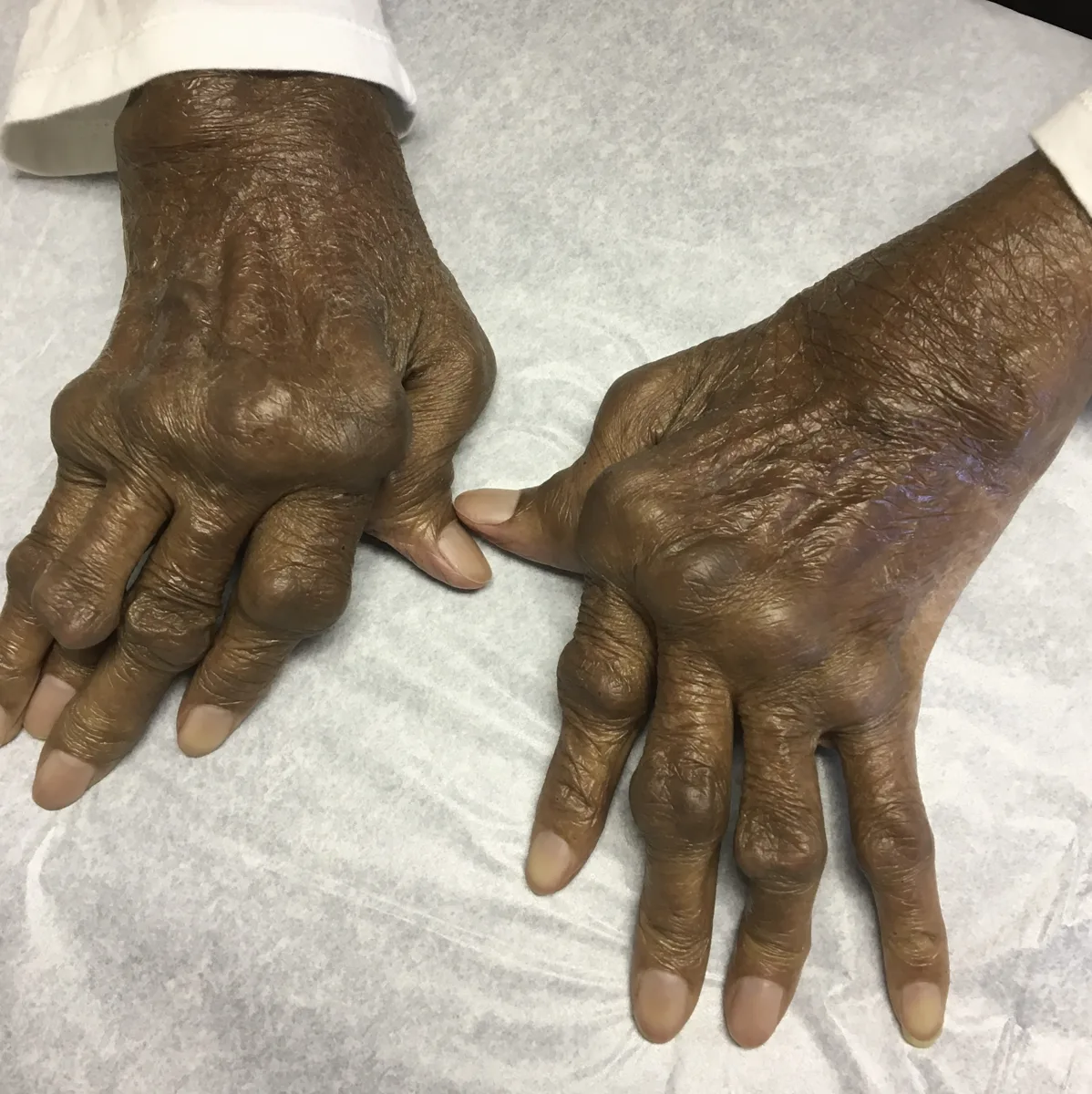
Rheumatoid arthritis is a chronic autoimmune inflammatory arthritis affecting about 0.5–1% of adults, women two to three times more often than men, with peak onset at 30–60 years. Genetic susceptibility (HLA-DRB1 shared epitope) and environmental triggers, especially smoking, lead to antibodies against citrullinated proteins and synovial inflammation driven by T and B cells, TNF and IL-6; the inflamed synovium (pannus) erodes cartilage and bone. It presents as a symmetrical polyarthritis of the small joints of the hands and feet with prolonged morning stiffness, sparing the DIP joints, and may involve the cervical spine, lungs, eyes, skin, blood and vessels. Diagnosis is clinical, supported by RF and anti-CCP antibodies, raised ESR/CRP and imaging; the 2010 ACR/EULAR criteria classify early disease. Management is a treat-to-target strategy: start methotrexate as soon as possible with short-term glucocorticoids, aim for remission within 6 months, and add a biologic or targeted synthetic DMARD if poor prognostic factors are present and the target is not reached. Cardiovascular risk, infection, osteoporosis and interstitial lung disease drive long-term outcomes.
Patient case, mechanism, investigations, management, flashcards and exam-style questions.Open the lesson →
Key facts
- Prevalence about 0.5–1%; female to male ratio about 3:1; smoking is the strongest modifiable risk factor, especially for anti-CCP-positive disease
- Symmetrical polyarthritis of MCP, PIP, wrist and MTP joints with morning stiffness over 1 hour; DIP joints spared
- RF is about 70% sensitive and 80% specific; anti-CCP about 60–70% sensitive and 95% specific and predicts erosive disease
- X-ray changes: soft-tissue swelling, periarticular osteopenia, symmetrical joint-space narrowing and marginal erosions
- Methotrexate is the anchor drug: once weekly with folic acid on another day; teratogenic and requires blood monitoring
- Treat-to-target: assess every 1–3 months; aim for remission (DAS28 <2.6) or at least low disease activity, with improvement by 3 months and target by 6 months
- Screen for TB, hepatitis B and C and HIV before biologics or JAK inhibitors; JAK inhibitors are restricted in people over 65, smokers and those with cardiovascular, cancer or VTE risk
- Cardiovascular disease is the leading cause of death; RA roughly doubles cardiovascular risk
Differential diagnosis
| Condition | Clues | Key test |
|---|---|---|
| Psoriatic arthritis | Psoriasis, nail pitting, DIP involvement, dactylitis, asymmetry | RF and anti-CCP usually negative; X-ray pencil-in-cup |
| Viral polyarthritis | Acute onset, under 6 weeks, rash, exposure to children or travel | Parvovirus B19 IgM, hepatitis B/C, chikungunya serology |
| Systemic lupus erythematosus | Non-erosive deforming arthritis (Jaccoud), rash, cytopenias, renal disease | ANA, anti-dsDNA, complement |
| Polymyalgia rheumatica | Over 50, girdle stiffness, little peripheral synovitis | ESR/CRP; RF and anti-CCP negative |
| Hand osteoarthritis | DIP and PIP bony nodes, first CMC joint, brief stiffness | Normal CRP; X-ray osteophytes, central erosions in erosive OA |
| Chronic tophaceous gout | Asymmetric, tophi, previous acute attacks | Aspirate for urate crystals; dual-energy CT |
| CPPD (pseudo-RA pattern) | Older, wrists and MCP 2–3, chondrocalcinosis | Crystals; X-ray chondrocalcinosis |
| Haemochromatosis arthropathy | MCP 2–3 hook osteophytes, diabetes, liver disease | Ferritin and transferrin saturation; HFE genotype |
Exam pearls
Guideline
EULAR recommendations for the management of RA with synthetic and biologic DMARDs (2025 update, published 2026); ACR guideline for the treatment of RA (2021); NICE NG100 Rheumatoid arthritis in adults (2018, updated 2020); 2010 ACR/EULAR RA classification criteria
References
- Smolen JS, et al.. EULAR recommendations for the management of rheumatoid arthritis with synthetic and biologic disease-modifying antirheumatic drugs: 2025 update. Ann Rheum Dis 2026.
- Fraenkel L, Bathon JM, England BR, et al.. 2021 American College of Rheumatology guideline for the treatment of rheumatoid arthritis. Arthritis Care Res (Hoboken) 2021.
- National Institute for Health and Care Excellence (NICE). Rheumatoid arthritis in adults: management (NG100). NICE guideline 2018.
- Aletaha D, Neogi T, Silman AJ, et al.. 2010 rheumatoid arthritis classification criteria: an American College of Rheumatology/European League Against Rheumatism collaborative initiative. Arthritis Rheum 2010.
- Smolen JS, Aletaha D, McInnes IB. Rheumatoid arthritis. Lancet 2016.
- Ytterberg SR, Bhatt DL, Mikuls TR, et al.. Cardiovascular and cancer risk with tofacitinib in rheumatoid arthritis. N Engl J Med 2022.
Related topics
By Dr Khalid Seidi (B.Sc., M.D.) · MedEd World Clinical Knowledge library. Original teaching content checked against current guidelines (November 2026); confirm the latest local guidance before clinical use. Not a substitute for clinical judgement.