Clinical Knowledge › Internal medicine › Rheumatology and immunology › Inflammatory arthritis and spondyloarthritis
Psoriatic arthritis
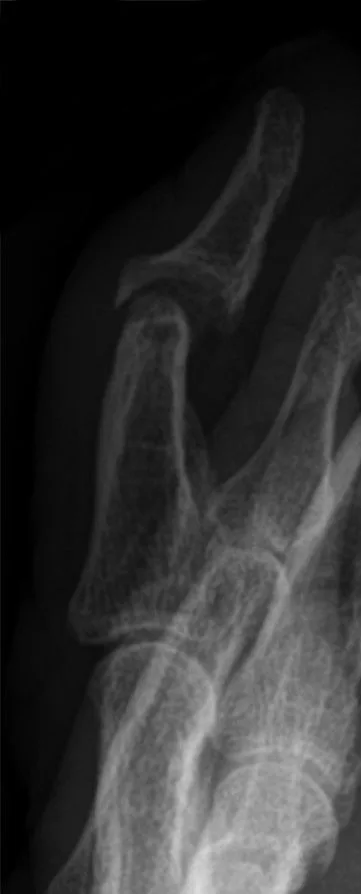
Psoriatic arthritis (PsA) is a seronegative inflammatory arthritis that develops in about a quarter of people with psoriasis, usually years after the skin disease. It belongs to the spondyloarthritis family and involves several domains: peripheral arthritis (asymmetric oligoarthritis, symmetric polyarthritis, DIP-predominant disease or arthritis mutilans), axial disease, enthesitis, dactylitis, skin and nail psoriasis, uveitis and inflammatory bowel disease. The IL-23/IL-17 and TNF pathways drive inflammation, causing both erosions and new bone formation; the X-ray hallmark is the pencil-in-cup deformity. Diagnosis is clinical and supported by the CASPAR criteria; rheumatoid factor and anti-CCP are usually negative. Treatment aims at remission or low disease activity: NSAIDs and local steroid injections, then methotrexate or another csDMARD, and biologics targeting TNF, IL-17 or IL-23, or JAK inhibitors, selected by the dominant domains. Cardiovascular and metabolic comorbidity must also be managed.
Patient case, mechanism, investigations, management, flashcards and exam-style questions.Open the lesson →
Key facts
- PsA affects about 20–30% of people with psoriasis; skin disease precedes arthritis in about 70%
- Patterns: asymmetric oligoarthritis, symmetric polyarthritis, DIP-predominant, arthritis mutilans, axial
- Dactylitis, enthesitis and nail pitting or onycholysis are key clues
- CASPAR: inflammatory articular disease plus ≥3 points (current psoriasis scores 2)
- X-ray: erosions with new bone formation, pencil-in-cup deformity, acro-osteolysis
- RF and anti-CCP are usually negative; CRP may be normal
- Methotrexate is the preferred csDMARD with significant skin disease; then biologics (TNF, IL-17, IL-23) or JAK inhibitors
- IL-23 inhibitors are not used for axial disease; IL-17 inhibitors are avoided in IBD
Differential diagnosis
| Condition | Clues | Key test |
|---|---|---|
| Rheumatoid arthritis | Symmetric MCP/PIP synovitis, no DIP or dactylitis | RF and anti-CCP positive; periarticular osteopenia |
| Gout | Acute monoarthritis; urate is high in psoriasis | Needle-shaped crystals on aspiration |
| Osteoarthritis (Heberden nodes) | Bony hard DIP swelling, no inflammation or nail disease | Osteophytes, normal CRP |
| Erosive (inflammatory) hand osteoarthritis | Central erosions (gull-wing) in DIP/PIP | X-ray gull-wing pattern; no psoriasis |
| Reactive arthritis | Recent GI or genitourinary infection | NAAT or stool culture; self-limiting |
| Axial spondyloarthritis | Symmetric sacroiliitis, young onset | No psoriasis; marginal syndesmophytes |
Exam pearls
Guideline
EULAR recommendations for the management of psoriatic arthritis with pharmacological therapies: 2023 update; GRAPPA 2021 treatment recommendations; CASPAR (2006)
References
- Gossec L, Kerschbaumer A, Ferreira RJO, et al.. EULAR recommendations for the management of psoriatic arthritis with pharmacological therapies: 2023 update. Ann Rheum Dis 2024.
- Coates LC, Soriano ER, Corp N, et al.. Group for Research and Assessment of Psoriasis and Psoriatic Arthritis (GRAPPA): updated treatment recommendations for psoriatic arthritis 2021. Nat Rev Rheumatol 2022.
- Taylor W, Gladman D, Helliwell P, et al.. Classification criteria for psoriatic arthritis: development of new criteria from a large international study. Arthritis Rheum 2006.
- National Institute for Health and Care Excellence. Psoriasis: assessment and management (CG153). NICE 2012.
- National Institute for Health and Care Excellence. Spondyloarthritis in over 16s: diagnosis and management (NG65). NICE 2017.
- Ritchlin CT, Colbert RA, Gladman DD.. Psoriatic arthritis. N Engl J Med 2017.
Related topics
By Dr Khalid Seidi (B.Sc., M.D.) · MedEd World Clinical Knowledge library. Original teaching content checked against current guidelines (November 2026); confirm the latest local guidance before clinical use. Not a substitute for clinical judgement.