Clinical Knowledge › Urology › Urological cancers
Penile cancer
Penile cancer is a rare malignancy in Europe and North America but considerably more common in parts of South America, Africa and South Asia. About 95% are squamous cell carcinomas, arising either through high-risk human papillomavirus infection (mostly HPV16; basaloid and warty types) or through chronic inflammation, particularly lichen sclerosus and phimosis, in HPV-independent tumours. Other risk factors are lack of childhood circumcision, poor genital hygiene, smoking and immunosuppression. Patients typically present late with a non-healing lump, ulcer or bleeding of the glans or foreskin. Diagnosis is by biopsy; spread is stepwise to inguinal and then pelvic lymph nodes, and nodal status is the strongest predictor of survival. Treatment aims to remove the primary with organ-sparing surgery where possible, and to stage the groins with ultrasound and dynamic sentinel node biopsy or lymphadenectomy. Prevention includes HPV vaccination, treatment of phimosis and lichen sclerosus, and smoking cessation.
Patient case, mechanism, investigations, management, flashcards and exam-style questions.Open the lesson →
Key facts
- Rare in high-income countries (about 1 per 100 000 men) but more common in parts of Brazil, sub-Saharan Africa and South Asia; peak age 50–70
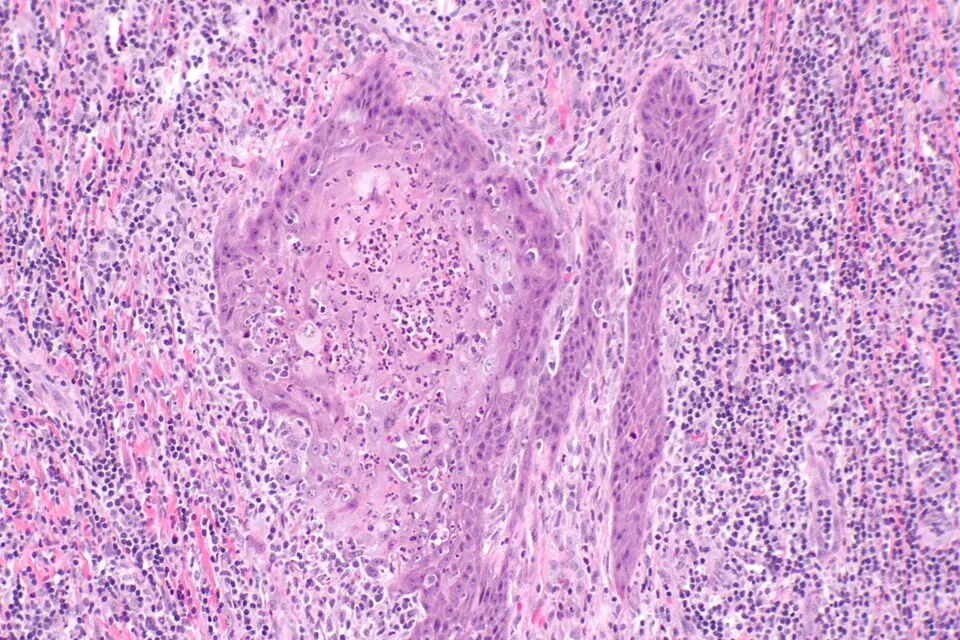
- About 95% are squamous cell carcinoma; roughly half are HPV-associated (HPV16 most often; p16-positive basaloid and warty types)
- Risk factors: phimosis (strongest), lack of neonatal circumcision, poor hygiene, high-risk HPV, lichen sclerosus, smoking, HIV and other immunosuppression, PUVA
- Precursor: penile intraepithelial neoplasia (PeIN), HPV-associated or differentiated (lichen sclerosus related)
- Most tumours arise on the glans or inner prepuce; patients often delay seeking help because of embarrassment
- Lymphatic spread is stepwise: inguinal nodes, then pelvic nodes; skip metastases to pelvic nodes are rare; nodal status is the main prognostic factor
- Clinically node-negative groins in pT1b or higher tumours are staged with dynamic sentinel node biopsy or modified inguinal lymphadenectomy
- Organ-sparing surgery (wide local excision, glans resurfacing, glansectomy) is preferred when oncologically safe; partial or total penectomy for more invasive tumours
Differential diagnosis
| Condition | Clues | Key test |
|---|---|---|
| Balanitis or balanoposthitis | Inflamed, often itchy, responds to hygiene and topical treatment | Swabs; biopsy if not settling in 4–6 weeks |
| Lichen sclerosus | White, atrophic, scarred skin; may cause phimosis; is also a risk factor | Biopsy of any thickened or ulcerated area |
| Syphilitic chancre | Single painless indurated ulcer, recent sexual exposure | Syphilis serology, dark-field or PCR |
| Chancroid or donovanosis | Painful ragged ulcer (chancroid) or beefy red granulomatous ulcer (donovanosis) | Swab culture or PCR, tissue smear for Donovan bodies |
| Genital warts (condylomata acuminata) | Soft papillomatous lesions, HPV6/11 | Clinical; biopsy if atypical, pigmented or fixed |
| Giant condyloma (Buschke–Löwenstein tumour) or verrucous carcinoma | Large cauliflower-like locally destructive lesion | Deep excision biopsy |
| Herpes simplex | Painful grouped vesicles and shallow ulcers, recurrent | Viral PCR swab |
Exam pearls
Guideline
EAU-ASCO Penile Cancer Guidelines (2026 update; joint guideline first issued 2023)
References
- Parnham A, Albersen M, Ayres B, et al.. European Association of Urology and American Society of Clinical Oncology Guidelines on Penile Cancer: A Summary of the 2026 Guidelines Update. Eur Urol 2026.
- Vreeburg MTA, Donswijk ML, Albersen M, et al.. New EAU/ASCO guideline recommendations on sentinel node biopsy for penile cancer and remaining challenges from a nuclear medicine perspective. Eur J Nucl Med Mol Imaging 2024.
- Aveta A, Iossa V, Spena G, et al.. Penile cancer and lymph node management: a call for standardization. Int Urol Nephrol 2026.
- Pandolfo SD, Aveta A, Iossa V, et al.. Global guidelines for the management of penile cancer: evaluating clinical alignment and methodological rigor. Minerva Urol Nephrol 2026.
- Gerdtsson A, Abedi E, Baseckas G, et al.. The Swedish national guidelines on penile cancer. Scand J Urol 2025.
- National Institute for Health and Care Excellence. Suspected cancer: recognition and referral (NG12). NICE, London 2015.
Related topics
By Dr Khalid Seidi (B.Sc., M.D.) · MedEd World Clinical Knowledge library. Original teaching content checked against current guidelines (November 2026); confirm the latest local guidance before clinical use. Not a substitute for clinical judgement.