Clinical Knowledge › Urology › Urological cancers
Prostate cancer
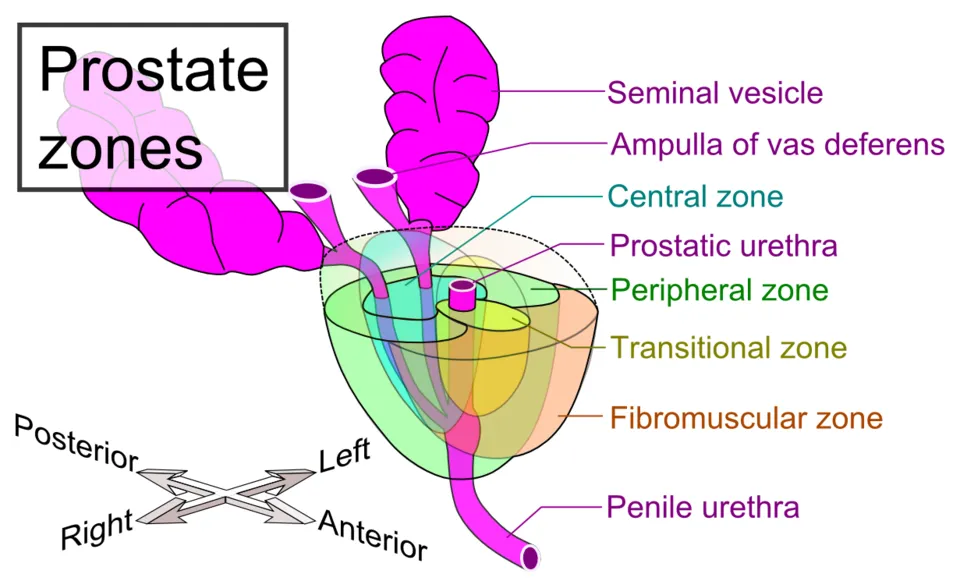
Prostate cancer is an adenocarcinoma arising mostly in the peripheral zone of the prostate and is the commonest male cancer in Europe and North America. Risk rises steeply with age and is higher in men of Black African ancestry, with a family history, or carrying BRCA2 and other DNA-repair gene variants. Early disease is usually silent. Diagnosis follows an MRI-first pathway: a raised age-referenced PSA or an abnormal digital rectal examination leads to multiparametric MRI scored by PI-RADS v2.1, then targeted plus regional (perilesional) biopsy, preferably transperineal. Histology is graded by ISUP grade group, and risk groups combine grade, PSA and clinical stage. Low-risk disease is managed by active surveillance; intermediate and high-risk localised disease by radical prostatectomy or radiotherapy with androgen deprivation. Metastatic disease, typically sclerotic bone metastases, is treated with androgen deprivation plus an androgen receptor pathway inhibitor. Malignant spinal cord compression is the key emergency.
Patient case, mechanism, investigations, management, flashcards and exam-style questions.Open the lesson →
Key facts
- Commonest male cancer in Europe and North America; about 70% arise in the peripheral zone, which is why digital rectal examination can feel them
- Risk factors: age, Black African ancestry, first-degree family history, germline BRCA2 (also BRCA1, HOXB13, Lynch syndrome genes)
- Raised PSA is not specific: BPH, prostatitis, urinary infection, catheterisation and ejaculation also raise it; 5-alpha-reductase inhibitors roughly halve it
- MRI-first pathway: multiparametric MRI (PI-RADS v2.1) before biopsy; PI-RADS 3–5 lesions are targeted, and a negative MRI with low PSA density can avoid biopsy
- ISUP grade groups: GG1 = Gleason 3+3, GG2 = 3+4, GG3 = 4+3, GG4 = 8, GG5 = 9–10
- Active surveillance is standard for low-risk disease and an option for selected favourable intermediate-risk GG2 disease
- Metastatic hormone-sensitive disease: androgen deprivation therapy plus an androgen receptor pathway inhibitor (abiraterone, enzalutamide, apalutamide or darolutamide), with or without docetaxel
- Back pain with leg weakness or sphincter change in known prostate cancer = malignant spinal cord compression: dexamethasone and whole-spine MRI within 24 hours
Differential diagnosis
| Condition | Clues | Key test |
|---|---|---|
| Benign prostatic hyperplasia | Smooth, symmetrically enlarged, rubbery gland; transition zone; LUTS | MRI without suspicious lesion; PSA density usually low |
| Acute or chronic prostatitis | Fever, perineal pain, tender boggy gland; PSA falls after treatment | Urine culture; repeat PSA 6–8 weeks after treatment |
| Urinary tract infection or recent instrumentation | Transient PSA rise after UTI, catheter or cystoscopy | Repeat PSA after the event has settled |
| Granulomatous prostatitis (e.g. after BCG) | Hard nodule that mimics cancer on DRE and MRI | Biopsy histology |
| Bladder cancer invading prostate | Visible haematuria, irritative symptoms | Cystoscopy; CT urogram |
| Other causes of sclerotic bone metastases (breast cancer, lymphoma, Paget disease) | Sclerotic lesions or raised ALP | PSA, PSMA PET, bone biopsy if PSA not raised |
| Rectal cancer | Hard mass on rectal examination arising from the bowel wall | Colonoscopy and pelvic MRI |
Exam pearls
Guideline
EAU-EANM-ESTRO-ESUR-ISUP-SIOG Prostate Cancer Guidelines 2026 (Parts I and II), AUA/ASTRO Clinically Localized Prostate Cancer Amendment 2026 and NICE NG131 (2019, with later updates)
References
- Cornford P, van den Bergh RCN, Briers E, et al.. EAU-EANM-ESTRO-ESUR-ISUP-SIOG Guidelines on Prostate Cancer-2026 Update. Part I: Screening, Diagnosis, and Local Treatment with Curative Intent. Eur Urol 2026.
- Tilki D, van den Bergh RCN, Briers E, et al.. EAU-EANM-ESTRO-ESUR-ISUP-SIOG Guidelines on Prostate Cancer. Part II-2026 Update: Treatment of Relapsing and Metastatic Prostate Cancer. Eur Urol 2026.
- Eastham JA, Barocas DA, Chu CE, et al.. Clinically Localized Prostate Cancer: AUA/ASTRO Guideline Amendment (2026). J Urol 2026.
- National Institute for Health and Care Excellence. Prostate cancer: diagnosis and management (NG131). NICE, London 2019.
- National Institute for Health and Care Excellence. Suspected cancer: recognition and referral (NG12). NICE, London 2015.
- Kasivisvanathan V, Rannikko AS, Borghi M, et al.. MRI-targeted or standard biopsy for prostate-cancer diagnosis. N Engl J Med 2018.
Related topics
By Dr Khalid Seidi (B.Sc., M.D.) · MedEd World Clinical Knowledge library. Original teaching content checked against current guidelines (November 2026); confirm the latest local guidance before clinical use. Not a substitute for clinical judgement.