Clinical Knowledge › Urology › Urological cancers
Testicular cancer
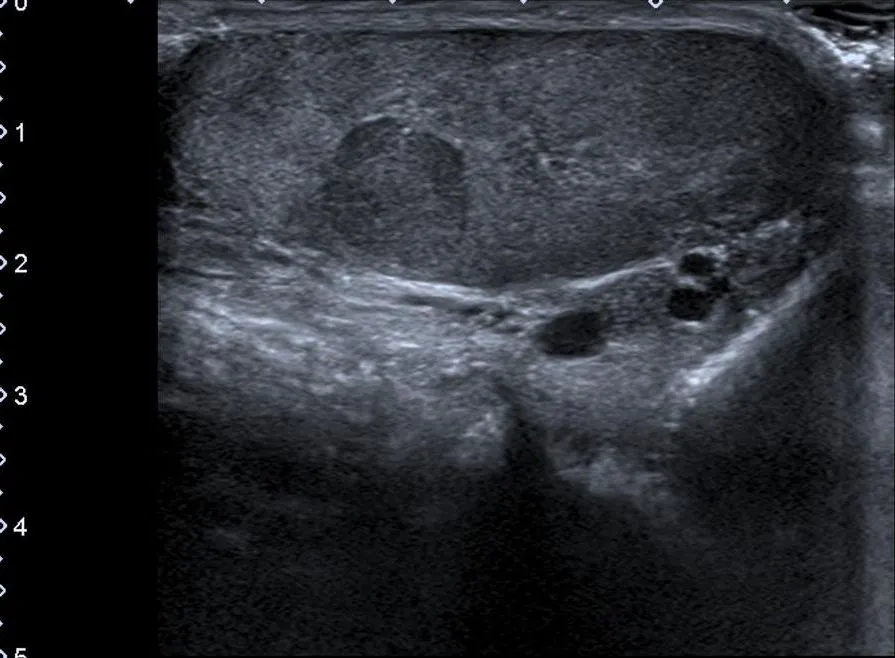
Testicular cancer is the commonest solid malignancy in men aged 15–40, and over 95% are germ cell tumours arising from germ cell neoplasia in situ. They divide into seminomas and non-seminomatous germ cell tumours (often mixed). Cryptorchidism, a previous testicular cancer, a brother or father with the disease and infertility are the main risk factors. The typical patient notices a painless, hard lump within the testis; examination shows a mass you can get above that does not transilluminate. Urgent scrotal ultrasound confirms an intratesticular lesion, and AFP, beta-hCG and LDH are taken before radical inguinal orchidectomy, the diagnostic and therapeutic operation. AFP is never raised by pure seminoma. Staging CT and post-orchidectomy markers define stage and IGCCCG prognostic group. Stage I disease is usually managed by surveillance or one course of adjuvant chemotherapy; metastatic disease is cured in most men by cisplatin-based chemotherapy such as BEP. Cure rates exceed 95%.
Patient case, mechanism, investigations, management, flashcards and exam-style questions.Open the lesson →
Key facts
- Commonest solid cancer in men aged 15–40; over 95% are germ cell tumours derived from germ cell neoplasia in situ (GCNIS)
- Seminoma (about half) peaks at 30–40; non-seminomatous germ cell tumours peak at 20–30 and are usually mixed
- Risk factors: cryptorchidism (including the contralateral testis), previous testicular cancer, first-degree relative, infertility, Klinefelter syndrome (mediastinal GCT)
- Painless hard intratesticular lump that you can get above and that does not transilluminate; lymph drains to para-aortic nodes, not inguinal nodes
- Urgent scrotal ultrasound plus AFP, beta-hCG and LDH before orchidectomy; AFP is never raised in pure seminoma
- Radical inguinal orchidectomy with high cord ligation; never a scrotal incision or scrotal biopsy; offer sperm banking first
- Stage I: surveillance preferred; seminoma may receive single-dose carboplatin, high-risk non-seminoma one cycle of BEP
- Metastatic disease: BEP (bleomycin, etoposide, cisplatin) by IGCCCG risk; cure in over 90% of good-risk patients
Differential diagnosis
| Condition | Clues | Key test |
|---|---|---|
| Epididymo-orchitis | Tender epididymis, dysuria, fever; improves with antibiotics | Urinalysis, STI tests; ultrasound if no improvement in 2 weeks |
| Hydrocele | Transilluminates; testis may be impalpable within it | Ultrasound to check the underlying testis |
| Epididymal cyst | Separate from and usually above or behind the testis; transilluminates | Ultrasound |
| Varicocele | 'Bag of worms' above the testis, enlarges on standing or Valsalva | Doppler ultrasound |
| Testicular torsion | Sudden severe pain, high-riding testis, absent cremasteric reflex | Immediate surgical exploration |
| Inguinoscrotal hernia | Cannot get above it; cough impulse; may reduce | Clinical; ultrasound |
| Testicular lymphoma | Man over 60, often bilateral, B symptoms | Orchidectomy histology; staging |
Exam pearls
Guideline
EAU Guidelines on Testicular Cancer (2026 summary), ESMO-EURACAN Testicular Seminoma and Non-seminoma Guideline (2022) and AUA Early-Stage Testicular Cancer Guideline (2023 amendment)
References
- Patrikidou A, Cazzaniga W, Oing C, et al.. European Association of Urology Guidelines on Testicular Cancer: Summary of the 2026 Guidelines. Eur Urol 2026.
- Oldenburg J, Berney DM, Bokemeyer C, et al.. Testicular seminoma and non-seminoma: ESMO-EURACAN Clinical Practice Guideline for diagnosis, treatment and follow-up. Ann Oncol 2022.
- Stephenson A, Bass EB, Bixler BR, et al.. Diagnosis and Treatment of Early-Stage Testicular Cancer: AUA Guideline Amendment 2023. J Urol 2024.
- Gillessen S, Sauvé N, Collette L, et al.. Predicting outcomes in men with metastatic nonseminomatous germ cell tumors (NSGCT): results from the IGCCCG Update Consortium. J Clin Oncol 2021.
- National Institute for Health and Care Excellence. Suspected cancer: recognition and referral (NG12). NICE, London 2015.
- Amin MB, Edge SB, Greene FL, et al., eds.. AJCC Cancer Staging Manual. Springer 2017.
Related topics
By Dr Khalid Seidi (B.Sc., M.D.) · MedEd World Clinical Knowledge library. Original teaching content checked against current guidelines (November 2026); confirm the latest local guidance before clinical use. Not a substitute for clinical judgement.