Clinical Knowledge › Internal medicine › Cardiology and angiology › Arrhythmias and conduction disorders
Premature atrial and ventricular complexes
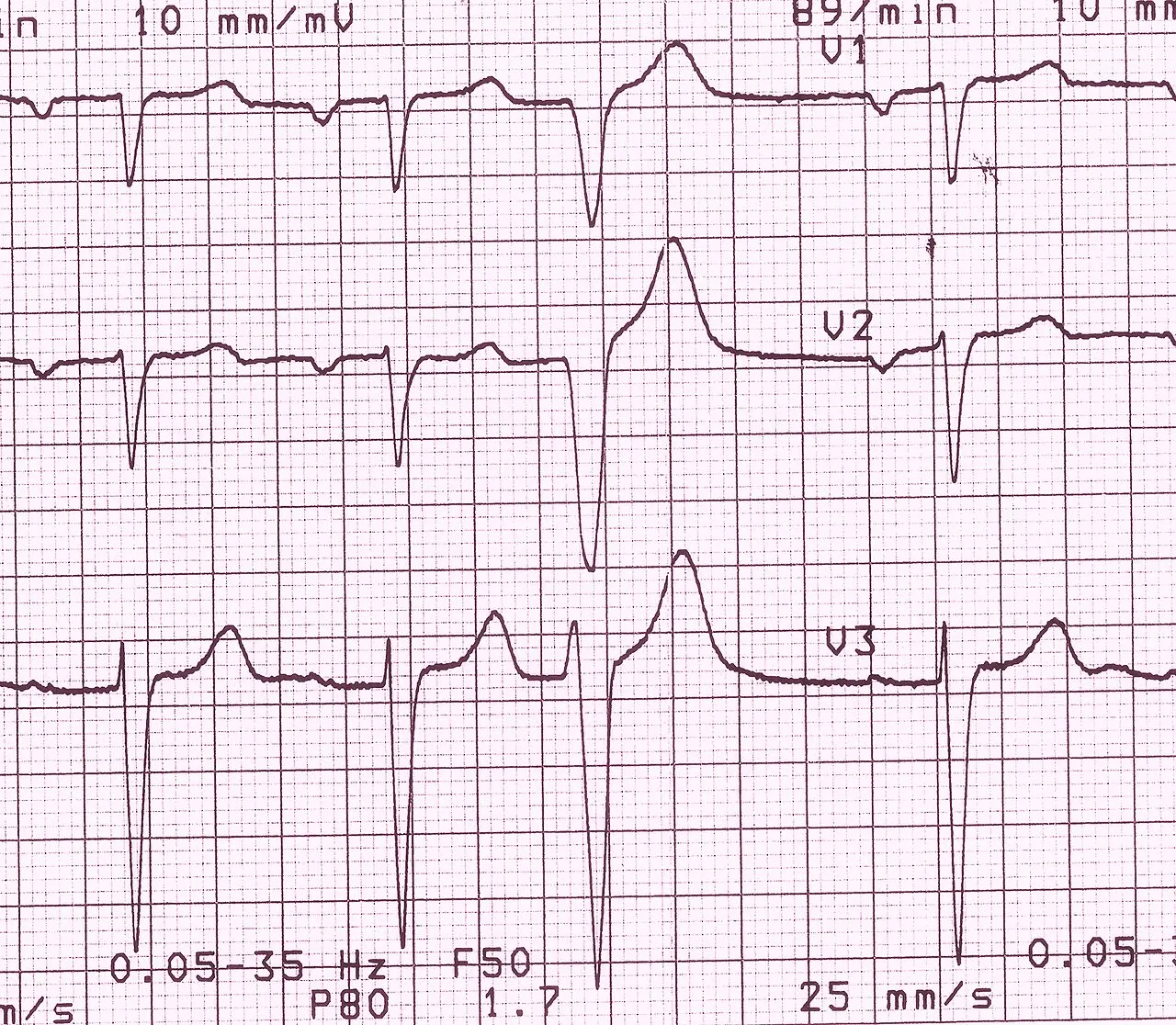
Premature atrial complexes (PACs) and premature ventricular complexes (PVCs), often called ectopic beats or extrasystoles, are early beats arising outside the sinus node. They are the commonest cause of palpitations ('skipped' or 'thumping' beats) and are found on Holter monitoring in most healthy adults. A PAC is an early, differently shaped P wave usually followed by a narrow QRS and a non-compensatory pause; a PVC is an early broad QRS (120 ms or more) without a preceding P wave, with a discordant T wave and usually a fully compensatory pause. Most are benign, but frequent ectopy matters: a high PAC burden predicts atrial fibrillation and stroke, and frequent PVCs (typically over 10% of beats) can cause a reversible PVC-induced cardiomyopathy and may signal structural heart disease. Evaluation uses a 12-lead ECG, Holter burden, echocardiography and, with red flags, exercise testing and cardiac MRI. Treatment ranges from reassurance and correction of triggers to beta-blockers or calcium-channel blockers and catheter ablation; class IC drugs must be avoided after myocardial infarction.
Patient case, mechanism, investigations, management, flashcards and exam-style questions.Open the lesson →
Key facts
- PAC: early abnormal P wave, usually narrow QRS, non-compensatory pause; may be blocked or aberrantly conducted
- PVC: early wide QRS (120 ms or more), no preceding P wave, discordant T wave, full compensatory pause
- Very common: ectopy is found on 24-hour Holter in most healthy adults and increases with age
- Patterns: bigeminy (every other beat), trigeminy, couplets; 3 or more consecutive PVCs over 100/min = NSVT
- PVC burden over about 10% (risk rises above 20–24%) can cause reversible PVC-induced cardiomyopathy
- Frequent PACs predict incident AF and stroke; frequent PVCs predict heart failure and death in population studies
- Red flags: syncope, family history of sudden death, structural disease, multiform PVCs, PVCs increasing with exercise, non-outflow morphology
- Treatment: reassurance; beta-blocker or verapamil or diltiazem; ablation for symptomatic RVOT PVCs or PVC cardiomyopathy; avoid class IC drugs after MI (CAST)
Differential diagnosis
| Condition | Clues | Key test |
|---|---|---|
| Atrial fibrillation | Continuously irregularly irregular without P waves | 12-lead ECG, Holter |
| Second-degree AV block | Dropped QRS after a P wave that is on time, not early | ECG: P–P interval constant |
| Sinus arrhythmia | Gradual phasic change in rate with respiration, identical P waves | ECG with breathing |
| Intermittent pre-excitation (WPW) | Short PR and delta wave on some beats, not premature | 12-lead ECG |
| Non-sustained ventricular tachycardia | 3 or more consecutive ventricular beats over 100/min | Holter, echo, CMR |
| Accelerated idioventricular rhythm | Wide-complex rhythm 50–110/min, often after reperfusion | ECG context |
| Multifocal atrial tachycardia | 3 or more P-wave morphologies with rate over 100/min | 12-lead ECG |
Exam pearls
Guideline
2022 ESC Guidelines for ventricular arrhythmias and prevention of sudden cardiac death; 2019 ESC SVT guideline; 2024 ESC AF guideline; 2017 AHA/ACC/HRS ventricular arrhythmia guideline
References
- Zeppenfeld K, Tfelt-Hansen J, de Riva M, et al.. 2022 ESC Guidelines for the management of patients with ventricular arrhythmias and the prevention of sudden cardiac death. Eur Heart J 2022.
- Brugada J, Katritsis DG, Arbelo E, et al.. 2019 ESC Guidelines for the management of patients with supraventricular tachycardia. Eur Heart J 2020.
- Van Gelder IC, Rienstra M, Bunting KV, et al.. 2024 ESC Guidelines for the management of atrial fibrillation developed in collaboration with the European Association for Cardio-Thoracic Surgery (EACTS). Eur Heart J 2024.
- Dukes JW, Dewland TA, Vittinghoff E, et al.. Ventricular Ectopy as a Predictor of Heart Failure and Death. J Am Coll Cardiol 2015.
- Baman TS, Lange DC, Ilg KJ, et al.. Relationship between burden of premature ventricular complexes and left ventricular function. Heart Rhythm 2010.
- Echt DS, Liebson PR, Mitchell LB, et al.. Mortality and morbidity in patients receiving encainide, flecainide, or placebo. The Cardiac Arrhythmia Suppression Trial. N Engl J Med 1991.
Related topics
By Dr Khalid Seidi (B.Sc., M.D.) · MedEd World Clinical Knowledge library. Original teaching content checked against current guidelines (November 2026); confirm the latest local guidance before clinical use. Not a substitute for clinical judgement.