Clinical Knowledge › Internal medicine › Cardiology and angiology › Arrhythmias and conduction disorders
Supraventricular tachycardia (AVNRT and AVRT)
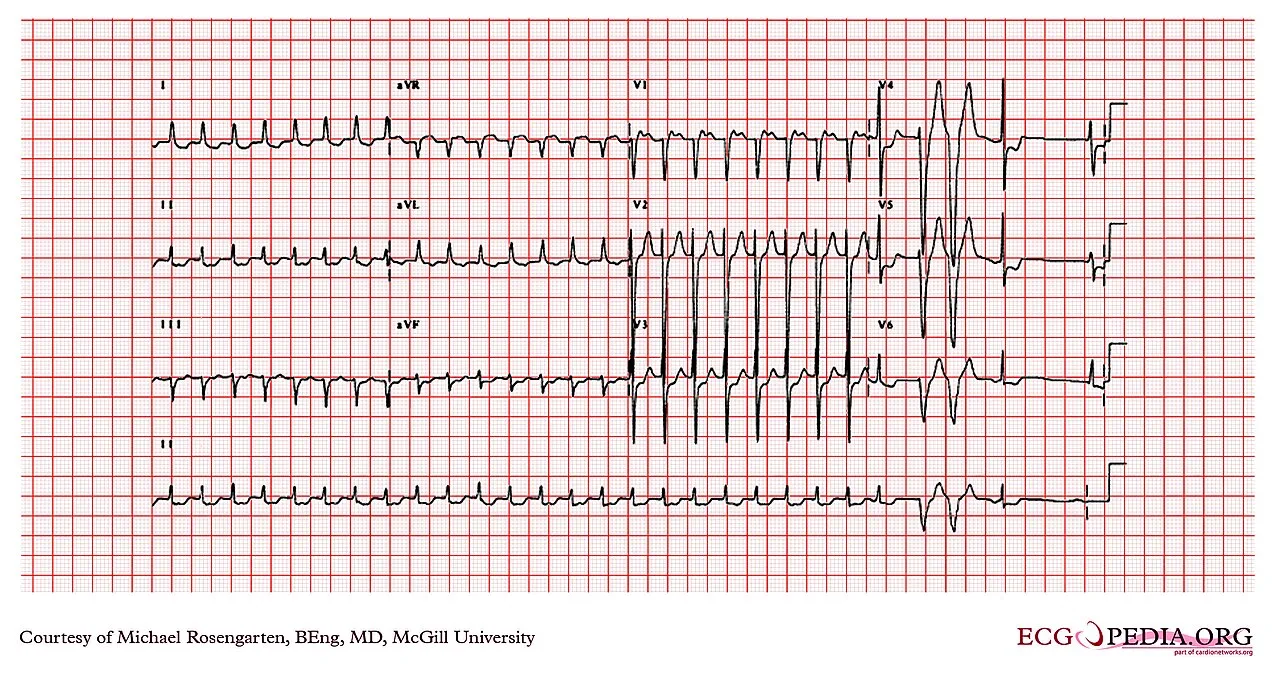
Paroxysmal supraventricular tachycardia (SVT) in clinical use usually means a regular narrow-complex tachycardia that starts and stops abruptly and depends on the atrioventricular (AV) node. The two main mechanisms are AV nodal re-entrant tachycardia (AVNRT), a circuit using fast and slow pathways within or around the AV node, and AV re-entrant tachycardia (AVRT), a larger circuit that uses an accessory pathway. AVNRT is the commonest, especially in young and middle-aged women; AVRT is commoner in younger patients and is associated with Wolff–Parkinson–White pre-excitation. Patients describe sudden rapid regular palpitations, neck pounding, breathlessness or presyncope. The ECG shows a regular tachycardia, usually 150–250/min, with P waves hidden in or just after the QRS. Acute treatment is modified Valsalva manoeuvre, then intravenous adenosine, then verapamil, diltiazem or a beta-blocker, with synchronised cardioversion if the patient is unstable. Catheter ablation is curative in about 95% and is first-line long-term therapy under the 2019 ESC guideline.
Patient case, mechanism, investigations, management, flashcards and exam-style questions.Open the lesson →
Key facts
- AVNRT is the commonest regular paroxysmal SVT; it uses dual AV nodal pathways and is more frequent in women
- Typical (slow–fast) AVNRT hides the retrograde P wave in the QRS or shows a pseudo-r' in V1 and pseudo-S in the inferior leads
- Orthodromic AVRT conducts down the AV node and up an accessory pathway, giving a narrow QRS with a retrograde P wave in the ST segment (RP over 70 ms)
- Antidromic AVRT conducts down the accessory pathway and produces a broad-complex tachycardia that mimics VT
- First-line acute treatment of stable SVT is the modified Valsalva manoeuvre (legs raised after a 15-second strain)
- Adenosine 6 mg rapid IV bolus with saline flush, then 12 mg (up to 18 mg), terminates AV node-dependent SVT
- Unstable SVT needs synchronised DC cardioversion
- Catheter ablation (slow pathway modification or accessory pathway ablation) cures about 95% with low risk and is first-line long-term therapy
Differential diagnosis
| Condition | Clues | Key test |
|---|---|---|
| Sinus tachycardia | Gradual onset and offset; upright P before each QRS; identifiable cause | 12-lead ECG; treat underlying cause |
| Atrial flutter with 2:1 block | Fixed rate about 150/min; sawtooth waves in II, III, aVF | 12-lead ECG; adenosine unmasks flutter waves without terminating |
| Focal atrial tachycardia | Abnormal P before each QRS, warm-up/cool-down; AV block may occur without stopping it | 12-lead ECG; adenosine response |
| Atrial fibrillation | Irregularly irregular rhythm | 12-lead ECG or rhythm strip |
| Ventricular tachycardia | Broad QRS, AV dissociation, structural heart disease | 12-lead ECG; treat broad-complex tachycardia as VT if uncertain |
| Panic disorder | Gradual onset, anxiety symptoms, sinus rhythm when recorded | Ambulatory ECG during symptoms |
Exam pearls
Guideline
2019 ESC Guidelines for the management of supraventricular tachycardia (current ESC edition) and 2015 ACC/AHA/HRS adult SVT guideline, with 2025 AHA/ERC resuscitation guidance
References
- Brugada J, Katritsis DG, Arbelo E, et al.. 2019 ESC Guidelines for the management of patients with supraventricular tachycardia. Eur Heart J 2020.
- Page RL, Joglar JA, Caldwell MA, et al.. 2015 ACC/AHA/HRS Guideline for the Management of Adult Patients With Supraventricular Tachycardia: A Report of the American College of Cardiology/American Heart Association Task Force on Clinical Practice Guidelines and the Heart Rhythm Society. Circulation 2016.
- Appelboam A, Reuben A, Mann C, et al.. Postural modification to the standard Valsalva manoeuvre for emergency treatment of supraventricular tachycardias (REVERT): a randomised controlled trial. Lancet 2015.
- Wigginton JG, Agarwal S, Bartos JA, et al.. Part 9: Adult Advanced Life Support: 2025 American Heart Association Guidelines for Cardiopulmonary Resuscitation and Emergency Cardiovascular Care. Circulation 2025.
- Jackman WM, Wang XZ, Friday KJ, et al.. Catheter ablation of accessory atrioventricular pathways (Wolff-Parkinson-White syndrome) by radiofrequency current. N Engl J Med 1991.
- Brugada P, Brugada J, Mont L, et al.. A new approach to the differential diagnosis of a regular tachycardia with a wide QRS complex. Circulation 1991.
Related topics
By Dr Khalid Seidi (B.Sc., M.D.) · MedEd World Clinical Knowledge library. Original teaching content checked against current guidelines (November 2026); confirm the latest local guidance before clinical use. Not a substitute for clinical judgement.