Clinical Knowledge › Internal medicine › Basics of internal medicine › Laboratory test interpretation
Serum lactate
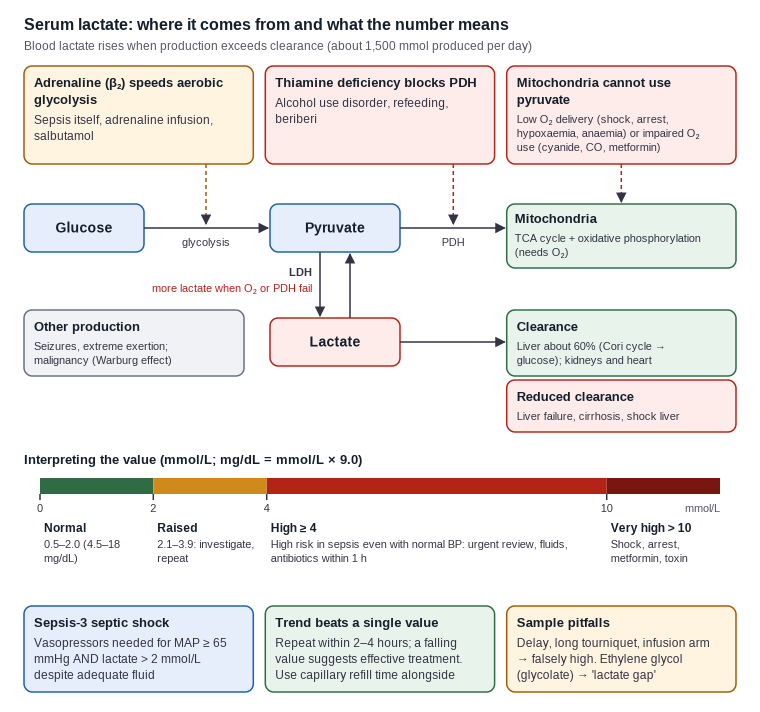
Lactate is the end product of anaerobic glycolysis and is normally below 2 mmol/L (18 mg/dL). On the ward it is a fast, cheap point-of-care marker of physiological stress, measured on venous or arterial blood gas analysers. A raised value is a warning sign, not a diagnosis: it signals tissue hypoperfusion (type A: shock, cardiac arrest, severe hypoxaemia, mesenteric or limb ischaemia) or impaired lactate handling and increased production without hypoperfusion (type B: liver failure, metformin, adrenaline and salbutamol, thiamine deficiency, malignancy, seizures). In suspected sepsis a lactate is part of the first-hour bundle; a value of 4 mmol/L or more indicates high risk even with a normal blood pressure, and Sepsis-3 defines septic shock as vasopressor need with lactate above 2 mmol/L after fluids. Trends matter more than single values, so repeat within 2–4 hours. Capillary refill time is an evidence-based companion target. Pre-analytical delay, prolonged tourniquet use and assay interference by glycolate in ethylene glycol poisoning can give misleading results.
Patient case, mechanism, investigations, management, flashcards and exam-style questions.Open the lesson →
Key facts
- Normal lactate is below 2 mmol/L (about 18 mg/dL); mg/dL = mmol/L × 9.0
- Venous lactate is acceptable for screening; a normal venous value makes arterial hyperlactataemia very unlikely
- Lactate 2–4 mmol/L is intermediate risk; 4 mmol/L or more in suspected sepsis triggers urgent senior review, fluids and antibiotics
- Sepsis-3 septic shock: vasopressors needed to keep MAP at 65 mmHg or more AND lactate above 2 mmol/L despite adequate fluid resuscitation
- Re-measure an initially raised lactate within 2–4 hours; a falling value suggests effective treatment
- Type B causes include liver failure, metformin, adrenaline, salbutamol, linezolid, propofol infusion, thiamine deficiency and haematological malignancy
- About half to two thirds of lactate is cleared by the liver, so cirrhosis slows clearance
- Ethylene glycol metabolites (glycolate) falsely raise lactate on many blood gas analysers: a 'lactate gap' with the laboratory method
Differential diagnosis
| Condition | Clues | Key test |
|---|---|---|
| Septic shock | Infection, hypotension or high NEWS2, mottling, long capillary refill | Blood cultures, repeat lactate, response to fluids and vasopressors |
| Cardiogenic shock | Cold peripheries, raised JVP, pulmonary oedema, ischaemic ECG | ECG, troponin, bedside echocardiography |
| Mesenteric ischaemia | Pain out of proportion to examination, AF; lactate may be normal early | CT angiography |
| Generalised seizure | Transient high lactate that clears within 1–2 hours | Repeat lactate after the seizure |
| Beta-2 agonist effect | High lactate in a well-perfused asthmatic on nebulised or IV salbutamol | Normal perfusion; falls when salbutamol reduced |
| Metformin-associated lactic acidosis | Metformin plus AKI, very high lactate, severe acidosis | Lactate, pH, creatinine, metformin history |
| Ethylene glycol poisoning | High lactate on blood gas analyser, normal laboratory lactate, raised osmolal gap | Laboratory lactate, osmolal gap, toxic alcohol levels |
Exam pearls
Guideline
Surviving Sepsis Campaign international guidelines 2026 (building on 2021), Sepsis-3 consensus definitions (2016) and NICE suspected sepsis guidance (NG51, 2016; recommendations for people aged 16 or over updated 2024)
References
- Prescott HC, Antonelli M, Alhazzani W, et al.. Executive summary: Surviving Sepsis Campaign: international guidelines for management of sepsis and septic shock 2026. Crit Care Med 2026.
- Singer M, Deutschman CS, Seymour CW, et al.. The Third International Consensus Definitions for Sepsis and Septic Shock (Sepsis-3). JAMA 2016.
- National Institute for Health and Care Excellence (NICE). Suspected sepsis: recognition, diagnosis and early management (NG51), with 2024 update of recommendations for people aged 16 or over. NICE guideline 2024.
- Kraut JA, Madias NE.. Lactic acidosis. N Engl J Med 2014.
- Hernández G, Ospina-Tascón GA, Damiani LP, et al.. Effect of a resuscitation strategy targeting peripheral perfusion status vs serum lactate levels on 28-day mortality among patients with septic shock: the ANDROMEDA-SHOCK randomized clinical trial. JAMA 2019.
- ANDROMEDA-SHOCK-2 Investigators; Hernández G, Ospina-Tascón GA, et al.. Personalized hemodynamic resuscitation targeting capillary refill time in early septic shock: the ANDROMEDA-SHOCK-2 randomized clinical trial. JAMA 2025.
Related topics
By Dr Khalid Seidi (B.Sc., M.D.) · MedEd World Clinical Knowledge library. Original teaching content checked against current guidelines (November 2026); confirm the latest local guidance before clinical use. Not a substitute for clinical judgement.