Clinical Knowledge › Urology › Urological trauma
Testicular trauma
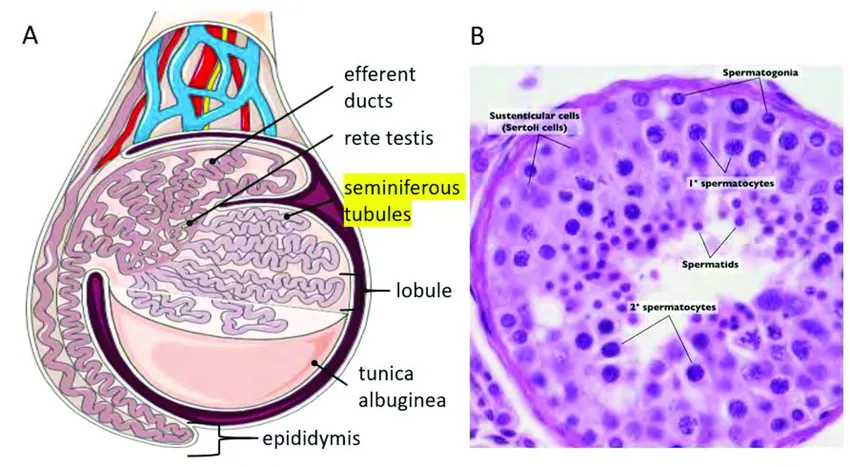
Testicular trauma is injury to the testis and its coverings, most often from blunt force in young men (sport, kicks, assault, road collisions) and less often from penetrating wounds, bites or degloving. Blunt force crushes the testis against the pubic symphysis or thigh and can tear the tunica albuginea (testicular rupture), with extrusion of seminiferous tubules and bleeding into the tunica vaginalis (haematocele). Haematoma, contusion, traumatic torsion and dislocation also occur. Pain often prevents adequate examination, so scrotal ultrasound with Doppler is the key test: loss of the echogenic tunica line, a heterogeneous testis with an irregular contour and absent flow suggest rupture. Suspected rupture, large or expanding haematoceles and all penetrating wounds need prompt scrotal exploration, debridement and closure of the tunica albuginea; early repair (ideally within about 72 hours) salvages most testes. Small haematomas and contusions are managed conservatively with ultrasound follow-up, remembering that trauma may unmask a testicular tumour.
Patient case, mechanism, investigations, management, flashcards and exam-style questions.Open the lesson →
Key facts
- Blunt trauma causes most testicular injuries, usually unilateral; penetrating injuries are bilateral far more often
- Testicular rupture = a tear in the tunica albuginea with extrusion of seminiferous tubules; it is a surgical emergency
- Scrotal ultrasound with colour Doppler is the first-line test; loss of tunica albuginea continuity, contour irregularity and absent flow suggest rupture
- Exploration within about 72 hours salvages most ruptured testes; delayed repair markedly increases orchidectomy rates
- Explore all penetrating scrotal injuries; about one-third of gunshot wounds involve both testes
- A haematocele much larger than the opposite testis (EAU: more than about three times) or an expanding one should be explored even without proven rupture
- Always look for associated urethral, penile, perineal and pelvic injuries (blood at the meatus, butterfly perineal bruising)
- An intratesticular lesion after minor trauma may be a tumour: follow every non-operated lesion with ultrasound until it resolves
Differential diagnosis
| Condition | Clues | Key test |
|---|---|---|
| Testicular rupture | Tense tender swelling, testis cannot be outlined; tunica albuginea breach | Ultrasound: discontinuous tunica, heterogeneous parenchyma |
| Haematocele without rupture | Fluctuant swelling around an intact testis, often bluish scrotum | Ultrasound: complex fluid in tunica vaginalis, intact tunica albuginea |
| Intratesticular haematoma or contusion | Pain with intact contour | Ultrasound: avascular focal lesion; repeat until resolved |
| Traumatic testicular torsion | Sudden severe pain, high-riding horizontal testis, absent cremasteric reflex after a minor blow | Doppler: absent flow, whirlpool sign; explore without delay |
| Testicular dislocation | Empty hemiscrotum after straddle or motorcycle tank injury; testis in groin | Ultrasound or CT to locate the testis |
| Post-traumatic epididymitis | Tender swollen epididymis days after injury, testis normal | Ultrasound: enlarged hyperaemic epididymis; urinalysis |
| Testicular tumour unmasked by trauma | Mass disproportionate to the injury or persisting after swelling settles | Ultrasound follow-up; AFP, beta-hCG, LDH |
| Urethral injury with extravasation | Blood at meatus, perineal butterfly bruising, inability to void | Retrograde urethrogram before any catheter |
Exam pearls
Guideline
EAU Guidelines on Urological Trauma (2026 edition) and AUA Urotrauma Guideline (2020)
References
- European Association of Urology. EAU Guidelines on Urological Trauma. EAU Guidelines Office, Arnhem 2026.
- Morey AF, Broghammer JA, Hollowell CMP, et al.. Urotrauma Guideline 2020: AUA Guideline. J Urol 2021.
- Buckley JC, McAninch JW.. Use of ultrasonography for the diagnosis of testicular injuries in blunt scrotal trauma. J Urol 2006.
- Bhatt S, Dogra VS.. Role of US in testicular and scrotal trauma. Radiographics 2008.
- Deurdulian C, Mittelstaedt CA, Chong WK, Fielding JR.. US of acute scrotal trauma: optimal technique, imaging findings, and management. Radiographics 2007.
- Moore EE, Malangoni MA, Cogbill TH, et al.. Organ injury scaling VII: cervical vascular, peripheral vascular, adrenal, penis, testis, and scrotum. J Trauma 1996.
Related topics
By Dr Khalid Seidi (B.Sc., M.D.) · MedEd World Clinical Knowledge library. Original teaching content checked against current guidelines (November 2026); confirm the latest local guidance before clinical use. Not a substitute for clinical judgement.