Clinical Knowledge › Urology › Urological trauma
Ureteric injury
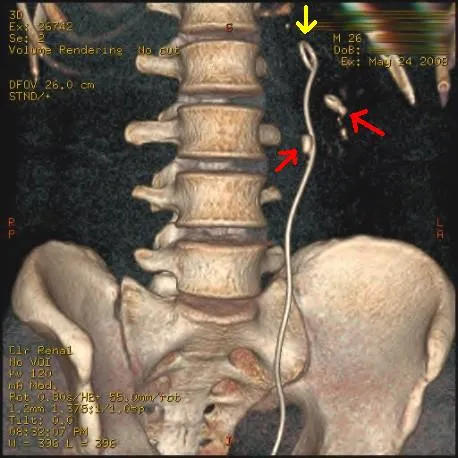
Ureteric injury is uncommon but easily missed. Most injuries are iatrogenic, occurring during gynaecological surgery (especially hysterectomy), colorectal and vascular operations and ureteroscopy; external trauma, mainly gunshot wounds, causes the rest, and blunt injury is rare apart from deceleration avulsion at the pelviureteric junction in children. The pelvic ureter is most at risk where it passes under the uterine artery, at the pelvic brim near the ovarian vessels and beside the vaginal vault. Mechanisms include ligation, transection, crush, devascularisation and thermal (diathermy) injury, which declares itself days later. Only about a third of iatrogenic injuries are recognised during the operation; the rest present with flank pain, fever, ileus, prolonged high-creatinine drain fluid, a urinoma, anuria, or continuous vaginal leakage from a ureterovaginal fistula. CT urography with a delayed phase and retrograde pyelography confirm the diagnosis. Injuries recognised at surgery are repaired immediately: primary repair or ureteroureterostomy for upper and mid-ureteric injuries and reimplantation, with psoas hitch or Boari flap, for distal injuries, always over a stent. Late injuries are first drained by stent or nephrostomy, with reconstruction early or after 6–12 weeks.
Patient case, mechanism, investigations, management, flashcards and exam-style questions.Open the lesson →
Key facts
- Iatrogenic injury causes most ureteric injuries; hysterectomy is the commonest single cause, followed by colorectal, vascular and endoscopic urological procedures
- The distal (pelvic) ureter is most at risk: beneath the uterine artery ('water under the bridge'), at the pelvic brim near the infundibulopelvic ligament and at the vaginal vault
- External ureteric trauma is mostly penetrating (gunshot); blunt deceleration can avulse the PUJ, especially in children
- Haematuria is absent in a large proportion of ureteric injuries, so it cannot be used to exclude them
- Only about one-third of iatrogenic injuries are recognised during the operation; delayed signs are flank pain, fever, ileus, urinoma, high drain output and vaginal leakage
- Drain fluid creatinine much higher than serum creatinine confirms a urine leak
- Diagnosis: CT urography with delayed excretory phase; retrograde pyelography localises the injury and allows stent placement
- Repair principles: debride devitalised tissue, spatulated tension-free watertight anastomosis over a stent, with drainage; distal injuries are reimplanted (psoas hitch, Boari flap)
Differential diagnosis
| Condition | Clues | Key test |
|---|---|---|
| Bladder injury or vesicovaginal fistula | Leakage after hysterectomy, bladder dye stains vaginal swab | Cystography; three-swab dye test |
| Postoperative ileus | Distension and vomiting after surgery, no leak | Normal creatinine and CT urogram |
| Pelvic abscess or collection | Fever and pain after pelvic surgery | CT; aspirate creatinine equals serum |
| Acute kidney injury (prerenal or drug-induced) | Low urine output after surgery | No hydronephrosis on ultrasound |
| Ureteric stone | Colic and hydronephrosis | CT KUB shows calculus |
| Lymphocele | Pelvic fluid collection after lymph node dissection | Aspirate creatinine equals serum |
| Stress urinary incontinence | Leakage with effort only | Normal voiding; dry between efforts |
Exam pearls
Guideline
EAU Guidelines on Urological Trauma (2026 edition; 2023 summary paper) – iatrogenic and external ureteric trauma; AUA Urotrauma Guideline (2020 amendment); WSES–AAST kidney and uro-trauma guidelines (2019)
References
- European Association of Urology. EAU Guidelines on Urological Trauma (2026 edition). EAU Guidelines Office, Arnhem 2026.
- Serafetinidis E, Campos-Juanatey F, Hallscheidt P, et al.. Summary Paper of the Updated 2023 European Association of Urology Guidelines on Urological Trauma. Eur Urol Focus 2024.
- Morey AF, Broghammer JA, Hollowell CMP, McKibben MJ, Souter L. Urotrauma Guideline 2020: AUA Guideline. J Urol 2021.
- Burks FN, Santucci RA. Management of iatrogenic ureteral injury. Ther Adv Urol 2014.
- Gild P, Kluth LA, Vetterlein MW, Engel O, Chun FKH, Fisch M. Adult iatrogenic ureteral injury and stricture-incidence and treatment strategies. Asian J Urol 2018.
- Souli A, Alves A, Tillou X, Menahem B. Iatrogenic ureteral injury: What should the digestive surgeon know?. J Visc Surg 2024.
Related topics
By Dr Khalid Seidi (B.Sc., M.D.) · MedEd World Clinical Knowledge library. Original teaching content checked against current guidelines (November 2026); confirm the latest local guidance before clinical use. Not a substitute for clinical judgement.