Clinical Knowledge › Urology › Urological trauma
Urethral injury
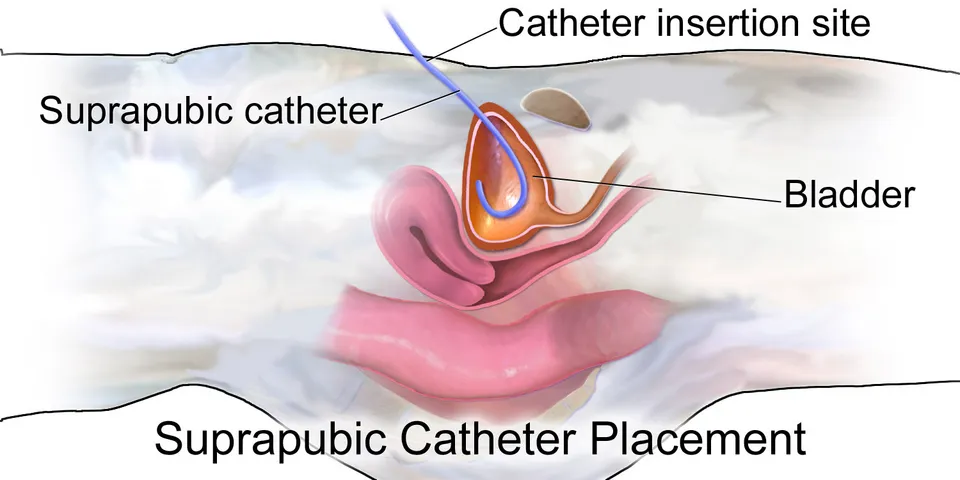
Urethral injuries are divided into posterior injuries, almost always pelvic fracture urethral injuries (PFUI) at the bulbomembranous junction in men, and anterior injuries of the bulbar or penile urethra caused by straddle falls, penile fracture, penetrating wounds or, most often overall, catheterisation and instrumentation. PFUI complicates roughly 5–10% of male pelvic fractures, particularly bilateral pubic rami fractures and symphyseal disruption; in women urethral injury is rare and usually accompanies vaginal laceration. The classic signs are blood at the external meatus, inability to void with a palpable bladder, a perineal 'butterfly' haematoma, and sometimes a high-riding prostate, although rectal examination is unreliable for the urethra and is used mainly to detect rectal injury. When urethral injury is suspected, a urethral catheter must not be forced: a retrograde urethrogram shows partial (contrast enters the bladder) or complete disruption. Initial treatment is urinary diversion by suprapubic catheter, with primary endoscopic realignment an option in stable patients; definitive reconstruction for PFUI is delayed anastomotic urethroplasty after about 3 months. Key long-term problems are stricture, erectile dysfunction and incontinence.
Patient case, mechanism, investigations, management, flashcards and exam-style questions.Open the lesson →
Key facts
- Posterior urethral injury = pelvic fracture urethral injury (PFUI), usually at the bulbomembranous junction; anterior injury = bulbar or penile urethra
- PFUI occurs in about 5–10% of male pelvic fractures; risk is highest with bilateral pubic rami ('straddle' or butterfly) fractures and symphyseal diastasis or sacroiliac disruption
- Straddle injury crushes the bulbar urethra against the pubic arch; iatrogenic catheter or instrument trauma is the commonest cause of anterior urethral injury overall
- Signs: blood at the meatus, inability to void, palpable bladder, perineal or scrotal butterfly haematoma; DRE is unreliable for urethral injury but checks for rectal injury
- Blood at the meatus after pelvic trauma: retrograde urethrogram before any urethral catheter (one gentle attempt by an experienced clinician only if local practice allows)
- Partial rupture: contrast extravasates but enters the bladder; complete rupture: extravasation with no bladder filling
- Initial management: suprapubic catheter (or primary endoscopic realignment in stable patients); immediate open urethroplasty of PFUI is avoided
- Definitive PFUI repair: delayed anastomotic (excision and primary anastomosis) urethroplasty after about 3 months; penetrating anterior injuries are repaired immediately
Differential diagnosis
| Condition | Clues | Key test |
|---|---|---|
| Bladder rupture | Visible haematuria, suprapubic pain, pelvic fracture; no blood at meatus | CT cystography |
| Penile fracture | Snap and detumescence during intercourse, aubergine deformity; blood at meatus suggests urethral involvement | Clinical; RUG or cystoscopy if meatal blood |
| Catheter-related urethral trauma | Painful balloon inflation, blood at meatus after catheter attempt | Flexible cystoscopy; suprapubic catheter |
| Acute urinary retention (non-traumatic) | Older man, LUTS, palpable bladder, no trauma | Catheter passes easily |
| Rectal injury | Blood on DRE after pelvic fracture | Proctoscopy; CT |
| Testicular or scrotal trauma | Scrotal swelling and pain after blunt trauma | Scrotal ultrasound |
Exam pearls
Guideline
EAU Guidelines on Urological Trauma (2026 edition; 2023 summary paper), AUA Urotrauma Guideline (2020 amendment) and WSES–AAST kidney and uro-trauma guidelines (2019)
References
- European Association of Urology. EAU Guidelines on Urological Trauma (2026 edition). EAU Guidelines Office, Arnhem 2026.
- Serafetinidis E, Campos-Juanatey F, Hallscheidt P, et al.. Summary Paper of the Updated 2023 European Association of Urology Guidelines on Urological Trauma. Eur Urol Focus 2024.
- Morey AF, Broghammer JA, Hollowell CMP, McKibben MJ, Souter L. Urotrauma Guideline 2020: AUA Guideline. J Urol 2021.
- Barratt RC, Bernard J, Mundy AR, Greenwell TJ. Pelvic fracture urethral injury in males-mechanisms of injury, management options and outcomes. Transl Androl Urol 2018.
- Horiguchi A. Management of male pelvic fracture urethral injuries: Review and current topics. Int J Urol 2019.
- Johnsen NV, Kaufman MR, Dmochowski RR, Milam DF. Erectile Dysfunction Following Pelvic Fracture Urethral Injury. Sex Med Rev 2018.
Related topics
By Dr Khalid Seidi (B.Sc., M.D.) · MedEd World Clinical Knowledge library. Original teaching content checked against current guidelines (November 2026); confirm the latest local guidance before clinical use. Not a substitute for clinical judgement.