Clinical Knowledge › Neurology › Demyelinating and neuroinflammatory disorders
Acute disseminated encephalomyelitis (ADEM)
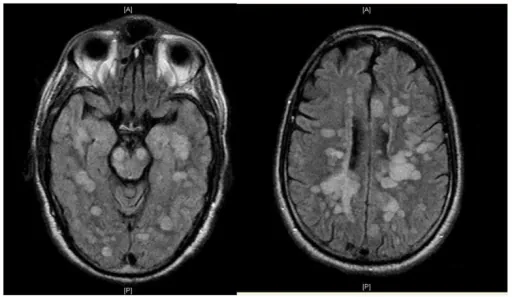
Acute disseminated encephalomyelitis (ADEM) is an immune-mediated, usually monophasic, inflammatory demyelinating disorder of the CNS that mainly affects children 1–4 weeks after a viral infection or, rarely, vaccination. It presents with acute or subacute encephalopathy (altered consciousness or behaviour not explained by fever) together with multifocal deficits such as ataxia, hemiparesis, optic neuritis, seizures and myelitis. MRI shows large, poorly marginated, bilateral asymmetric white matter lesions, often with deep grey matter (thalami, basal ganglia) and brainstem or spinal cord involvement. CSF may show a lymphocytic pleocytosis and raised protein, usually without OCBs. About half of children with ADEM have MOG-IgG, which predicts relapsing MOGAD. Infection, especially meningoencephalitis, must be excluded and empirical antimicrobials given until results are known. Treatment is high-dose IV methylprednisolone followed by an oral taper, with IVIG or plasma exchange for steroid-refractory disease. Most children recover well, though some have residual deficits.
Patient case, mechanism, investigations, management, flashcards and exam-style questions.Open the lesson →
Key facts
- Encephalopathy is required for the IPMSSG diagnosis of paediatric ADEM
- Typically follows a viral illness by 1–4 weeks; peak age 3–7 years
- MRI: large fluffy bilateral white matter lesions with deep grey matter involvement; absence of black holes and lesions of similar age
- CSF: lymphocytic pleocytosis and raised protein; OCBs usually absent
- MOG-IgG is positive in about 40–50% of paediatric ADEM and predicts relapse (MOGAD)
- First-line treatment: IV methylprednisolone 30 mg/kg/day (max 1 g) for 3–5 days then oral taper over 4–6 weeks (teaching dose; check local protocol)
- Monophasic in most; multiphasic ADEM or ADEM followed by optic neuritis suggests MOGAD
- Acute haemorrhagic leukoencephalitis (Hurst disease) is a fulminant haemorrhagic variant with high mortality
Differential diagnosis
| Condition | Clues | Key test |
|---|---|---|
| Viral or bacterial meningoencephalitis | Fever at presentation, CSF neutrophils or high cell count, positive PCR | CSF microscopy, culture and PCR |
| First attack of multiple sclerosis | No encephalopathy, older child or adult, ovoid periventricular lesions, OCBs | MRI pattern, CSF OCBs, follow-up MRI |
| MOG antibody-associated disease | ADEM with optic neuritis or relapses | Serum MOG-IgG |
| NMOSD | Area postrema syndrome, LETM, older age | AQP4-IgG |
| Autoimmune encephalitis (anti-NMDAR) | Psychiatric features, dyskinesia, normal or minimal MRI | CSF NMDAR antibodies |
| Primary CNS vasculitis | Strokes, headache, multifocal infarcts | Angiography, brain biopsy |
| Mitochondrial or metabolic leukodystrophy | Progressive course, family history, symmetrical lesions | Lactate, genetic testing, MR spectroscopy |
Exam pearls
Guideline
International Pediatric MS Study Group (IPMSSG) criteria for paediatric ADEM (2013) and 2023 International MOGAD Panel criteria
References
- Krupp LB, Tardieu M, Amato MP, et al.. International Pediatric Multiple Sclerosis Study Group criteria for pediatric multiple sclerosis and immune-mediated central nervous system demyelinating disorders: revisions to the 2007 definitions. Mult Scler 2013.
- Pohl D, Alper G, Van Haren K, et al.. Acute disseminated encephalomyelitis: Updates on an inflammatory CNS syndrome. Neurology 2016.
- Banwell B, Bennett JL, Marignier R, et al.. Diagnosis of myelin oligodendrocyte glycoprotein antibody-associated disease: International MOGAD Panel proposed criteria. Lancet Neurol 2023.
- Penman ID, Ralston SH, Strachan MWJ, Hobson RP, eds.. Davidson's Principles and Practice of Medicine. 2022.
- Loscalzo J, Fauci AS, Kasper DL, et al., eds.. Harrison's Principles of Internal Medicine. 2022.
- Papadakis MA, McPhee SJ, Rabow MW, et al., eds.. Current Medical Diagnosis and Treatment 2026. 2026.
Related topics
By Dr Khalid Seidi (B.Sc., M.D.) · MedEd World Clinical Knowledge library. Original teaching content checked against current guidelines (November 2026); confirm the latest local guidance before clinical use. Not a substitute for clinical judgement.