Clinical Knowledge › Neurology › Demyelinating and neuroinflammatory disorders
Transverse myelitis
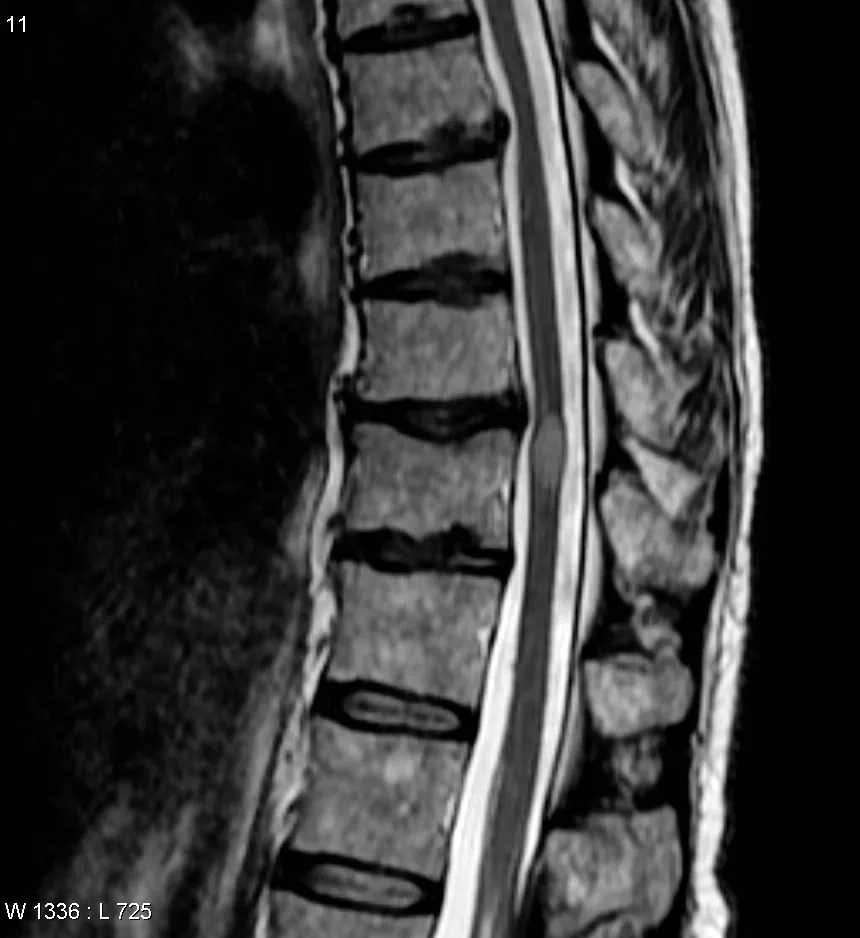
Transverse myelitis is acute or subacute inflammation of the spinal cord causing bilateral motor, sensory and autonomic dysfunction below a level, reaching its nadir between 4 hours and 21 days. Symptoms include weakness, a sensory level, band-like pain and sphincter dysfunction. Causes include demyelinating disease (MS, NMOSD, MOGAD), systemic autoimmune disease (SLE, Sjögren syndrome, sarcoidosis), infections (VZV, HSV, enteroviruses, HIV, HTLV-1, syphilis, schistosomiasis) and post-infectious or idiopathic inflammation. The first priority is urgent MRI of the whole spine to exclude compressive myelopathy, followed by contrast MRI of the brain and cord, lumbar puncture showing inflammation, and antibody testing (AQP4-IgG, MOG-IgG). Partial myelitis with short lesions suggests MS; longitudinally extensive lesions suggest NMOSD, MOGAD or other causes. Treatment is high-dose IV methylprednisolone, adding early plasma exchange for severe deficits, with bladder care, thromboprophylaxis and rehabilitation. Outcomes range from full recovery to permanent paraplegia.
Patient case, mechanism, investigations, management, flashcards and exam-style questions.Open the lesson →
Key facts
- Bilateral sensory, motor and autonomic dysfunction attributable to the cord with a clear sensory level
- Nadir between 4 hours and 21 days; under 4 hours suggests spinal cord infarction
- Urgent MRI of the whole spine first to exclude compression (tumour, abscess, disc, haematoma)
- Inflammation shown by gadolinium enhancement, CSF pleocytosis or raised IgG index
- Partial myelitis with short asymmetric lesions predicts MS; LETM (3 or more segments) suggests NMOSD or MOGAD
- Test AQP4-IgG and MOG-IgG, and screen for infection, B12, copper and systemic autoimmune disease
- Treat with IV methylprednisolone 1 g daily for 3–5 days; add plasma exchange early if severe
- Rapid onset, complete paraplegia, back pain and spinal shock predict poor outcome
Differential diagnosis
| Condition | Clues | Key test |
|---|---|---|
| Compressive myelopathy | Progressive back pain, known cancer, fever (abscess), trauma | Urgent MRI whole spine |
| Spinal cord infarction | Hyperacute onset under 4 hours, anterior cord syndrome, aortic surgery | DWI MRI cord; vascular imaging |
| Guillain–Barré syndrome | Ascending weakness, areflexia, no sensory level, bladder spared | Nerve conduction; CSF albuminocytological dissociation |
| Dural arteriovenous fistula | Older man, stepwise or exertional myelopathy, flow voids | Spinal angiography |
| Vitamin B12 or copper deficiency | Subacute dorsal column syndrome | B12, MMA, copper, caeruloplasmin |
| Spinal epidural abscess | Fever, severe back pain, raised CRP, injecting drug use | MRI with contrast; blood cultures |
| Functional neurological disorder | Inconsistent signs, Hoover sign | Normal MRI and CSF; positive signs |
Exam pearls
Guideline
Transverse Myelitis Consortium Working Group diagnostic criteria (2002), IPND NMOSD criteria (2015), MOGAD criteria (2023) and 2024 McDonald criteria
References
- Transverse Myelitis Consortium Working Group. Proposed diagnostic criteria and nosology of acute transverse myelitis. Neurology 2002.
- Frohman EM, Wingerchuk DM. Clinical practice. Transverse myelitis. N Engl J Med 2010.
- Wingerchuk DM, Banwell B, Bennett JL, et al.. International consensus diagnostic criteria for neuromyelitis optica spectrum disorders. Neurology 2015.
- Banwell B, Bennett JL, Marignier R, et al.. Diagnosis of myelin oligodendrocyte glycoprotein antibody-associated disease: International MOGAD Panel proposed criteria. Lancet Neurol 2023.
- Penman ID, Ralston SH, Strachan MWJ, Hobson RP, eds.. Davidson's Principles and Practice of Medicine. 2022.
- Loscalzo J, Fauci AS, Kasper DL, et al., eds.. Harrison's Principles of Internal Medicine. 2022.
Related topics
By Dr Khalid Seidi (B.Sc., M.D.) · MedEd World Clinical Knowledge library. Original teaching content checked against current guidelines (November 2026); confirm the latest local guidance before clinical use. Not a substitute for clinical judgement.