Clinical Knowledge › Internal medicine › Endocrinology › Adrenal disorders
Adrenocortical carcinoma
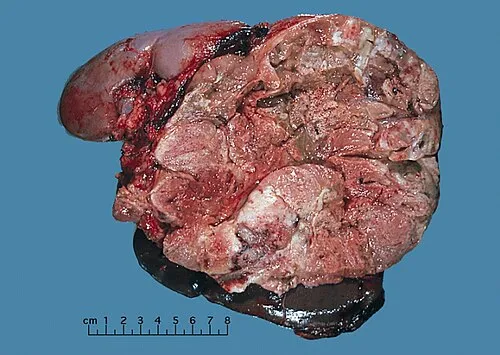
Adrenocortical carcinoma (ACC) is a rare, aggressive malignancy of the adrenal cortex, with an incidence of about 1–2 per million per year and peaks in early childhood and in the fifth decade. It is associated with germline TP53 (Li–Fraumeni) and mismatch-repair (Lynch) variants. About half to two-thirds of tumours secrete hormones: rapidly progressive Cushing syndrome with hypokalaemia, virilisation, or a mix of cortisol and androgen excess is highly suggestive. Others present with abdominal mass effect or as a large, dense, heterogeneous incidentaloma. Work-up combines a full steroid profile, exclusion of phaeochromocytoma, and CT of chest, abdomen and pelvis; biopsy is avoided. Diagnosis is histological (Weiss score, Ki-67) after complete open en-bloc resection, the only curative treatment. Adjuvant mitotane is advised for high-risk disease, while the ADIUVO trial supports surveillance for low-risk tumours. Advanced disease is treated with mitotane plus etoposide, doxorubicin and cisplatin. Overall 5-year survival is roughly 35–50%, strongly dependent on ENSAT stage.
Patient case, mechanism, investigations, management, flashcards and exam-style questions.Open the lesson →
Key facts
- Rare (about 1–2 per million per year); bimodal age peaks under 5 years and 40–50 years; slightly more common in women
- Germline TP53 (Li–Fraumeni) causes many childhood cases (TP53 R337H founder variant in southern Brazil); Lynch syndrome and MEN1 are other associations
- Rapid Cushing syndrome with hypokalaemia, virilisation in women or feminisation in men with an adrenal mass suggests carcinoma
- Typical imaging: over 4 cm (often over 10 cm), heterogeneous, unenhanced CT above 20 HU, necrosis, calcification, venous invasion
- Always exclude phaeochromocytoma; avoid biopsy (tumour seeding, cannot separate adenoma from carcinoma)
- ENSAT stage: I ≤5 cm, II over 5 cm (both confined), III local invasion, nodes or venous thrombus, IV distant metastases
- Complete (R0) open en-bloc resection by an expert surgeon is the only cure; tumour rupture greatly worsens outcome
- Mitotane is adrenolytic: target level 14–20 mg/L; it causes adrenal insufficiency, so give hydrocortisone in higher than usual doses
Differential diagnosis
| Condition | Clues | Key test |
|---|---|---|
| Adrenocortical adenoma | Small, homogeneous, lipid-rich, slow or no growth | Unenhanced CT 10 HU or less; histology if resected (Weiss under 3) |
| Phaeochromocytoma | Paroxysms, hypertension; heterogeneous vascular mass | Plasma or urine metanephrines |
| Adrenal metastasis | Known primary (lung, kidney, melanoma), often bilateral | FDG-PET-CT; biopsy after metanephrines |
| Adrenal lymphoma | Bilateral masses, B symptoms, high LDH, adrenal insufficiency | CT-guided biopsy after excluding phaeochromocytoma |
| Renal cell carcinoma (upper pole) | Haematuria, mass arising from kidney | Multiplanar CT or MRI |
| Ovarian or testicular androgen-secreting tumour | Virilisation with very high testosterone but normal DHEAS | Pelvic ultrasound or MRI; adrenal imaging normal |
| Pituitary or ectopic ACTH Cushing | Cushing with hyperpigmentation and high ACTH | ACTH raised (ACC suppresses ACTH) |
Exam pearls
Guideline
ESE/ENSAT Clinical Practice Guideline on the management of adrenocortical carcinoma in adults (2018) and ESMO–EURACAN Clinical Practice Guideline for adrenocortical carcinomas and malignant phaeochromocytomas (2020), with the ESE/ENSAT adrenal incidentaloma guideline (2023)
References
- Fassnacht M, Dekkers OM, Else T, et al.. European Society of Endocrinology Clinical Practice Guidelines on the management of adrenocortical carcinoma in adults, in collaboration with the European Network for the Study of Adrenal Tumors. Eur J Endocrinol 2018.
- Fassnacht M, Assie G, Baudin E, et al.. Adrenocortical carcinomas and malignant phaeochromocytomas: ESMO-EURACAN Clinical Practice Guidelines for diagnosis, treatment and follow-up. Ann Oncol 2020.
- Terzolo M, Angeli A, Fassnacht M, et al.. Adjuvant mitotane treatment for adrenocortical carcinoma. N Engl J Med 2007.
- Terzolo M, Fassnacht M, Perotti P, et al.. Adjuvant mitotane versus surveillance in low-grade, localised adrenocortical carcinoma (ADIUVO): an international, multicentre, open-label, randomised, phase 3 trial and observational study. Lancet Diabetes Endocrinol 2023.
- Fassnacht M, Terzolo M, Allolio B, et al.. Combination chemotherapy in advanced adrenocortical carcinoma. N Engl J Med 2012.
- Fassnacht M, Tsagarakis S, Terzolo M, et al.. European Society of Endocrinology clinical practice guidelines on the management of adrenal incidentalomas, in collaboration with the European Network for the Study of Adrenal Tumors. Eur J Endocrinol 2023.
Related topics
By Dr Khalid Seidi (B.Sc., M.D.) · MedEd World Clinical Knowledge library. Original teaching content checked against current guidelines (November 2026); confirm the latest local guidance before clinical use. Not a substitute for clinical judgement.