Clinical Knowledge › Internal medicine › Endocrinology › Adrenal disorders
Primary adrenal insufficiency (Addison disease)
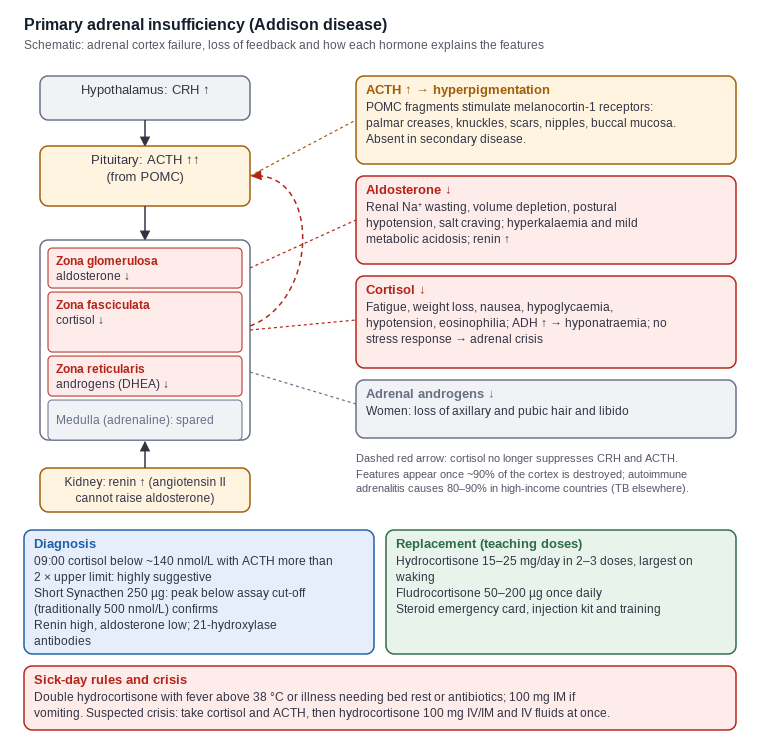
Primary adrenal insufficiency (Addison disease) is failure of the adrenal cortex, causing deficiency of cortisol and usually aldosterone, with compensatory rises in ACTH and renin. In high-income countries about 80–90% of cases are autoimmune, often with other autoimmune diseases in the autoimmune polyendocrine syndromes; tuberculosis remains an important cause where it is common, and other causes include adrenal haemorrhage, metastases, fungal and HIV-related infections, drugs, congenital adrenal hyperplasia and adrenoleukodystrophy. Symptoms develop slowly and are non-specific: fatigue, weakness, anorexia, weight loss, nausea, abdominal pain, salt craving and postural dizziness. Hyperpigmentation of skin creases, scars and buccal mucosa is the clue that distinguishes primary from secondary disease. Typical laboratory findings are hyponatraemia, hyperkalaemia, raised urea and sometimes hypoglycaemia. Diagnosis rests on a low morning cortisol with a high ACTH, confirmed by a short Synacthen test, with high renin and 21-hydroxylase antibodies to establish the cause. Treatment is lifelong hydrocortisone and fludrocortisone, with education on sick-day rules, a steroid emergency card and injectable hydrocortisone to prevent adrenal crisis.
Patient case, mechanism, investigations, management, flashcards and exam-style questions.Open the lesson →
Key facts
- Primary adrenal insufficiency = adrenal cortex failure: low cortisol and aldosterone with high ACTH and renin
- Autoimmune adrenalitis causes 80–90% in high-income countries (21-hydroxylase antibodies); tuberculosis is a major cause in endemic regions
- Hyperpigmentation (palmar creases, buccal mucosa, scars, nipples) results from high ACTH/POMC and is absent in secondary adrenal insufficiency
- Hyponatraemia, hyperkalaemia, raised urea, hypoglycaemia, eosinophilia and mild hypercalcaemia are typical laboratory clues
- Morning cortisol below about 140 nmol/L (5 µg/dL) with ACTH more than twice the upper limit strongly suggests the diagnosis
- Short Synacthen test (250 µg): peak cortisol below the assay-specific cut-off (traditionally 500 nmol/L, about 18 µg/dL; lower with newer assays) confirms it
- Treat with hydrocortisone 15–25 mg/day in 2–3 doses plus fludrocortisone 50–200 µg/day (teaching doses; check local formulary)
- Sick-day rules: double the hydrocortisone dose with fever or illness, inject 100 mg IM if vomiting, and carry a steroid emergency card
Differential diagnosis
| Condition | Clues | Key test |
|---|---|---|
| Secondary (ACTH-deficient) adrenal insufficiency | No pigmentation, potassium normal, other pituitary deficiencies, recent glucocorticoid use | Low or normal ACTH; pituitary MRI |
| Glucocorticoid-induced adrenal insufficiency | Recent long-term or high-dose steroids stopped | Drug history; low ACTH; ESE/ES 2024 guidance |
| Gastrointestinal disease or malignancy | Weight loss, vomiting, abdominal pain | Normal cortisol; endoscopy or imaging |
| Anorexia nervosa | Weight loss in a young woman, amenorrhoea | Cortisol often high; no hyperkalaemia or pigmentation |
| SIADH | Hyponatraemia without hyperkalaemia, euvolaemic | Normal cortisol; adrenal insufficiency must be excluded before diagnosing SIADH |
| Haemochromatosis | Bronze skin, diabetes, liver disease | Ferritin and transferrin saturation |
| Depression or chronic fatigue | Fatigue and anorexia without electrolyte change | Normal morning cortisol and Synacthen test |
Exam pearls
Guideline
Endocrine Society 2016 guideline on primary adrenal insufficiency, NICE NG243 adrenal insufficiency (2024) and the ESE/Endocrine Society 2024 glucocorticoid-induced adrenal insufficiency guideline
References
- Bornstein SR, Allolio B, Arlt W, et al.. Diagnosis and Treatment of Primary Adrenal Insufficiency: An Endocrine Society Clinical Practice Guideline. J Clin Endocrinol Metab 2016.
- Husebye ES, Pearce SH, Krone NP, Kämpe O.. Adrenal insufficiency. Lancet 2021.
- National Institute for Health and Care Excellence (NICE). Adrenal insufficiency: identification and management (NG243). NICE guideline 2024.
- Beuschlein F, Else T, Bancos I, et al.. European Society of Endocrinology and Endocrine Society Joint Clinical Guideline: Diagnosis and Therapy of Glucocorticoid-induced Adrenal Insufficiency. J Clin Endocrinol Metab 2024.
- Rushworth RL, Torpy DJ, Falhammar H.. Adrenal Crisis. N Engl J Med 2019.
- Arlt W; Society for Endocrinology Clinical Committee.. Society for Endocrinology Endocrine Emergency Guidance: Emergency management of acute adrenal insufficiency (adrenal crisis) in adult patients. Endocr Connect 2016.
Related topics
By Dr Khalid Seidi (B.Sc., M.D.) · MedEd World Clinical Knowledge library. Original teaching content checked against current guidelines (November 2026); confirm the latest local guidance before clinical use. Not a substitute for clinical judgement.