Clinical Knowledge › Dermatology › Eczema and dermatitis
Allergic contact dermatitis
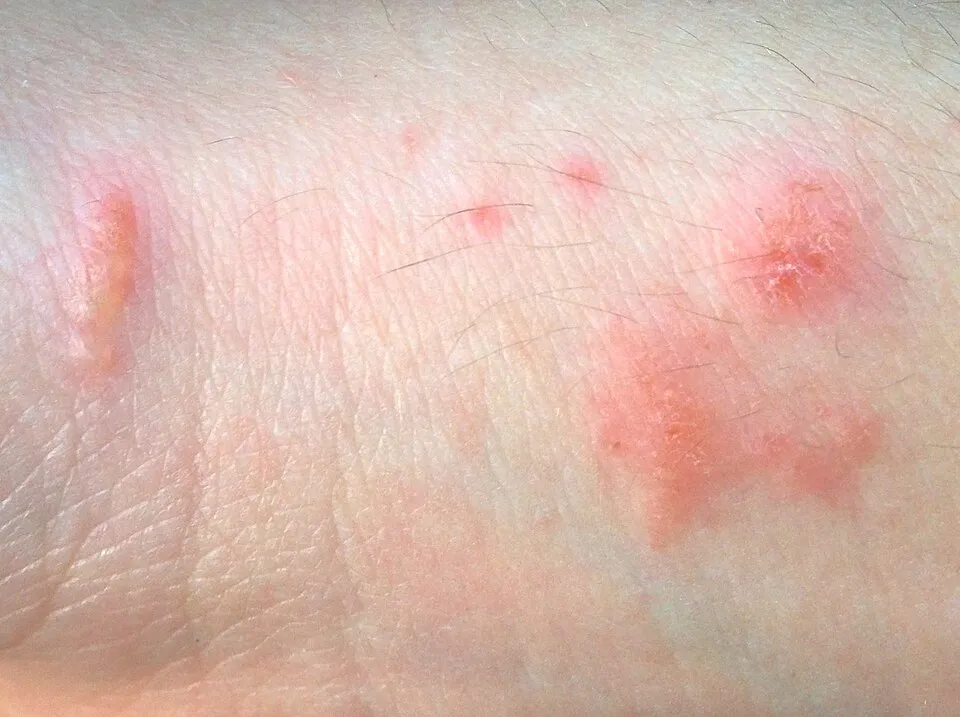
Allergic contact dermatitis (ACD) is a type IV, T-cell-mediated delayed hypersensitivity reaction to a small molecule (hapten) that penetrates the skin, binds proteins and is presented to T cells. After a sensitisation phase, re-exposure causes an itchy eczematous eruption 24-72 hours later. Acute ACD shows ill-defined erythema, oedema, papules and vesicles; chronic ACD shows scaling and lichenification. The site points to the cause: earlobes and umbilicus (nickel), eyelids (nail varnish, airborne allergens), scalp margin and face (hair dye p-phenylenediamine), hands (rubber accelerators, preservatives, acrylates), feet (shoe chromate and rubber), and linear streaks (plants). Topical medicaments, including corticosteroids, are frequent hidden culprits. Patch testing with the European baseline series (plus extra series and own products), read at day 2 and day 3-4 with a later reading near day 7, is the gold standard. Treatment is allergen identification, strict avoidance and substitution, emollients and potent topical corticosteroids, with tapered oral prednisolone for severe widespread disease.
Patient case, mechanism, investigations, management, flashcards and exam-style questions.Open the lesson →
Key facts
- Type IV delayed hypersensitivity: sensitisation phase then elicitation 24-72 h after re-exposure
- Itch is the main symptom; the eruption often spreads beyond the contact site
- Nickel is the commonest contact allergen in Europe (about 15-20% of women patch tested)
- Methylisothiazolinone caused an epidemic in the 2010s, leading to EU bans in leave-on cosmetics
- Distribution is the main clue: earlobes, umbilicus, eyelids, hairline, hands, feet, linear plant streaks
- Patch testing is the gold standard: allergens under occlusion for 48 h, read at day 2, day 3-4 and around day 7
- Patch test grading (ICDRG): ?+ doubtful, + weak, ++ strong (vesicles), +++ extreme (bullae), IR irritant
- Treatment: avoidance and substitution, emollients, potent topical steroid; oral prednisolone taper 2-3 weeks if severe
Differential diagnosis
| Condition | Clues | Key test |
|---|---|---|
| Irritant contact dermatitis | Burning more than itch, sharply limited to contact site, wet-work history | Negative or non-relevant patch test |
| Atopic dermatitis | Flexural eczema from childhood, atopy | Clinical; patch test if pattern changes |
| Seborrhoeic dermatitis | Greasy scale on scalp, eyebrows, nasolabial folds | Clinical |
| Contact urticaria | Wheals within 30-60 minutes of contact (e.g. latex) | Skin prick test or specific IgE |
| Cellulitis | Unilateral, tender, warm, fever; no vesicles or itch | Clinical; inflammatory markers |
| Herpes simplex / eczema herpeticum | Grouped monomorphic punched-out erosions, pain, fever | Viral PCR swab |
| Photoallergic contact dermatitis | Sun-exposed sites with sparing under chin and behind ears | Photopatch testing |
Exam pearls
Guideline
ESCD diagnostic patch testing guideline update (2026); European baseline series (2023 revision); BAD contact dermatitis guideline (2017); ESCD hand eczema guideline (2022)
References
- European Society of Contact Dermatitis (Uter W, Aerts O, Agner T, et al.). European Society of Contact Dermatitis guideline for diagnostic patch testing - recommendations on best practice (update 2026). Contact Dermatitis 2026.
- Wilkinson SM, Gonçalo M, Aerts O, et al.. The European baseline series and recommended additions: 2023. Contact Dermatitis 2023.
- British Association of Dermatologists (Johnston GA, Exton LS, Mohd Mustapa MF, et al.). British Association of Dermatologists' guidelines for the management of contact dermatitis 2017. Br J Dermatol 2017.
- European Society of Contact Dermatitis (Johansen JD, Aalto-Korte K, Agner T, et al.). European Society of Contact Dermatitis guideline for diagnostic patch testing - recommendations on best practice. Contact Dermatitis 2015.
- European Society of Contact Dermatitis (Thyssen JP, Schuttelaar MLA, Alfonso JH, et al.). Guidelines for diagnosis, prevention, and treatment of hand eczema. Contact Dermatitis 2022.
- Vandeweege S, Debaene B, Lapeere H, Verstraelen H. A systematic review of allergic and irritant contact dermatitis of the vulva: the most important allergens/irritants and the role of patch testing. Contact Dermatitis 2023.
Related topics
By Dr Khalid Seidi (B.Sc., M.D.) · MedEd World Clinical Knowledge library. Original teaching content checked against current guidelines (November 2026); confirm the latest local guidance before clinical use. Not a substitute for clinical judgement.