Clinical Knowledge › Dermatology › Eczema and dermatitis
Irritant contact dermatitis
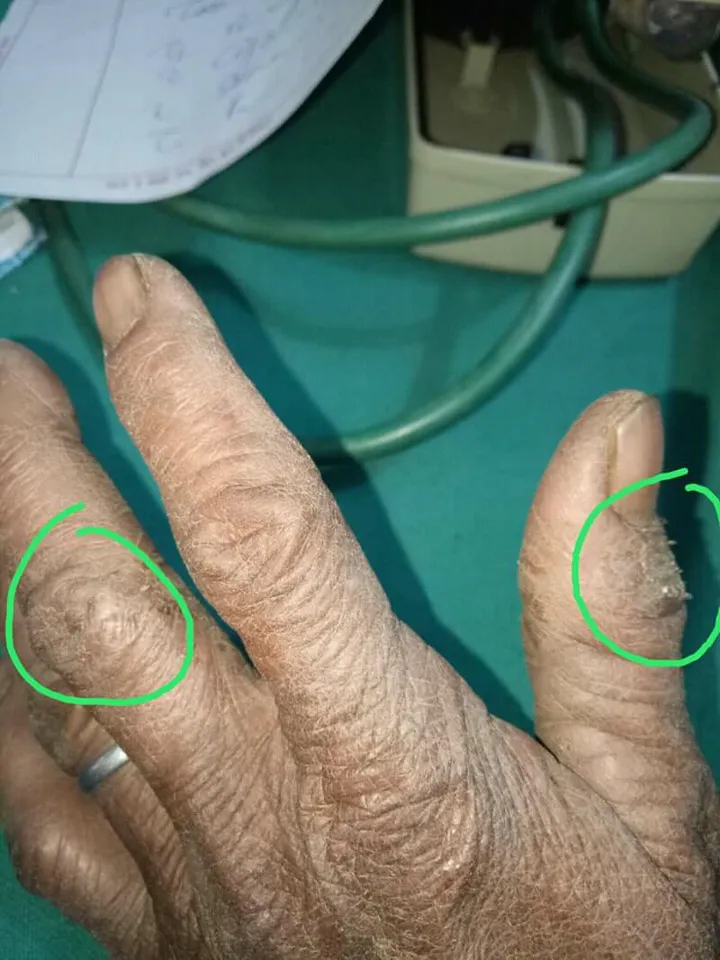
Irritant contact dermatitis (ICD) is non-immunological inflammation of the skin caused by direct damage from chemical or physical agents. It is the commonest form of contact dermatitis and the leading occupational skin disease, typically affecting the hands of people doing 'wet work' (healthcare, hairdressing, cleaning, catering). Acute ICD after a strong irritant (acid, alkali, cement) causes sharply demarcated erythema, oedema, vesicles, bullae or even necrosis confined to the contact site, with burning or stinging more than itch. Chronic cumulative ICD from repeated weak irritants produces dryness, scaling, chapping, fissures and lichenification on the backs of the hands and finger webs. There is no confirmatory test: the diagnosis rests on history, distribution and a negative or non-relevant patch test, which is needed to exclude allergic contact dermatitis. Management is irritant avoidance, gloves, emollients and short potent topical steroid courses; severe chronic hand eczema may need alitretinoin or delgocitinib cream.
Patient case, mechanism, investigations, management, flashcards and exam-style questions.Open the lesson →
Key facts
- Commonest type of contact dermatitis (about 80%) and the commonest occupational skin disease
- Non-immunological: no prior sensitisation; anyone exposed to enough irritant will react
- Main cause is wet work: hands wet for more than 2 hours a day or washed more than about 20 times a day
- Symptoms: burning, stinging and soreness more than itch; sharply limited to the contact site
- Chronic cumulative ICD: dry, scaly, fissured dorsal hands and finger webs; 'housewife's' or 'healthcare worker' hands
- Atopic dermatitis (especially with filaggrin loss-of-function) roughly doubles the risk of hand ICD
- Diagnosis of exclusion: patch testing is needed when chronic, to exclude coexisting allergic contact dermatitis
- Treatment ladder: avoid irritant, protect, emollients, potent topical steroid, then alitretinoin, delgocitinib cream, phototherapy or systemic therapy
Differential diagnosis
| Condition | Clues | Key test |
|---|---|---|
| Allergic contact dermatitis | Itch predominates; spreads beyond contact site; delayed 24-72 h after exposure to a specific allergen | Patch testing (positive and relevant) |
| Atopic hand eczema | Personal or family atopy, flexural eczema, onset in childhood | Clinical; patch test if atypical |
| Pompholyx (vesicular hand eczema) | Itchy deep-seated vesicles on palms and lateral fingers | Clinical; patch test to exclude allergy |
| Palmar psoriasis | Sharply demarcated thick plaques with silvery scale; nail pitting; psoriasis elsewhere | Clinical; biopsy if unclear |
| Tinea manuum | Usually one hand ('two feet, one hand'); fine powdery scale in palmar creases | Skin scrapings for KOH microscopy and culture |
| Chemical burn | Immediate pain and necrosis after concentrated acid, alkali or cement | Clinical; pH of the chemical |
| Scabies | Burrows in finger webs, nocturnal itch, contacts affected | Dermoscopy ('delta-wing jet'), skin scraping |
Exam pearls
Guideline
ESCD Guidelines for diagnosis, prevention and treatment of hand eczema (2022); BAD contact dermatitis guideline (2017); ESCD patch testing guideline update (2026); NICE TA1107 delgocitinib (2025)
References
- British Association of Dermatologists (Johnston GA, Exton LS, Mohd Mustapa MF, et al.). British Association of Dermatologists' guidelines for the management of contact dermatitis 2017. Br J Dermatol 2017.
- European Society of Contact Dermatitis (Thyssen JP, Schuttelaar MLA, Alfonso JH, et al.). Guidelines for diagnosis, prevention, and treatment of hand eczema. Contact Dermatitis 2022.
- European Society of Contact Dermatitis (Uter W, Aerts O, Agner T, et al.). European Society of Contact Dermatitis guideline for diagnostic patch testing - recommendations on best practice (update 2026). Contact Dermatitis 2026.
- Wilkinson SM, Gonçalo M, Aerts O, et al.. The European baseline series and recommended additions: 2023. Contact Dermatitis 2023.
- European Society of Contact Dermatitis (Johansen JD, Aalto-Korte K, Agner T, et al.). European Society of Contact Dermatitis guideline for diagnostic patch testing - recommendations on best practice. Contact Dermatitis 2015.
- Bissonnette R, Warren RB, Pinter A, et al.. Efficacy and safety of delgocitinib cream in adults with moderate to severe chronic hand eczema (DELTA 1 and DELTA 2): results from multicentre, randomised, controlled, double-blind, phase 3 trials. Lancet 2024.
Related topics
By Dr Khalid Seidi (B.Sc., M.D.) · MedEd World Clinical Knowledge library. Original teaching content checked against current guidelines (November 2026); confirm the latest local guidance before clinical use. Not a substitute for clinical judgement.