Clinical Knowledge › Dermatology › Eczema and dermatitis
Pompholyx
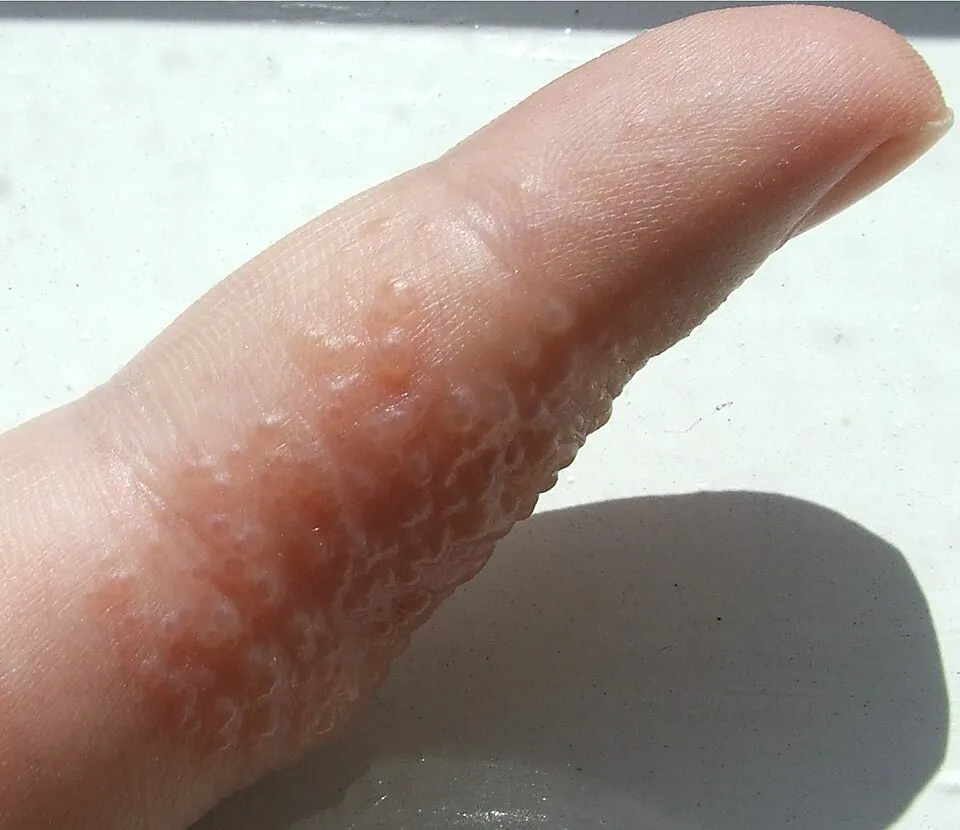
Pompholyx (dyshidrotic eczema, acute or recurrent vesicular hand eczema) is an eczema of the palms, lateral fingers and soles characterised by crops of intensely itchy, deep-seated, tense vesicles that look like tapioca or 'sago grains' because of the thick overlying stratum corneum. Large lesions may coalesce into bullae. Attacks last 2-3 weeks and end with peeling, fissuring and brown dots of dried vesicles; many patients relapse, often in hot weather. Despite the name, sweat glands are not the cause, although hyperhidrosis and heat are triggers. Other associations are atopy, contact allergy (nickel, cobalt), an 'id' reaction to tinea pedis, smoking and intravenous immunoglobulin. Diagnosis is clinical, but the feet should be examined and scraped for tinea, and patch testing is recommended for recurrent or chronic disease. Treatment comprises potassium permanganate soaks, drainage of large blisters, very potent topical corticosteroids and emollients, with alitretinoin, delgocitinib cream or PUVA for chronic recurrent disease.
Patient case, mechanism, investigations, management, flashcards and exam-style questions.Open the lesson →
Key facts
- Deep-seated, tense, itchy vesicles on palms, sides of fingers and soles ('sago-grain' or tapioca vesicles)
- Classified as acute recurrent vesicular hand eczema in the ESCD 2022 hand eczema guideline
- Episodes last 2-3 weeks and end with desquamation, collarettes of scale and painful fissures
- Triggers: heat, sweating, atopy, stress, smoking, contact allergens (nickel, cobalt, fragrances), IVIG
- Look at the feet: an id reaction to inflammatory tinea pedis can mimic or trigger pompholyx
- Patch test recurrent or chronic cases; up to a third have a relevant contact allergy
- Acute: potassium permanganate soaks (1:10 000), drain bullae, very potent topical steroid
- Chronic recurrent: alitretinoin, delgocitinib cream, PUVA; dyshidrosiform pemphigoid in older adults needs biopsy
Differential diagnosis
| Condition | Clues | Key test |
|---|---|---|
| Allergic contact dermatitis of the hands | Dorsal hand involvement, exposure history, spreading beyond palms | Patch testing |
| Vesicular tinea pedis / id reaction | Unilateral foot vesicles, toe-web scaling; hand vesicles are sterile | KOH and culture of the feet (hands negative) |
| Palmoplantar pustulosis | Sterile yellow pustules turning brown on palms and soles, smokers, psoriasis | Clinical; swab sterile |
| Dyshidrosiform bullous pemphigoid | Older adult, tense haemorrhagic palmoplantar blisters, later truncal bullae | Biopsy with direct immunofluorescence (linear IgG/C3) |
| Scabies | Burrows in finger webs and wrists, nocturnal itch, family affected; infants get palmoplantar vesicles | Dermoscopy, skin scraping for mites |
| Hand, foot and mouth disease | Oval grey vesicles on palms and soles with oral ulcers in a child | Clinical; enterovirus PCR |
| Bullous impetigo | Flaccid bullae with honey crusts | Bacterial swab |
Exam pearls
Guideline
ESCD Guidelines for diagnosis, prevention and treatment of hand eczema (2022); BAD contact dermatitis guideline (2017); NICE TA1107 delgocitinib (2025) and TA177 alitretinoin
References
- European Society of Contact Dermatitis (Thyssen JP, Schuttelaar MLA, Alfonso JH, et al.). Guidelines for diagnosis, prevention, and treatment of hand eczema. Contact Dermatitis 2022.
- British Association of Dermatologists (Johnston GA, Exton LS, Mohd Mustapa MF, et al.). British Association of Dermatologists' guidelines for the management of contact dermatitis 2017. Br J Dermatol 2017.
- Bissonnette R, Warren RB, Pinter A, et al.. Efficacy and safety of delgocitinib cream in adults with moderate to severe chronic hand eczema (DELTA 1 and DELTA 2): results from multicentre, randomised, controlled, double-blind, phase 3 trials. Lancet 2024.
- National Institute for Health and Care Excellence. Delgocitinib for treating moderate to severe chronic hand eczema (TA1107). NICE, London 2025.
- Ruzicka T, Lynde CW, Jemec GB, et al.. Efficacy and safety of oral alitretinoin (9-cis retinoic acid) in patients with severe chronic hand eczema refractory to topical corticosteroids: results of a randomized, double-blind, placebo-controlled, multicentre trial. Br J Dermatol 2008.
- Bissonnette R, Agner T, Molin S, et al.. Hand eczema - Part 1: Epidemiology, pathogenesis, diagnosis, and work-up. J Am Acad Dermatol 2025.
Related topics
By Dr Khalid Seidi (B.Sc., M.D.) · MedEd World Clinical Knowledge library. Original teaching content checked against current guidelines (November 2026); confirm the latest local guidance before clinical use. Not a substitute for clinical judgement.