Clinical Knowledge › Internal medicine › Gastroenterology and hepatology › Relevant pharmacology
Aminosalicylates
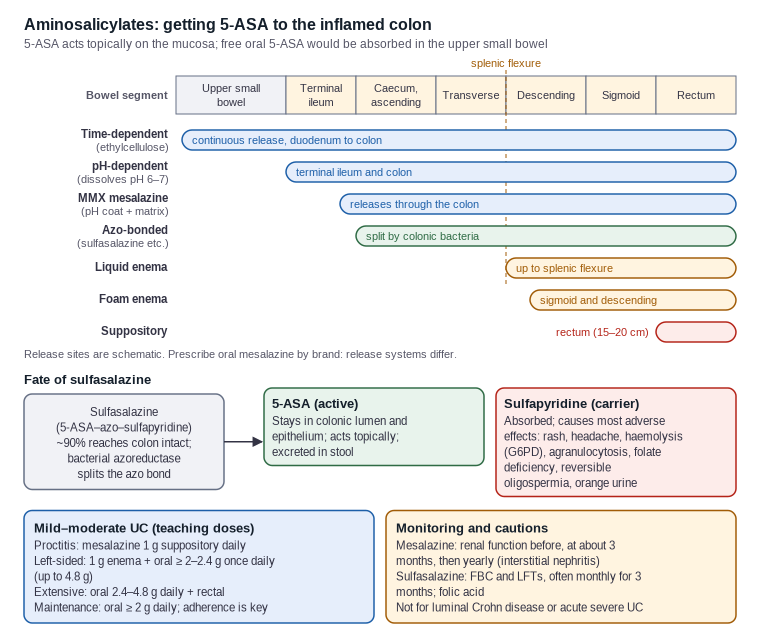
Aminosalicylates deliver 5-aminosalicylic acid (5-ASA, mesalazine) to the inflamed colonic mucosa, where it acts topically to reduce inflammation. They are the first-line treatment for inducing and maintaining remission in mild to moderate ulcerative colitis, given by mouth (at least 2–2.4 g a day, once daily) and rectally as suppositories or enemas; combined oral and rectal treatment works best for left-sided and extensive disease, and suppositories are best for proctitis. Sulfasalazine joins 5-ASA to sulfapyridine by an azo bond that colonic bacteria split; sulfapyridine causes most of its adverse effects, including rash, headache, haemolysis, agranulocytosis, folate deficiency and reversible male infertility. Newer formulations release mesalazine by pH or over time. Aminosalicylates are no longer recommended for luminal Crohn disease. Rare but important adverse effects of mesalazine include interstitial nephritis, which is why renal function is checked before and during treatment, and a paradoxical worsening of colitis.
Patient case, mechanism, investigations, management, flashcards and exam-style questions.Open the lesson →
Key facts
- 5-ASA acts topically on colonic mucosa; the drug must reach the inflamed bowel, hence pH-dependent, time-release and rectal formulations
- Mild to moderate UC: oral mesalazine at least 2–2.4 g a day (up to 4.8 g in moderate activity) plus rectal mesalazine; once-daily dosing is as effective as divided dosing
- Proctitis: mesalazine 1 g suppository daily is first-line and better than oral 5-ASA or rectal steroids
- Maintenance in UC: oral 5-ASA at least 2 g a day; non-adherence is a major cause of relapse
- Sulfasalazine = 5-ASA + sulfapyridine (azo bond split by colonic bacteria); sulfapyridine causes most adverse effects
- Sulfasalazine: oligospermia, haemolysis in G6PD deficiency, agranulocytosis, folate deficiency (give folic acid), orange body fluids
- Mesalazine can cause interstitial nephritis: check renal function before starting, at about 3 months and then yearly
- Aminosalicylates are not recommended for induction or maintenance of luminal Crohn disease (ECCO 2024, ACG 2025, BSG 2025)
Differential diagnosis
| Condition | Clues | Key test |
|---|---|---|
| Mesalazine (pH-dependent release) | Coated to release at pH 6–7 in terminal ileum and colon | Prescribe by brand; formulations are not interchangeable |
| Mesalazine (time-dependent, ethylcellulose granules) | Releases gradually from duodenum to colon | Older use in small bowel Crohn disease, now not recommended |
| Mesalazine MMX (multimatrix) | Once-daily high-dose release throughout colon | Adherence advantage |
| Sulfasalazine | 5-ASA bound to sulfapyridine; also a DMARD in rheumatoid arthritis and spondyloarthritis | FBC and LFT monitoring; folic acid |
| Balsalazide | 5-ASA bound to an inert carrier by azo bond | Fewer sulfa effects |
| Olsalazine | Two 5-ASA molecules joined by azo bond | Secretory diarrhoea |
| Rectal mesalazine (suppository, foam, liquid enema) | Suppository reaches about 15–20 cm; enemas reach the splenic flexure | Choose by extent on colonoscopy |
| Budesonide MMX or prednisolone | Not aminosalicylates; add-on if 5-ASA fails | Never for maintenance |
Exam pearls
Guideline
ECCO Guidelines on Therapeutics in Ulcerative Colitis: Medical Treatment (2026), ACG clinical guideline update: ulcerative colitis in adults (2025), BSG guidelines on IBD in adults (2025), AGA guideline on mild to moderate UC (2019) and ECCO Guidelines on Therapeutics in Crohn's Disease (2024)
References
- Gisbert JP, Chaparro M, Verstockt B, et al.. ECCO Guidelines on Therapeutics in Ulcerative Colitis: Medical Treatment. J Crohns Colitis 2026.
- Rubin DT, Ananthakrishnan AN, Siegel CA, Barnes EL, Long MD.. ACG clinical guideline update: ulcerative colitis in adults. Am J Gastroenterol 2025.
- Moran GW, Gordon M, Sinopoulou V, et al.. British Society of Gastroenterology guidelines on inflammatory bowel disease in adults: 2025. Gut 2025.
- Ko CW, Singh S, Feuerstein JD, et al.. AGA Clinical Practice Guidelines on the Management of Mild-to-Moderate Ulcerative Colitis. Gastroenterology 2019.
- Gordon H, Minozzi S, Kopylov U, et al.. ECCO Guidelines on Therapeutics in Crohn's Disease: Medical Treatment. J Crohns Colitis 2024.
- Murray A, Nguyen TM, Parker CE, Feagan BG, MacDonald JK.. Oral 5-aminosalicylic acid for induction of remission in ulcerative colitis. Cochrane Database Syst Rev 2020.
Related topics
By Dr Khalid Seidi (B.Sc., M.D.) · MedEd World Clinical Knowledge library. Original teaching content checked against current guidelines (November 2026); confirm the latest local guidance before clinical use. Not a substitute for clinical judgement.