Clinical Knowledge › Internal medicine › Gastroenterology and hepatology › Relevant pharmacology
Proton pump inhibitors and H2 receptor antagonists
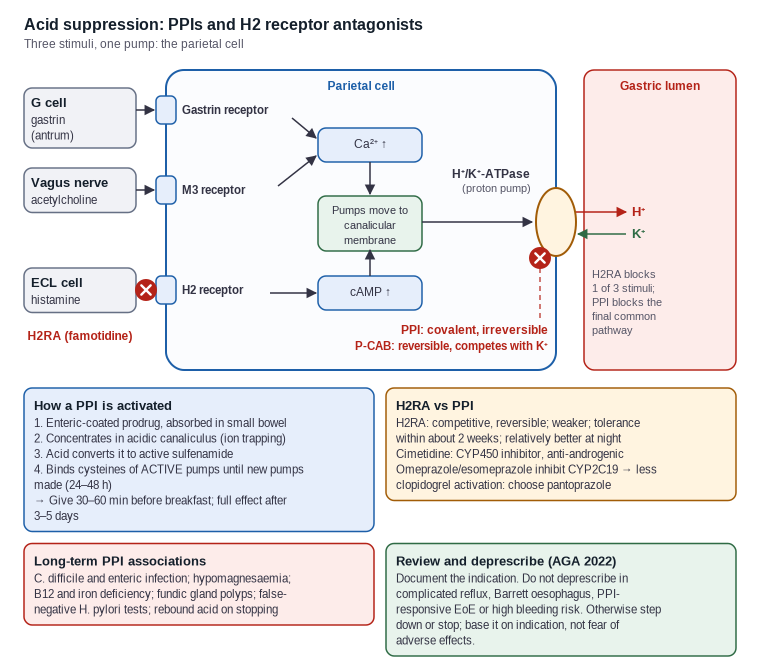
Proton pump inhibitors (PPIs) and histamine H2 receptor antagonists (H2RAs) are the main drugs that reduce gastric acid. PPIs such as omeprazole, lansoprazole, esomeprazole and pantoprazole are prodrugs activated in the acidic parietal cell canaliculus, where they bind the H+/K+-ATPase covalently and block the final step of acid secretion; they work best taken 30–60 minutes before breakfast. H2RAs such as famotidine block histamine-stimulated secretion reversibly, are weaker, and lose effect within weeks (tachyphylaxis). PPIs heal reflux oesophagitis and peptic ulcers, form part of Helicobacter pylori eradication, protect high-risk NSAID and antiplatelet users, and reduce rebleeding after endoscopic haemostasis. Potassium-competitive acid blockers such as vonoprazan give faster, stronger acid suppression. PPIs are generally safe but are overused; long-term use is linked to enteric infection, hypomagnesaemia and B12 deficiency, so every patient needs a documented indication and regular review for deprescribing.
Patient case, mechanism, investigations, management, flashcards and exam-style questions.Open the lesson →
Key facts
- PPIs irreversibly inhibit the parietal cell H+/K+-ATPase (proton pump), the final common pathway of acid secretion
- PPIs are acid-activated prodrugs: give 30–60 minutes before a meal so the drug is present when pumps are activated
- H2 receptor antagonists (famotidine, cimetidine) competitively block histamine on parietal cells; tolerance develops within about 2 weeks
- Standard 8-week PPI course heals most erosive oesophagitis; LA grade C/D oesophagitis and Barrett oesophagus need long-term PPI
- After endoscopic therapy for a high-risk bleeding ulcer, give high-dose PPI (continuous or intermittent) for 3 days, then twice daily to complete about 2 weeks
- Cimetidine inhibits several CYP450 enzymes and has anti-androgenic effects; omeprazole and esomeprazole inhibit CYP2C19 and can reduce clopidogrel activation
- Long-term PPI use is associated with C. difficile and other enteric infections, hypomagnesaemia, B12 and iron deficiency, fundic gland polyps and false-negative H. pylori tests
- AGA 2022: review the indication regularly; deprescribe when there is no ongoing indication, but not solely because of feared adverse effects
Differential diagnosis
| Condition | Clues | Key test |
|---|---|---|
| Proton pump inhibitor (omeprazole, lansoprazole, esomeprazole, pantoprazole, rabeprazole) | Most potent first-line acid suppressant; once daily before breakfast | Symptom response; endoscopy to confirm healing in severe oesophagitis |
| H2 receptor antagonist (famotidine, cimetidine, nizatidine) | Weaker, faster on-demand relief; nocturnal acid; tachyphylaxis | Symptom diary; add at bedtime for nocturnal symptoms |
| Potassium-competitive acid blocker (vonoprazan, tegoprazan) | Acid-stable, reversible, rapid full effect from first dose | Used in H. pylori regimens and severe oesophagitis where available |
| Antacids and alginates | Neutralise acid or form a raft; immediate brief relief | First-line in pregnancy and for mild intermittent symptoms |
| Misoprostol | Prostaglandin E1 analogue; protects mucosa; causes diarrhoea; abortifacient | Alternative NSAID gastroprotection, contraindicated in pregnancy |
| Sucralfate | Coats ulcer bases in acid; no acid suppression | Rarely used; binds other drugs; aluminium load in kidney failure |
| Bismuth subcitrate or subsalicylate | Antibacterial and mucosal protective; black stools | Component of bismuth quadruple H. pylori therapy |
Exam pearls
Guideline
AGA Clinical Practice Update on De-Prescribing of PPIs (2022), ACG GERD guideline (2022), AGA Clinical Practice Update on potassium-competitive acid blockers (2024) and ACG upper GI and ulcer bleeding guideline (2021)
References
- Targownik LE, Fisher DA, Saini SD.. AGA Clinical Practice Update on De-Prescribing of Proton Pump Inhibitors: Expert Review. Gastroenterology 2022.
- Katz PO, Dunbar KB, Schnoll-Sussman FH, Greer KB, Yadlapati R, Spechler SJ.. ACG Clinical Guideline for the Diagnosis and Management of Gastroesophageal Reflux Disease. Am J Gastroenterol 2022.
- Patel A, Laine L, Moayyedi P, Wu J.. AGA Clinical Practice Update on Integrating Potassium-Competitive Acid Blockers Into Clinical Practice: Expert Review. Gastroenterology 2024.
- Laine L, Barkun AN, Saltzman JR, Martel M, Leontiadis GI.. ACG Clinical Guideline: Upper Gastrointestinal and Ulcer Bleeding. Am J Gastroenterol 2021.
- Moayyedi P, Eikelboom JW, Bosch J, et al.. Safety of Proton Pump Inhibitors Based on a Large, Multi-Year, Randomized Trial of Patients Receiving Rivaroxaban or Aspirin. Gastroenterology 2019.
- Laine L, DeVault K, Katz P, et al.. Vonoprazan Versus Lansoprazole for Healing and Maintenance of Healing of Erosive Esophagitis: A Randomized Trial. Gastroenterology 2023.
Related topics
By Dr Khalid Seidi (B.Sc., M.D.) · MedEd World Clinical Knowledge library. Original teaching content checked against current guidelines (November 2026); confirm the latest local guidance before clinical use. Not a substitute for clinical judgement.