Clinical Knowledge › Surgery › Basics of surgery
Anastomotic leak
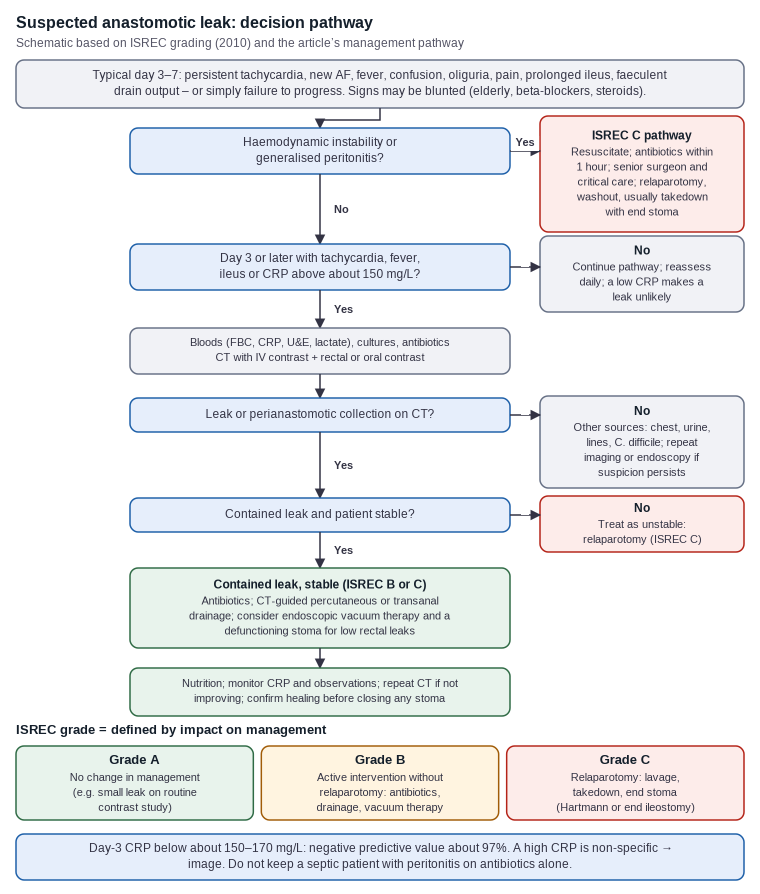
An anastomotic leak is a defect in the wall of a surgical join between two hollow viscera that lets luminal contents escape, causing a local collection, peritonitis, fistula or sepsis. It is the most feared complication of gastrointestinal surgery: after colonic resection it occurs in about 2–8% of patients, after low anterior resection for rectal cancer in about 10–15%, and after oesophagectomy in roughly one in ten or more. Leaks usually declare themselves between days 3 and 7 with tachycardia, fever, pain, ileus, new arrhythmia, confusion or simply failure to progress; CRP that remains high on day 3–5 is a useful warning, whereas a low CRP makes a leak unlikely. Contrast-enhanced CT, with luminal contrast where helpful, confirms the diagnosis. The International Study Group of Rectal Cancer grades leaks by their management: A needs no change, B needs active non-operative treatment such as antibiotics and drainage, and C needs re-operation. Prevention depends on patient optimisation, a tension-free, well-perfused anastomosis and, for low rectal joins, a defunctioning stoma.
Patient case, mechanism, investigations, management, flashcards and exam-style questions.Open the lesson →
Key facts
- Typical presentation day 3–7; may occur earlier (technical failure) or later (ischaemic or after stoma closure)
- Incidence: about 2–8% after colonic resection, about 10–15% after low anterior resection, about 10–20% after oesophagectomy
- ISREC grading (rectal): A no change in management; B active treatment without relaparotomy; C relaparotomy
- Risk factors: male sex, obesity, smoking, malnutrition, steroids, preoperative radiotherapy, low anastomosis, emergency surgery, blood loss and contamination
- CRP on day 3 below about 150–170 mg/L has a negative predictive value around 97%; a high CRP is non-specific and needs imaging
- CT with IV contrast (plus rectal or oral contrast as appropriate) is the key test; look for extraluminal gas, contrast, collection or free fluid
- Septic patient with diffuse peritonitis: resuscitation, antibiotics and relaparotomy, usually with takedown of the anastomosis and an end stoma
- A defunctioning loop ileostomy does not prevent leaks after low anterior resection but reduces their severity and re-operation rate
Differential diagnosis
| Condition | Clues | Key test |
|---|---|---|
| Prolonged postoperative ileus | Distension and vomiting without fever, tachycardia or peritonism; CRP falling | Clinical; electrolytes; CT if not settling |
| Intra-abdominal abscess without leak | Fever and localised pain, often later (day 5–10) | CT with IV contrast |
| Postoperative haemorrhage | Early tachycardia and hypotension with falling haemoglobin | Haemoglobin; CT angiography |
| Hospital-acquired pneumonia | Fever, cough, hypoxia, chest signs; abdomen soft | Chest radiograph, sputum culture |
| Pulmonary embolism | Sudden dyspnoea, tachycardia, hypoxia; no abdominal signs | CT pulmonary angiography |
| C. difficile colitis | Diarrhoea, fever, leucocytosis after antibiotics | Stool toxin testing; CT shows colitis |
| Urinary tract or line infection | Dysuria or line-site erythema with fever | Urine culture, blood cultures from line and periphery |
Exam pearls
Guideline
ISREC definition and grading of anastomotic leakage (2010), ERAS Society colorectal guidelines (2025) and ISDE consensus on anastomotic leak after oesophagectomy (2026)
References
- Rahbari NN, Weitz J, Hohenberger W, et al.. Definition and grading of anastomotic leakage following anterior resection of the rectum: a proposal by the International Study Group of Rectal Cancer. Surgery 2010.
- Gustafsson UO, Rockall TA, Wexner S, et al.. Guidelines for perioperative care in elective colorectal surgery: Enhanced Recovery After Surgery (ERAS) Society recommendations 2025. Surgery 2025.
- Singh PP, Zeng IS, Srinivasa S, Lemanu DP, Connolly AB, Hill AG.. Systematic review and meta-analysis of use of serum C-reactive protein levels to predict anastomotic leak after colorectal surgery. Br J Surg 2014.
- Jayne D, Croft J, Corrigan N, et al.. Intraoperative fluorescence angiography with indocyanine green to prevent anastomotic leak in rectal cancer surgery (IntAct): an unblinded randomised controlled trial. Lancet Gastroenterol Hepatol 2025.
- Stuart SK, Lemmens JMG, Nieuwenhuijzen GAP, et al.. International Society for Diseases of the Esophagus consensus on the diagnosis and treatment of anastomotic leak after esophagectomy. Dis Esophagus 2026.
- Dindo D, Demartines N, Clavien PA.. Classification of surgical complications: a new proposal with evaluation in a cohort of 6336 patients and results of a survey. Ann Surg 2004.
Related topics
By Dr Khalid Seidi (B.Sc., M.D.) · MedEd World Clinical Knowledge library. Original teaching content checked against current guidelines (November 2026); confirm the latest local guidance before clinical use. Not a substitute for clinical judgement.