Clinical Knowledge › Surgery › Basics of surgery
Enhanced recovery after surgery (ERAS)
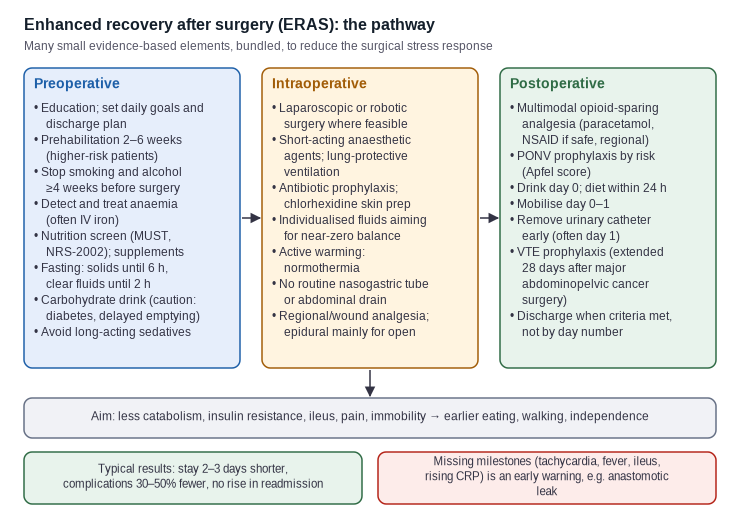
Enhanced recovery after surgery (ERAS) is a multidisciplinary, evidence-based pathway that bundles many small perioperative interventions to reduce the surgical stress response, keep physiology close to normal and help patients return to eating, walking and independence sooner. Developed in colorectal surgery and now applied in most specialties, it spans the whole journey: preoperative education, prehabilitation, smoking and alcohol cessation, anaemia and nutrition optimisation, short fasting with carbohydrate loading; intraoperative minimally invasive surgery, short-acting anaesthesia, balanced fluids, normothermia and avoidance of routine tubes and drains; and postoperative multimodal opioid-sparing analgesia, prophylaxis against nausea, early oral intake, early mobilisation and early catheter removal. Well-implemented pathways shorten hospital stay by about 2–3 days and reduce complications by roughly 30–50% without increasing readmission. Benefit depends on adherence, so audit is part of the pathway. The ERAS Society colorectal recommendations were updated in 2025, and NICE NG180 (2020) supports structured perioperative care.
Patient case, mechanism, investigations, management, flashcards and exam-style questions.Open the lesson →
Key facts
- ERAS aims to reduce the surgical stress response (catabolism, insulin resistance, ileus, pain, immobility) by combining 15–25 evidence-based elements
- Fasting: solids until 6 hours and clear fluids until 2 hours before anaesthesia; preoperative carbohydrate drinks reduce insulin resistance and thirst
- Prefer minimally invasive surgery; avoid routine nasogastric tubes and abdominal drains; remove urinary catheters early (often day 1)
- Aim for near-zero fluid balance: avoid both overload (oedema, ileus) and excessive restriction (acute kidney injury, as in the RELIEF trial)
- Multimodal opioid-sparing analgesia: regular paracetamol, NSAID if safe, regional or wound techniques; thoracic epidural mainly for open surgery
- Start oral intake and mobilisation on the day of surgery or day 1; give PONV prophylaxis according to risk
- Typical results: stay 2–3 days shorter and complications 30–50% fewer, especially when adherence is high
- Failure to progress on an ERAS pathway is an early warning sign of a complication such as anastomotic leak
Differential diagnosis
| Condition | Clues | Key test |
|---|---|---|
| Postoperative ileus | Nausea, vomiting, distension and no flatus after day 3–4 | Clinical; electrolytes; CT if prolonged to exclude obstruction or leak |
| Anastomotic leak | Tachycardia, fever, rising CRP, pain and failure to progress from day 3–7 | CRP trend; CT with IV and luminal contrast |
| Intra-abdominal collection or SSI | Fever, localised pain or wound erythema | Wound inspection; CT abdomen |
| Uncontrolled pain | Unable to mobilise or cough; high opioid needs | Pain scores; review analgesic plan and look for a cause |
| Postoperative nausea and vomiting | Early vomiting without distension, often female non-smokers | Apfel risk factors; rescue antiemetic from a different class |
| Acute kidney injury | Oliguria, rising creatinine after restrictive fluids or NSAIDs | Urine output, creatinine, fluid assessment |
| Delirium | Fluctuating confusion in older patients | 4AT; look for infection, drugs, retention, constipation |
| Urinary retention | Lower abdominal discomfort after catheter removal | Bladder scan |
Exam pearls
Guideline
ERAS Society guidelines for perioperative care in elective colorectal surgery (2025) with NICE NG180 Perioperative care in adults (2020) and ESPEN clinical nutrition in surgery (2021)
References
- Gustafsson UO, Rockall TA, Wexner S, et al.. Guidelines for perioperative care in elective colorectal surgery: Enhanced Recovery After Surgery (ERAS) Society recommendations 2025. Surgery 2025.
- Gustafsson UO, Scott MJ, Hubner M, et al.. Guidelines for perioperative care in elective colorectal surgery: Enhanced Recovery After Surgery (ERAS) Society recommendations: 2018. World J Surg 2019.
- Ljungqvist O, Scott M, Fearon KC.. Enhanced recovery after surgery: a review. JAMA Surg 2017.
- National Institute for Health and Care Excellence (NICE). Perioperative care in adults (NICE guideline NG180). London: NICE 2020.
- Weimann A, Braga M, Carli F, et al.. ESPEN practical guideline: clinical nutrition in surgery. Clin Nutr 2021.
- Allegranzi B, Zayed B, Bischoff P, et al.. New WHO recommendations on intraoperative and postoperative measures for surgical site infection prevention: an evidence-based global perspective. Lancet Infect Dis 2016.
Related topics
By Dr Khalid Seidi (B.Sc., M.D.) · MedEd World Clinical Knowledge library. Original teaching content checked against current guidelines (November 2026); confirm the latest local guidance before clinical use. Not a substitute for clinical judgement.