Clinical Knowledge › Surgery › Basics of surgery
Stomas and stoma complications
A stoma is a surgically created opening of a hollow viscus on the skin. Intestinal stomas are ileostomies (spouted, usually in the right iliac fossa, liquid and enzyme-rich output) and colostomies (flush, usually in the left iliac fossa, formed stool); a urostomy (ileal conduit) drains urine. Stomas are end (permanent or temporary, as in a Hartmann procedure) or loop (usually temporary, to defunction a distal anastomosis). Good outcomes start before surgery: counselling and site marking by a stoma nurse on a flat area within the rectus sheath, away from creases, scars and the belt line. Early complications include ischaemia, retraction, mucocutaneous separation, peristomal skin damage and high output (above about 1.5–2 L/day), which is the commonest cause of readmission after ileostomy and causes dehydration, sodium and magnesium depletion and acute kidney injury. Late problems are parastomal hernia, prolapse, stenosis, pyoderma gangrenosum and varices. Juniors must spot a dusky stoma, treat high output early and know when reversal is safe.
Patient case, mechanism, investigations, management, flashcards and exam-style questions.Open the lesson →
Key facts
- Ileostomy: right iliac fossa, spouted 2–3 cm, liquid output 0.5–1 L/day once adapted; colostomy: usually left iliac fossa, flush, formed stool
- End stoma = one opening (e.g. Hartmann procedure, panproctocolectomy); loop stoma = two lumens, usually a temporary defunctioning stoma protecting a distal anastomosis
- Preoperative counselling and site marking by a stoma nurse reduce leakage, skin problems and poor adjustment (ASCRS 2022)
- High-output stoma: above about 1.5–2 L/day; dehydration after a new ileostomy is the leading cause of readmission
- Treat high output by restricting hypotonic fluids to about 1 L/day, giving glucose–saline oral rehydration solution, loperamide before meals and correcting magnesium
- Peristomal skin irritation from leakage is the commonest complication overall; parastomal hernia is the commonest late complication (end colostomy highest risk)
- A dark, dusky stoma early after surgery needs urgent assessment of how deep the ischaemia extends: necrosis below the fascia means re-operation
- Peristomal pyoderma gangrenosum (painful ulcers with violaceous undermined edges) occurs mainly in inflammatory bowel disease; do not debride it
Differential diagnosis
| Condition | Clues | Key test |
|---|---|---|
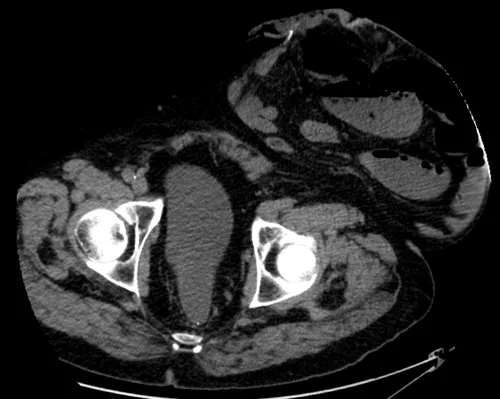
| Parastomal hernia | Bulge around the stoma that enlarges on coughing; leakage, appliance problems | Clinical examination standing and coughing; CT if uncertain |
| Stomal prolapse | Bowel telescopes out through the stoma, often a loop transverse colostomy | Clinical; check viability and reducibility |
| Stomal ischaemia or necrosis | Dusky, dark or black mucosa in the first days after surgery | Test tube and torch inserted into the lumen to judge depth; urgent surgical review |
| Stomal retraction | Stoma lies at or below skin level, leakage under the flange | Clinical; convex appliance or revision |
| Stomal stenosis | Narrowed opening, thin pencil stools, colicky pain, obstruction | Digital examination; contrast study or endoscopy |
| Peristomal pyoderma gangrenosum | Very painful ulcer with violaceous undermined edge in a patient with IBD | Clinical diagnosis of exclusion; swab and biopsy edge if atypical |
| Irritant contact dermatitis | Red, moist, sore skin matching the area of leakage | Review appliance fit and aperture size with stoma nurse |
| Peristomal candidiasis | Itchy red rash with satellite papules under the flange | Clinical; skin scraping if uncertain |
Exam pearls
Guideline
ASCRS Clinical Practice Guidelines for Ostomy Surgery (2022); European Hernia Society parastomal hernia guidelines (2018) and EHS–ESCP–EAES rapid guideline on parastomal hernia prevention (2023)
References
- Davis BR, Valente MA, Goldberg JE, et al.. The American Society of Colon and Rectal Surgeons Clinical Practice Guidelines for Ostomy Surgery. Dis Colon Rectum 2022.
- Antoniou SA, Agresta F, Garcia Alamino JM, et al.. European Hernia Society guidelines on prevention and treatment of parastomal hernias. Hernia 2018.
- Stabilini C, Muysoms FE, Tzanis AA, et al.. EHS Rapid Guideline: Evidence-Informed European Recommendations on Parastomal Hernia Prevention-With ESCP and EAES Participation. J Abdom Wall Surg 2023.
- Odensten C, Strigård K, Rutegård J, et al.. Use of Prophylactic Mesh When Creating a Colostomy Does Not Prevent Parastomal Hernia: A Randomized Controlled Trial-STOMAMESH. Ann Surg 2019.
- Ringblom C, Odensten C, Strigård K, et al.. No Reduction in Parastomal Hernia Rate 3 Years After Stoma Construction With Prophylactic Mesh: Three-year Follow-up Results From STOMAMESH-A Multicenter Double-blind Randomized Controlled Trial. Ann Surg 2023.
- Pironi L, et al.. ESPEN guidelines on chronic intestinal failure in adults – update 2023. Clin Nutr 2023.
Related topics
By Dr Khalid Seidi (B.Sc., M.D.) · MedEd World Clinical Knowledge library. Original teaching content checked against current guidelines (November 2026); confirm the latest local guidance before clinical use. Not a substitute for clinical judgement.