Clinical Knowledge › Surgery › Basics of surgery
Principles of laparoscopic and day-case surgery
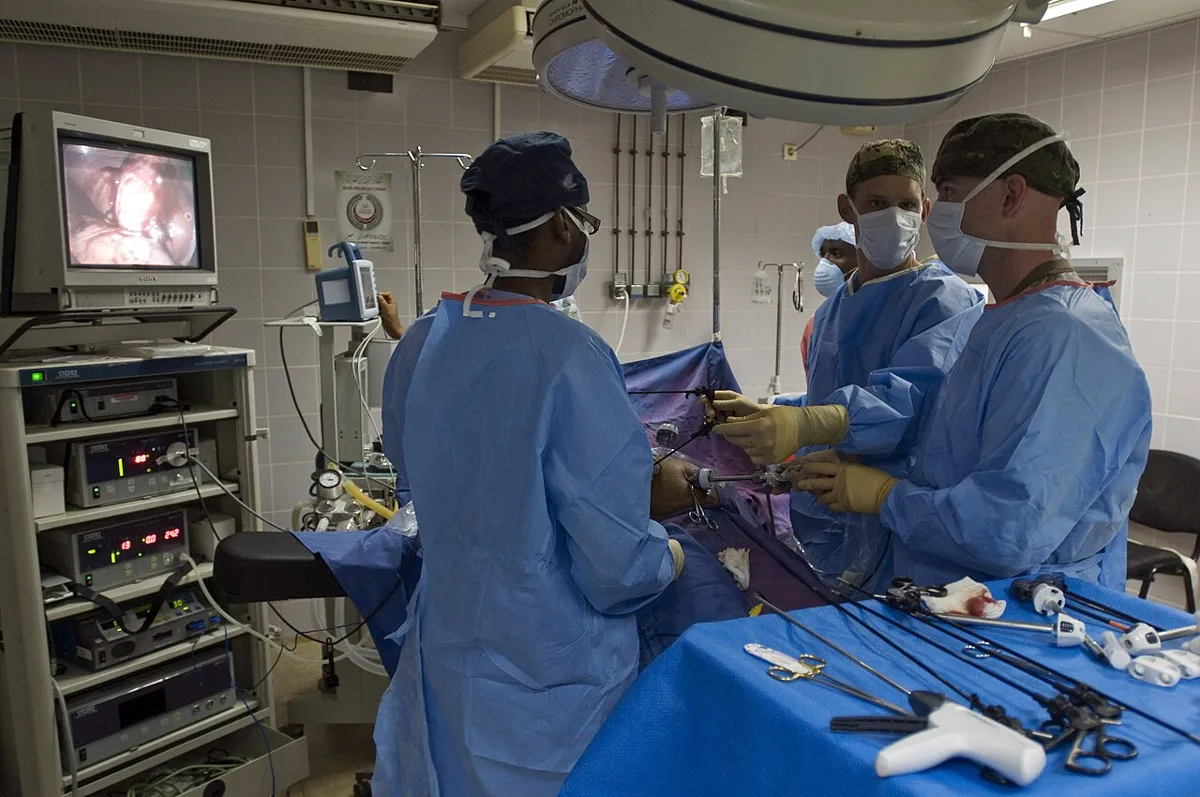
Laparoscopic (minimally invasive) surgery operates through small ports after insufflating the peritoneal cavity with carbon dioxide, usually at 12–15 mmHg. Compared with open surgery it reduces pain, wound infection, ileus, incisional hernia and length of stay, allowing many operations as day cases (same-day admission and discharge). The pneumoperitoneum raises intra-abdominal pressure, reduces venous return and functional residual capacity and causes hypercapnia, so severe cardiopulmonary disease and haemodynamic instability limit its use. Most serious injuries happen at port entry (bowel and major vessels); thermal bowel injury may present late with worsening pain, tachycardia and sepsis. Shoulder-tip pain from residual gas is common and benign. Day-case selection is based on physiological fitness, procedure and social support rather than fixed limits of age, BMI or ASA grade; success depends on short-acting anaesthesia, multimodal opioid-sparing analgesia, nausea prophylaxis, criteria-led discharge, a responsible adult at home and a clear route back if complications arise.
Patient case, mechanism, investigations, management, flashcards and exam-style questions.Open the lesson →
Key facts
- CO2 pneumoperitoneum is usually set at 12–15 mmHg; CO2 is used because it is non-flammable and highly soluble (lower embolism risk)
- Pneumoperitoneum effects: ↓venous return and cardiac output at high pressure, ↑systemic vascular resistance, ↓FRC and compliance, hypercapnia and acidosis, vagal bradycardia on insufflation
- Most major vascular and bowel injuries in laparoscopy occur during access (Veress needle or first trocar)
- Pain that worsens rather than improves 24–72 h after laparoscopy suggests an unrecognised bowel injury or bile leak
- Fascial defects of 10 mm or more should be closed to prevent port-site (often Richter) hernia
- Day-case suitability depends on physiology, procedure and social circumstances, not arbitrary limits of age, BMI or ASA grade (Association of Anaesthetists/BADS 2019)
- Discharge requires stable vital signs, controlled pain and nausea, minimal bleeding, mobilisation, written advice and a responsible adult escort
- Laparoscopy is safe in any trimester of pregnancy; SAGES 2024 favours laparoscopic appendicectomy and cholecystectomy (left lateral tilt, about 10–15 mmHg, fetal heart checks before and after)
Differential diagnosis
| Condition | Clues | Key test |
|---|---|---|
| Shoulder-tip pain from residual CO2 | Bilateral shoulder ache within 24–48 h; patient otherwise improving | Clinical; settles with mobilisation and simple analgesia |
| Unrecognised bowel injury | Worsening abdominal pain, tachycardia, fever, ileus 1–5 days after surgery | CT abdomen with contrast; low threshold for relaparoscopy |
| Bile leak after cholecystectomy | Right upper quadrant pain, fever, mild jaundice, bile in drain | Ultrasound or CT for collection; MRCP or ERCP |
| Port-site bleeding (inferior epigastric artery) | Expanding abdominal wall haematoma, falling haemoglobin | Clinical, ultrasound or CT |
| Port-site hernia | Lump or small bowel obstruction at a 10–12 mm port site | CT abdomen |
| Subcutaneous emphysema or capnothorax | Crepitus, rising end-tidal CO2, falling saturation intraoperatively | Clinical; chest X-ray for pneumothorax |
| Postoperative urinary retention | Suprapubic discomfort, unable to void after hernia repair or spinal anaesthesia | Bladder scan |
Exam pearls
Guideline
Association of Anaesthetists and British Association of Day Surgery Guidelines for day-case surgery (2019); SAGES guidelines for the use of laparoscopy during pregnancy (2024); EAES clinical practice guideline on the pneumoperitoneum (2002)
References
- Bailey CR, Ahuja M, Bartholomew K, et al.. Guidelines for day-case surgery 2019: Guidelines from the Association of Anaesthetists and the British Association of Day Surgery. Anaesthesia 2019.
- Kumar SS, Collings AT, Wunker C, et al.. SAGES guidelines for the use of laparoscopy during pregnancy. Surg Endosc 2024.
- Neudecker J, Sauerland S, Neugebauer E, et al.. The European Association for Endoscopic Surgery clinical practice guideline on the pneumoperitoneum for laparoscopic surgery. Surg Endosc 2002.
- Joshi GP, Ankichetty SP, Gan TJ, Chung F.. Society for Ambulatory Anesthesia consensus statement on preoperative selection of adult patients with obstructive sleep apnea scheduled for ambulatory surgery. Anesth Analg 2012.
- Jaschinski T, Mosch CG, Eikermann M, Neugebauer EA, Sauerland S.. Laparoscopic versus open surgery for suspected appendicitis. Cochrane Database Syst Rev 2018.
- HerniaSurge Group.. International guidelines for groin hernia management. Hernia 2018.
Related topics
By Dr Khalid Seidi (B.Sc., M.D.) · MedEd World Clinical Knowledge library. Original teaching content checked against current guidelines (November 2026); confirm the latest local guidance before clinical use. Not a substitute for clinical judgement.