Clinical Knowledge › Internal medicine › Rheumatology and immunology › Relevant pharmacology
Antihistamines and adrenaline auto-injectors
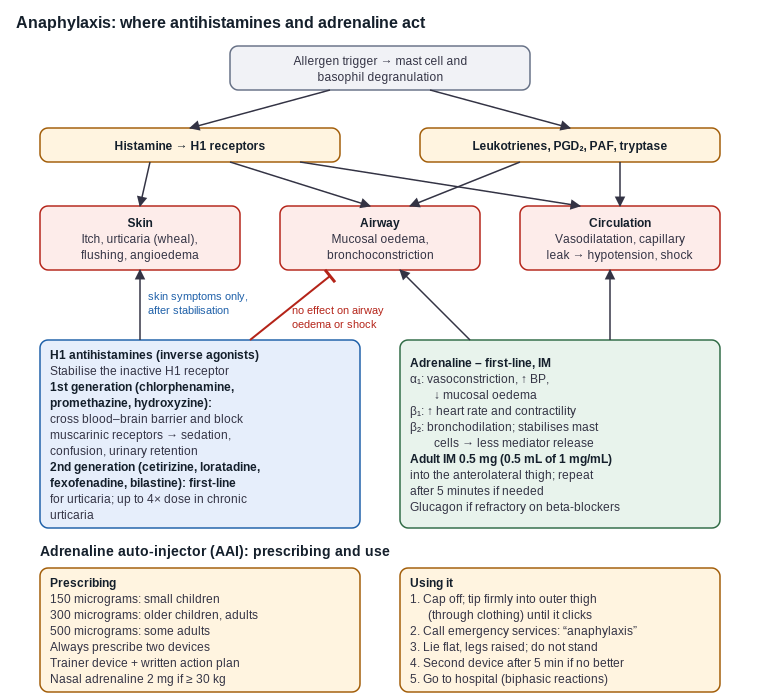
H1 antihistamines are inverse agonists that stabilise the inactive H1 receptor and so reduce itch, wheal, sneezing and rhinorrhoea. First-generation drugs such as chlorphenamine, promethazine and hydroxyzine cross the blood–brain barrier and block muscarinic receptors, causing sedation, impaired driving, confusion in older adults and urinary retention. Second-generation drugs (cetirizine, levocetirizine, loratadine, desloratadine, fexofenadine, bilastine) are preferred for urticaria and allergic rhinitis, up to four times the standard dose in chronic urticaria. Antihistamines do not treat airway obstruction or shock and are not first-line for anaphylaxis. Adrenaline is, through alpha-1 vasoconstriction, beta-1 inotropy, beta-2 bronchodilation and mast cell stabilisation. Adrenaline auto-injectors deliver a fixed intramuscular dose (150, 300 or 500 micrograms) into the anterolateral thigh. Patients at risk should carry two devices, be trained, use them early, lie down and call for help, and give a second dose after 5 minutes if needed. Needle-free nasal adrenaline 2 mg (for people weighing 30 kg or more) was approved in the US and EU in 2024 and in the UK in 2025.
Patient case, mechanism, investigations, management, flashcards and exam-style questions.Open the lesson →
Key facts
- H1 antihistamines are inverse agonists; first-generation agents also block muscarinic, alpha-adrenergic and serotonin receptors
- First-generation antihistamines cause sedation, psychomotor impairment, anticholinergic effects and paradoxical excitation in children; avoid routine use, especially in older adults
- Second-generation agents are first-line for urticaria and allergic rhinitis; up-dosing to four times the licensed dose is recommended in chronic urticaria
- Terfenadine and astemizole were withdrawn for QT prolongation and torsades with CYP3A4 inhibitors; fexofenadine is terfenadine's safe active metabolite
- Antihistamines are NOT first-line in anaphylaxis; they treat skin symptoms only after the patient is stabilised with adrenaline
- Adrenaline acts on alpha-1 (vasoconstriction, less oedema), beta-1 (inotropy) and beta-2 (bronchodilation, reduced mediator release) receptors
- Auto-injector doses: 150 micrograms for small children, 300 micrograms for older children and adults, 500 micrograms for some adults; IM into anterolateral thigh
- Always prescribe two auto-injectors, train with a trainer device, give a written action plan and advise lying down with legs raised after use
Differential diagnosis
| Condition | Clues | Key test |
|---|---|---|
| Intranasal corticosteroid | More effective than oral antihistamines for moderate–severe allergic rhinitis, especially nasal blockage | Symptom score, nasal examination |
| Leukotriene receptor antagonist (montelukast) | Adjunct in rhinitis with asthma or refractory urticaria; neuropsychiatric warnings | Clinical response |
| Omalizumab | Anti-IgE for chronic spontaneous urticaria not controlled on 4× antihistamine | Urticaria activity score (UAS7) |
| H2 antagonist (famotidine) | Adjunct for flushing, urticaria and GI symptoms in mastocytosis | Symptom response |
| Sodium cromoglicate | Mast cell stabiliser: eye drops, nasal spray, oral in mastocytosis | Symptom response |
| Glucagon | For anaphylaxis refractory to adrenaline in patients on beta-blockers | Persistent hypotension despite adrenaline |
| Icatibant or C1-inhibitor | Bradykinin-mediated angioedema does not respond to antihistamines or adrenaline | C4, C1-inhibitor level and function; ACE inhibitor history |
Exam pearls
Guideline
Resuscitation Council UK emergency treatment of anaphylaxis (2021), EAACI anaphylaxis guideline (2021 update) and international EAACI/GA²LEN/EuroGuiDerm/APAAACI urticaria guideline (2021)
References
- Resuscitation Council UK. Emergency treatment of anaphylaxis: guidelines for healthcare providers. Resuscitation Council UK 2021.
- Muraro A, Worm M, Alviani C, et al.. EAACI guidelines: anaphylaxis (2021 update). Allergy 2022.
- Zuberbier T, Abdul Latiff AH, Abuzakouk M, et al.. The international EAACI/GA²LEN/EuroGuiDerm/APAAACI guideline for the definition, classification, diagnosis, and management of urticaria. Allergy 2022.
- Cardona V, Ansotegui IJ, Ebisawa M, et al.. World Allergy Organization anaphylaxis guidance 2020. World Allergy Organ J 2020.
- Church MK, Maurer M, Simons FE, et al.. Risk of first-generation H1-antihistamines: a GA²LEN position paper. Allergy 2010.
- Medicines and Healthcare products Regulatory Agency (MHRA). MHRA approves adrenaline nasal spray – the first needle-free emergency treatment for anaphylaxis in the UK. GOV.UK 2025.
Related topics
By Dr Khalid Seidi (B.Sc., M.D.) · MedEd World Clinical Knowledge library. Original teaching content checked against current guidelines (November 2026); confirm the latest local guidance before clinical use. Not a substitute for clinical judgement.