Clinical Knowledge › Internal medicine › Rheumatology and immunology › Relevant pharmacology
Sulfasalazine, leflunomide and hydroxychloroquine
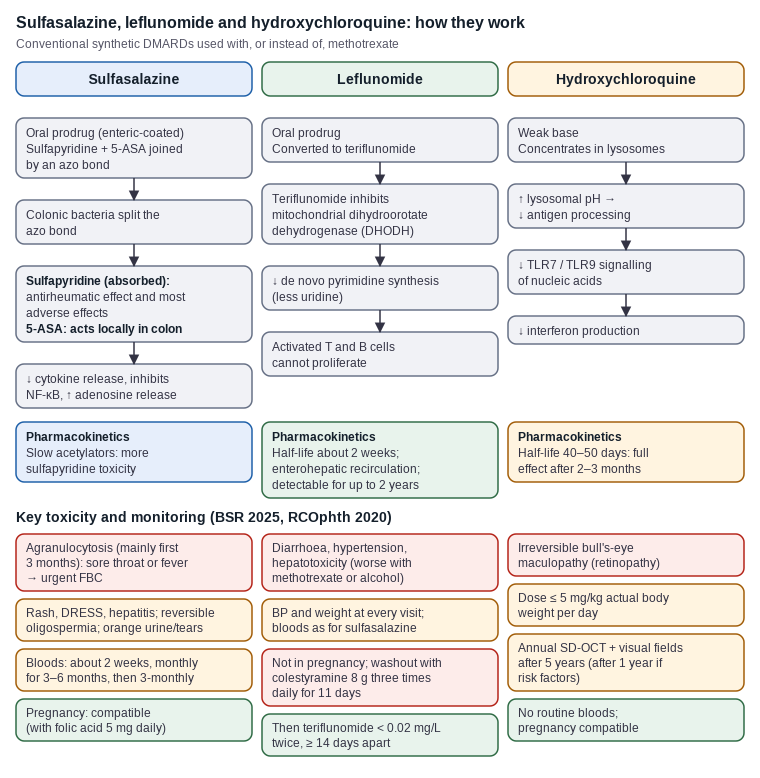
Sulfasalazine, leflunomide and hydroxychloroquine are the other conventional synthetic DMARDs used alongside or instead of methotrexate. Sulfasalazine is cleaved by colonic bacteria into sulfapyridine, which drives its antirheumatic effect and most side effects, and 5-aminosalicylic acid, which acts in the colon; it is compatible with pregnancy but can cause agranulocytosis, rash and reversible oligospermia. Leflunomide is converted to teriflunomide, which inhibits dihydroorotate dehydrogenase and starves activated lymphocytes of pyrimidines; it is as effective as methotrexate in RA but causes diarrhoea, hypertension and hepatotoxicity, and its very long half-life means a colestyramine washout is needed before pregnancy. Hydroxychloroquine raises lysosomal pH and dampens Toll-like receptor signalling; it is the backbone of lupus treatment and a mild DMARD in RA. Its key toxicity is irreversible retinopathy, so the dose is kept at or below 5 mg/kg actual body weight daily and annual retinal screening starts after 5 years.
Patient case, mechanism, investigations, management, flashcards and exam-style questions.Open the lesson →
Key facts
- Sulfasalazine = sulfapyridine + 5-ASA linked by an azo bond split by colonic bacteria; sulfapyridine causes most adverse effects
- Sulfasalazine teaching dose: 500 mg daily, increase weekly to 1 g twice daily (max 3 g/day); orange urine and tears are harmless
- Leflunomide → teriflunomide inhibits dihydroorotate dehydrogenase (DHODH), blocking de novo pyrimidine synthesis in activated T cells
- Leflunomide stays in the body up to 2 years; washout with colestyramine 8 g three times daily for 11 days before pregnancy or for toxicity
- Leflunomide: monitor blood pressure and weight as well as FBC and liver tests
- Hydroxychloroquine is recommended for all patients with SLE unless contraindicated, at a dose not above 5 mg/kg actual body weight per day
- HCQ retinopathy (bull's-eye maculopathy) is irreversible; RCOphth 2020 advises annual SD-OCT and visual field screening after 5 years (after 1 year if risk factors)
- Pregnancy: sulfasalazine and hydroxychloroquine are compatible; leflunomide is not
Differential diagnosis
| Condition | Clues | Key test |
|---|---|---|
| Sulfasalazine agranulocytosis | Sore throat, fever, mouth ulcers in first 3 months | Urgent FBC |
| Sulfasalazine DRESS | Rash, fever, eosinophilia, hepatitis 2–8 weeks after start | FBC with eosinophils, LFT, renal function |
| Leflunomide-induced hypertension | New BP rise after starting | Repeated BP measurement |
| Leflunomide hepatotoxicity | ALT rise, especially with methotrexate or alcohol | LFT; stop and wash out if severe |
| Hydroxychloroquine retinopathy | Paracentral scotoma, often asymptomatic early | SD-OCT, automated visual fields, fundus autofluorescence |
| Age-related macular degeneration | Central visual loss with drusen in older adults | Fundoscopy and OCT |
| Hydroxychloroquine cardiomyopathy | Heart failure, conduction block after long use | ECG, echo, cardiac MRI, endomyocardial biopsy |
Exam pearls
Guideline
BSR 2025 csDMARD guideline, RCOphth 2020 hydroxychloroquine monitoring and EULAR 2023 SLE recommendations
References
- British Society for Rheumatology. BSR guideline for the prescription and monitoring of conventional synthetic disease-modifying anti-rheumatic drugs (csDMARDs) 2025. Rheumatology (Oxford) 2025.
- Smolen JS, Edwards CJ, Konzett V, et al.. EULAR recommendations for the management of rheumatoid arthritis with synthetic and biologic disease-modifying antirheumatic drugs: 2025 update. Ann Rheum Dis 2026.
- Fraenkel L, Bathon JM, England BR, et al.. 2021 American College of Rheumatology Guideline for the Treatment of Rheumatoid Arthritis. Arthritis Care Res (Hoboken) 2021.
- Yusuf IH, Foot B, Lotery AJ.. The Royal College of Ophthalmologists recommendations on monitoring for hydroxychloroquine and chloroquine users in the United Kingdom (2020 revision): executive summary. Eye (Lond) 2021.
- Melles RB, Marmor MF.. The risk of toxic retinopathy in patients on long-term hydroxychloroquine therapy. JAMA Ophthalmol 2014.
- Marmor MF, Kellner U, Lai TY, Melles RB, Mieler WF.. Recommendations on screening for chloroquine and hydroxychloroquine retinopathy (2016 revision). Ophthalmology 2016.
Related topics
By Dr Khalid Seidi (B.Sc., M.D.) · MedEd World Clinical Knowledge library. Original teaching content checked against current guidelines (November 2026); confirm the latest local guidance before clinical use. Not a substitute for clinical judgement.