Clinical Knowledge › Internal medicine › Pulmonology › Obstructive lung diseases
Asthma
Asthma is a chronic, heterogeneous airway disease defined by variable respiratory symptoms (wheeze, breathlessness, chest tightness and cough) together with variable expiratory airflow limitation. It affects about 260 million people worldwide and causes over 400,000 deaths a year, most of them preventable. Most patients have type 2 inflammation driven by IL-4, IL-5 and IL-13, with eosinophils, IgE and mast cells, leading to airway hyper-responsiveness, mucus plugging and, over time, remodelling. Diagnosis needs objective evidence: bronchodilator reversibility, peak flow variability, raised FeNO or blood eosinophils, or a positive bronchial challenge. Current GINA and BTS/NICE/SIGN guidance has moved away from short-acting beta-agonist (SABA) monotherapy: for adults and adolescents, as-needed low-dose budesonide–formoterol, or maintenance-and-reliever therapy with the same inhaler, is preferred because it cuts severe exacerbations. Severe asthma is phenotyped and treated with biologics, and every patient needs a written action plan and inhaler technique checks.
Patient case, mechanism, investigations, management, flashcards and exam-style questions.Open the lesson →
Key facts
- Asthma = variable symptoms plus variable expiratory airflow limitation; confirm objectively before or soon after starting treatment
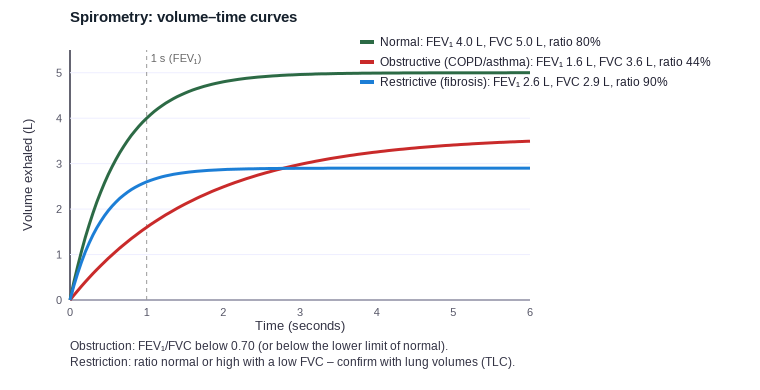
- Bronchodilator responsiveness: FEV1 increase of at least 12% and 200 mL from baseline (GINA 2026 kept this criterion)
- BTS/NICE/SIGN 2024: in adults, FeNO of 50 ppb or more, or raised blood eosinophils, supports the diagnosis; otherwise spirometry with reversibility, peak flow variability or bronchial challenge
- SABA-only treatment is no longer recommended for adults, adolescents or (since GINA 2026) children aged 6–11
- GINA Track 1 (preferred): as-needed low-dose ICS–formoterol at steps 1–2, maintenance-and-reliever therapy (MART) at steps 3–5
- Life-threatening asthma: PEF below 33%, SpO2 below 92%, normal PaCO2, silent chest, cyanosis, exhaustion, arrhythmia or confusion
- Severe asthma biologics target IgE, IL-5/IL-5R, IL-4Rα or TSLP; choice depends on eosinophils, FeNO, IgE and comorbidities
- Never use a LABA without an ICS in asthma: LABA monotherapy increases asthma deaths
Differential diagnosis
| Condition | Clues | Key test |
|---|---|---|
| COPD | Smoker over 35–40, persistent rather than variable airflow limitation, productive cough | Post-bronchodilator FEV1/FVC below LLN with little reversibility; DLCO often low |
| Inducible laryngeal obstruction (vocal cord dysfunction) | Inspiratory noise, throat tightness, sudden onset and offset, poor response to inhalers | Laryngoscopy during symptoms; flattened inspiratory flow–volume loop |
| Heart failure ('cardiac asthma') | Orthopnoea, oedema, crackles, older patient | NT-proBNP, echocardiography |
| Bronchiectasis | Daily purulent sputum, recurrent infections, crackles | High-resolution CT |
| Eosinophilic granulomatosis with polyangiitis | Late-onset severe asthma, sinusitis, very high eosinophils, neuropathy, rash | Eosinophil count, ANCA, biopsy |
| Allergic bronchopulmonary aspergillosis | Poorly controlled asthma, brown mucus plugs, fleeting infiltrates | Total IgE above 1000 IU/mL, Aspergillus-specific IgE, central bronchiectasis on CT |
| Inhaled foreign body (children) | Sudden onset after choking, unilateral wheeze | Chest X-ray (inspiratory and expiratory), bronchoscopy |
| Dysfunctional breathing | Air hunger, sighing, tingling, normal lung function | Normal spirometry and FeNO; Nijmegen questionnaire |
Exam pearls
Guideline
GINA Global Strategy for Asthma Management and Prevention (2026) and BTS/NICE/SIGN asthma guideline NG245 (2024)
References
- Global Initiative for Asthma (GINA). Global Strategy for Asthma Management and Prevention (2026 update). 2026.
- National Institute for Health and Care Excellence (NICE), British Thoracic Society and Scottish Intercollegiate Guidelines Network. Asthma: diagnosis, monitoring and chronic asthma management (BTS, NICE, SIGN) (NICE guideline NG245). 2024.
- Reddel HK, Bacharier LB, Bateman ED, et al.. Global Initiative for Asthma Strategy 2021: Executive Summary and Rationale for Key Changes. Am J Respir Crit Care Med 2022.
- O'Byrne PM, FitzGerald JM, Bateman ED, et al.. Inhaled Combined Budesonide-Formoterol as Needed in Mild Asthma. N Engl J Med 2018.
- Beasley R, Holliday M, Reddel HK, et al.. Controlled Trial of Budesonide-Formoterol as Needed for Mild Asthma. N Engl J Med 2019.
- Papi A, Chipps BE, Beasley R, et al.. Albuterol-Budesonide Fixed-Dose Combination Rescue Inhaler for Asthma. N Engl J Med 2022.
Related topics
By Dr Khalid Seidi (B.Sc., M.D.) · MedEd World Clinical Knowledge library. Original teaching content checked against current guidelines (November 2026); confirm the latest local guidance before clinical use. Not a substitute for clinical judgement.