Clinical Knowledge › Internal medicine › Pulmonology › Obstructive lung diseases
Cystic fibrosis
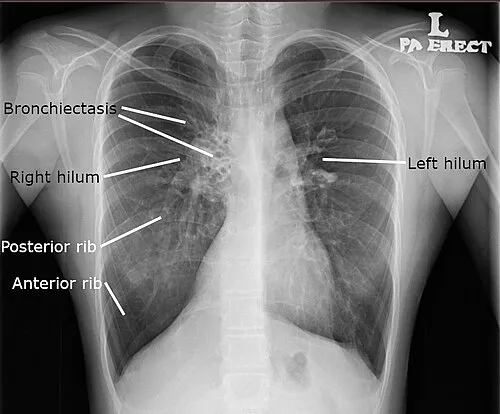
Cystic fibrosis (CF) is an autosomal recessive multisystem disease caused by variants in the CFTR gene, which encodes an epithelial chloride and bicarbonate channel. Defective CFTR dehydrates airway surface liquid and thickens secretions in the lungs, pancreas, intestine, liver, sweat glands and male reproductive tract. Most people are now diagnosed by newborn screening (immunoreactive trypsinogen, then DNA testing) and confirmed by a sweat chloride of 60 mmol/L or more. Untreated, sticky mucus leads to chronic infection with Staphylococcus aureus and later Pseudomonas aeruginosa, bronchiectasis and respiratory failure, while pancreatic insufficiency causes malabsorption, poor growth and later CF-related diabetes. Care is delivered by specialist centres and combines airway clearance, mucolytics, inhaled and systemic antibiotics, pancreatic enzymes, high-energy nutrition and fat-soluble vitamins. CFTR modulators such as elexacaftor–tezacaftor–ivacaftor have transformed outcomes for the large majority with at least one F508del variant, and survival is now well into adulthood.
Patient case, mechanism, investigations, management, flashcards and exam-style questions.Open the lesson →
Key facts
- Autosomal recessive: carrier frequency about 1 in 25 and incidence about 1 in 2,500 births in people of northern European ancestry; F508del is the commonest variant
- Diagnosis: sweat chloride 60 mmol/L or more confirms CF; 30–59 is intermediate (needs genotyping or further tests); below 30 makes CF unlikely
- Newborn screening: raised immunoreactive trypsinogen, then CFTR variant panel, then sweat test
- About 85% have exocrine pancreatic insufficiency: give pancreatic enzyme replacement with meals plus vitamins A, D, E and K
- Typical pathogens: S. aureus and H. influenzae in childhood, then Pseudomonas aeruginosa; Burkholderia cepacia complex and Mycobacterium abscessus carry special risks
- Exacerbations needing IV treatment usually receive two antipseudomonal antibiotics (beta-lactam plus aminoglycoside) for about 14 days
- Elexacaftor–tezacaftor–ivacaftor improves FEV1 by about 14 percentage points and greatly reduces exacerbations in people with one F508del allele
- Annual screening for CF-related diabetes with an oral glucose tolerance test from about age 10; HbA1c is unreliable
Differential diagnosis
| Condition | Clues | Key test |
|---|---|---|
| Primary ciliary dyskinesia | Neonatal respiratory distress, lifelong wet cough, otitis, situs inversus; normal sweat test | Nasal nitric oxide, ciliary studies, genetics |
| Non-CF bronchiectasis from immunodeficiency | Recurrent sinopulmonary infections; no malabsorption | Serum immunoglobulins and vaccine responses |
| Coeliac disease | Steatorrhoea and poor growth, but no lung disease | Tissue transglutaminase IgA, duodenal biopsy |
| Shwachman–Diamond syndrome | Pancreatic insufficiency with neutropenia and skeletal changes | Blood count, SBDS gene testing |
| Severe asthma | Wheeze and recurrent chest symptoms in a child | Normal sweat chloride; spirometry reversibility |
| Protein-losing enteropathy or other malabsorption | Oedema, poor growth | Faecal elastase, albumin, endoscopy |
| Gastro-oesophageal reflux with aspiration | Recurrent pneumonia, feeding problems | pH impedance, swallow study |
Exam pearls
Guideline
ECFS standards of care (2018 best practice and 2023–2024 standards), CF Foundation diagnostic consensus (2017) and NICE NG78 (2017)
References
- Farrell PM, White TB, Ren CL, et al.. Diagnosis of Cystic Fibrosis: Consensus Guidelines from the Cystic Fibrosis Foundation. J Pediatr 2017.
- Castellani C, Simmonds NJ, Barben J, et al.. Standards for the care of people with cystic fibrosis (CF): A timely and accurate diagnosis. J Cyst Fibros 2023.
- Castellani C, Duff AJA, Bell SC, et al.. ECFS best practice guidelines: the 2018 revision. J Cyst Fibros 2018.
- National Institute for Health and Care Excellence (NICE). Cystic fibrosis: diagnosis and management (NICE guideline NG78). 2017.
- Middleton PG, Mall MA, Dřevínek P, et al.; VX17-445-102 Study Group.. Elexacaftor-Tezacaftor-Ivacaftor for Cystic Fibrosis with a Single Phe508del Allele. N Engl J Med 2019.
- Keating C, Yonker LM, Vermeulen F, et al.. Vanzacaftor-tezacaftor-deutivacaftor versus elexacaftor-tezacaftor-ivacaftor in individuals with cystic fibrosis aged 12 years and older (SKYLINE Trials VX20-121-102 and VX20-121-103): results from two randomised, active-controlled, phase 3 trials. Lancet Respir Med 2025.
Related topics
By Dr Khalid Seidi (B.Sc., M.D.) · MedEd World Clinical Knowledge library. Original teaching content checked against current guidelines (November 2026); confirm the latest local guidance before clinical use. Not a substitute for clinical judgement.