Clinical Knowledge › Internal medicine › Pulmonology › Obstructive lung diseases
Bronchiolitis obliterans
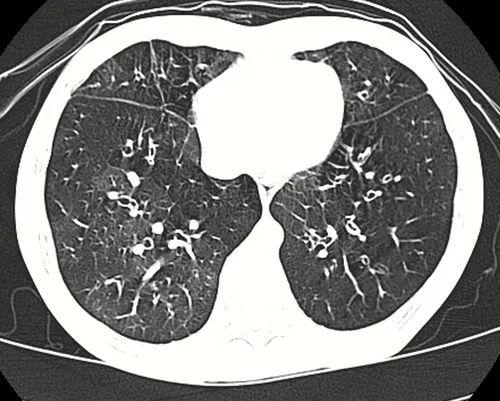
Bronchiolitis obliterans (obliterative or constrictive bronchiolitis) is fibrotic narrowing and eventual obliteration of the small airways, producing fixed airflow obstruction that does not respond to bronchodilators. It is not the same as organising pneumonia (formerly 'BOOP'), which is steroid-responsive and fills the alveoli. Today the commonest settings are chronic lung allograft dysfunction after lung transplantation and chronic graft-versus-host disease after allogeneic haematopoietic stem cell transplantation, where the clinical surrogate is called bronchiolitis obliterans syndrome (BOS). Other causes include severe childhood viral infection (adenovirus), toxic inhalation (diacetyl 'popcorn lung', nitrogen dioxide, sulfur mustard, burn pits), rheumatoid arthritis and drugs. Patients develop insidious breathlessness and dry cough with a normal chest X-ray; spirometry shows new obstruction and expiratory CT shows mosaic attenuation with air trapping. Biopsy is rarely needed. Treatment depends on the cause: optimised immunosuppression, azithromycin, inhaled steroid combinations, extracorporeal photopheresis or JAK and ROCK2 inhibitors in graft-versus-host disease, removal of exposures, pulmonary rehabilitation and, for selected patients, (re)transplantation.
Patient case, mechanism, investigations, management, flashcards and exam-style questions.Open the lesson →
Key facts
- Constrictive bronchiolitis = concentric submucosal fibrosis that narrows or obliterates bronchioles; it causes irreversible obstruction
- Do not confuse with organising pneumonia (formerly BOOP), which is restrictive, alveolar and steroid-responsive
- After lung transplantation, BOS is the commonest form of chronic lung allograft dysfunction (CLAD): a persistent fall in FEV1 of 20% or more from post-transplant baseline
- After allogeneic HSCT, BOS is the only lung manifestation that alone diagnoses chronic GVHD (NIH criteria)
- Chest X-ray is often normal; expiratory HRCT shows mosaic attenuation and air trapping
- Spirometry: new FEV1/FVC below 0.70 (or LLN), FEV1 decline, raised residual volume; no bronchodilator response
- Avoid prophylactic azithromycin after HSCT (ALLOZITHRO: more relapse of haematological cancer), but azithromycin is used to treat or prevent BOS after lung transplantation
- Prognosis is poor once established: about half of lung transplant recipients have CLAD by 5 years
Differential diagnosis
| Condition | Clues | Key test |
|---|---|---|
| Organising pneumonia | Subacute illness with patchy consolidation, restrictive pattern, rapid steroid response | CT consolidation; biopsy showing Masson bodies |
| Asthma | Variable symptoms and reversible obstruction | Bronchodilator response, PEF variability, FeNO |
| COPD | Smoking history, emphysema on CT, gradual decline | Smoking history, CT emphysema |
| Infection after transplantation | Fever, new infiltrates, positive BAL | BAL cultures and PCR |
| Acute rejection after lung transplant | Earlier timing, ground-glass, perivascular lymphocytic infiltrates | Transbronchial biopsy |
| Restrictive allograft syndrome | CLAD with restrictive physiology (TLC decline) and upper-lobe fibrosis | Lung volumes and CT |
| Hypersensitivity pneumonitis | Exposure, mixed obstruction/restriction, centrilobular nodules | CT, exposure history, BAL lymphocytosis |
Exam pearls
Guideline
ERS/EBMT clinical practice guideline on treatment of pulmonary chronic GVHD (2024), ISHLT CLAD consensus (2019), ISHLT/ATS/ERS BOS guideline (2014) and NIH chronic GVHD consensus (2014)
References
- Bos S, et al.. ERS/EBMT clinical practice guidelines on treatment of pulmonary chronic graft-versus-host disease in adults. Eur Respir J 2024.
- Verleden GM, Glanville AR, Lease ED, et al.. Chronic lung allograft dysfunction: definition, diagnostic criteria, and approaches to treatment – a consensus report from the Pulmonary Council of the ISHLT. J Heart Lung Transplant 2019.
- Meyer KC, Raghu G, Verleden GM, et al.. An international ISHLT/ATS/ERS clinical practice guideline: diagnosis and management of bronchiolitis obliterans syndrome. Eur Respir J 2014.
- Jagasia MH, Greinix HT, Arora M, et al.. National Institutes of Health Consensus Development Project on Criteria for Clinical Trials in Chronic Graft-versus-Host Disease: I. The 2014 Diagnosis and Staging Working Group Report. Biol Blood Marrow Transplant 2015.
- Barker AF, Bergeron A, Rom WN, Hertz MI.. Obliterative bronchiolitis. N Engl J Med 2014.
- Bergeron A, Chevret S, Granata A, et al.. Effect of Azithromycin on Airflow Decline-Free Survival After Allogeneic Hematopoietic Stem Cell Transplant: The ALLOZITHRO Randomized Clinical Trial. JAMA 2017.
Related topics
By Dr Khalid Seidi (B.Sc., M.D.) · MedEd World Clinical Knowledge library. Original teaching content checked against current guidelines (November 2026); confirm the latest local guidance before clinical use. Not a substitute for clinical judgement.