Clinical Knowledge › Internal medicine › Pulmonology › Obstructive lung diseases
Bronchiectasis
Bronchiectasis is a chronic lung disease in which bronchi are permanently and abnormally widened, causing daily cough with sputum, recurrent chest infections and exacerbations. It is the end result of a 'vicious vortex' of impaired mucociliary clearance, chronic bacterial infection, neutrophilic inflammation and structural damage. Causes include previous severe infection (tuberculosis, whooping cough, measles), immunodeficiency, allergic bronchopulmonary aspergillosis, primary ciliary dyskinesia, cystic fibrosis, connective tissue disease and COPD, though no cause is found in many adults. Diagnosis is made on high-resolution CT, followed by a standard panel of tests for treatable causes and regular sputum culture. Management rests on airway clearance taught by a physiotherapist, pulmonary rehabilitation, prompt 14-day antibiotics for exacerbations, eradication of new Pseudomonas aeruginosa, and long-term macrolides or inhaled antibiotics for frequent exacerbators. The DPP-1 inhibitor brensocatib is a new anti-inflammatory option in some countries.
Patient case, mechanism, investigations, management, flashcards and exam-style questions.Open the lesson →
Key facts
- Bronchiectasis = clinical syndrome (cough, sputum, exacerbations) plus permanent bronchial dilatation on CT
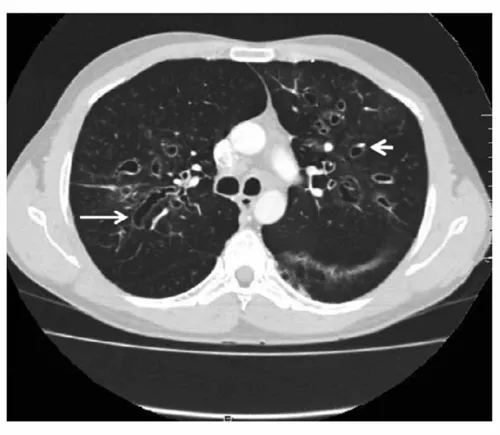
- CT signs: inner airway–artery ratio of 1 or more ('signet ring'), lack of tapering, and airways visible within 1 cm of the pleura
- Test every patient for treatable causes: full blood count, immunoglobulins, total IgE with Aspergillus-specific IgE/IgG, and sputum culture including mycobacteria
- Airway clearance techniques taught by a respiratory physiotherapist are recommended for nearly all patients
- Treat exacerbations with antibiotics guided by previous sputum culture, usually for 14 days
- First isolation of Pseudomonas aeruginosa: offer eradication therapy; chronic Pseudomonas predicts more exacerbations and higher mortality
- Long-term macrolide (e.g. azithromycin) or inhaled antibiotics reduce exacerbations in patients at high risk (classically 3 or more a year)
- Bronchiectasis Severity Index (BSI) combines age, BMI, FEV1, admissions, exacerbations, breathlessness, colonisation and radiological extent
Differential diagnosis
| Condition | Clues | Key test |
|---|---|---|
| COPD | Smoker, breathlessness predominant, less sputum | Spirometry; CT for coexisting bronchiectasis |
| Asthma | Variable wheeze, atopy, little daily purulent sputum | Spirometry with reversibility, FeNO, eosinophils |
| Pulmonary tuberculosis | Night sweats, weight loss, haemoptysis, upper-lobe cavities | Sputum smear, NAAT and culture |
| Cystic fibrosis | Young age, malabsorption, infertility, upper-lobe disease | Sweat chloride and CFTR genotyping |
| Chronic rhinosinusitis with post-nasal drip | Throat clearing, nasal discharge, normal chest CT | CT sinuses; ENT review |
| Lung cancer or endobronchial obstruction | Localised bronchiectasis, haemoptysis, smoker | CT and bronchoscopy |
| Interstitial lung disease (traction bronchiectasis) | Fine crackles, restrictive pattern, fibrosis around the dilated airways | High-resolution CT pattern |
Exam pearls
Guideline
ERS clinical practice guideline for the management of adult bronchiectasis (2025) and BTS guideline for bronchiectasis in adults (2019)
References
- Chalmers JD, Haworth CS, Flume P, et al.. European Respiratory Society clinical practice guideline for the management of adult bronchiectasis. Eur Respir J 2025.
- Hill AT, Sullivan AL, Chalmers JD, et al.. British Thoracic Society Guideline for bronchiectasis in adults. Thorax 2019.
- Polverino E, Goeminne PC, McDonnell MJ, et al.. European Respiratory Society guidelines for the management of adult bronchiectasis. Eur Respir J 2017.
- Aliberti S, Goeminne PC, O'Donnell AE, et al.. Criteria and definitions for the radiological and clinical diagnosis of bronchiectasis in adults for use in clinical trials: international consensus recommendations. Lancet Respir Med 2022.
- Chalmers JD, Goeminne P, Aliberti S, et al.. The bronchiectasis severity index. An international derivation and validation study. Am J Respir Crit Care Med 2014.
- Wong C, Jayaram L, Karalus N, et al.. Azithromycin for prevention of exacerbations in non-cystic fibrosis bronchiectasis (EMBRACE): a randomised, double-blind, placebo-controlled trial. Lancet 2012.
Related topics
By Dr Khalid Seidi (B.Sc., M.D.) · MedEd World Clinical Knowledge library. Original teaching content checked against current guidelines (November 2026); confirm the latest local guidance before clinical use. Not a substitute for clinical judgement.