Clinical Knowledge › Paediatrics › Musculoskeletal, rheumatology and dermatology
Atopic eczema in children
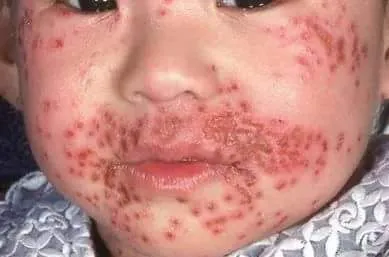
Atopic eczema (atopic dermatitis) is a chronic relapsing itchy inflammatory skin disease affecting up to 1 in 5 children; most start before age 2. Skin barrier failure (for example filaggrin loss-of-function variants), type 2 immune activation and Staphylococcus aureus colonisation drive an itch–scratch cycle. The pattern changes with age: cheeks, scalp and extensor surfaces in infants (nappy area spared), flexures in older children, and lichenified flexures, hands and eyelids in adolescents; on darker skin it may look papular, grey-violet and cause pigment change. Diagnosis is clinical. Management follows a stepped plan: generous emollients and soap substitutes, topical corticosteroids matched to severity and site (with fingertip units and proactive weekend use), topical calcineurin inhibitors from age 2, and specialist systemic or biologic therapy (dupilumab from 6 months) for severe disease. Watch for bacterial infection and eczema herpeticum, an emergency. Most eczema is not caused by food, but food allergy is more likely in infants with early severe eczema. Address sleep, school, family burden and steroid fears.
Patient case, mechanism, investigations, management, flashcards and exam-style questions.Open the lesson →
Key facts
- Affects up to 20% of children; about 60% start in the first year and most by age 5; many improve by adolescence
- Diagnosis (UK Working Party): itchy skin plus 3 or more of flexural involvement (cheeks or extensors under 18 months), history of flexural eczema, dry skin, personal atopy (or first-degree relative if under 4), onset before 2 (not used under 4 years)
- Infants: face, scalp and extensors, sparing the nappy area; children: flexures, wrists, ankles, neck; adolescents: lichenified flexures, hands, eyelids
- Emollients 250–500 g a week for a child, applied liberally and often, continued when skin is clear; soap substitutes
- Topical steroid potency matched to severity and site: mild (hydrocortisone 1%) for face; moderate or potent for body flares for 3–14 days; 1 fingertip unit covers two adult palms
- Eczema herpeticum (punched-out erosions, monomorphic vesicles, fever) is an emergency: same-day aciclovir and referral; ophthalmology if periorbital
- Topical tacrolimus 0.03% or pimecrolimus from age 2 as steroid-sparing second line; dupilumab licensed from 6 months for severe disease
- Daily emollients from birth do not prevent eczema (BEEP trial); early introduction of peanut and egg is advised in infants with eczema
Differential diagnosis
| Condition | Clues | Key test |
|---|---|---|
| Infantile seborrhoeic dermatitis | Non-itchy greasy salmon-pink scale on scalp (cradle cap) and flexures including nappy area, baby content | Clinical |
| Scabies | Intense night itch, burrows in finger webs, wrists, genitals; family members itchy | Dermoscopy or skin scraping |
| Contact dermatitis | Sharp borders at site of contact (nickel, fragrances, preservatives in wipes) | Patch testing |
| Psoriasis | Well-demarcated plaques with silvery scale, extensors, scalp, nails; less itchy | Clinical; biopsy if unclear |
| Tinea corporis | Annular scaly plaque with central clearing, often single | Skin scraping microscopy and culture |
| Primary immunodeficiency (Wiskott–Aldrich, hyper-IgE, Omenn) | Eczema with recurrent severe infections, petechiae, faltering growth, erythroderma | FBC with platelet size, IgE, immunoglobulins, lymphocyte subsets |
| Nutritional dermatoses (zinc deficiency) | Periorificial and acral erosive rash, diarrhoea, alopecia | Plasma zinc and ALP |
| Molluscum dermatitis | Eczema around molluscum papules | Clinical (umbilicated papules) |
Exam pearls
Guideline
NICE CG57 Atopic eczema in under 12s (2007; kept under NICE surveillance), NICE NG190 secondary bacterial infection of eczema (2021), EuroGuiDerm atopic eczema guideline (2022, living update 2025) and AAD adult guidelines (topical 2023; phototherapy and systemic 2023, focused update 2025)
References
- National Institute for Health and Care Excellence. Atopic eczema in under 12s: diagnosis and management (CG57). NICE clinical guideline 2007.
- Wollenberg A, Kinberger M, Arents B, et al.. European Guideline (EuroGuiDerm) on atopic eczema: Living update. J Eur Acad Dermatol Venereol 2025.
- Sidbury R, Alikhan A, Bercovitch L, et al.. Guidelines of care for the management of atopic dermatitis in adults with topical therapies. J Am Acad Dermatol 2023.
- Davis DMR, Drucker AM, Alikhan A, et al.. Guidelines of care for the management of atopic dermatitis in adults with phototherapy and systemic therapies. J Am Acad Dermatol 2023.
- Davis DMR, Frazer-Green L, Alikhan A, et al.. Focused update: Guidelines of care for the management of atopic dermatitis in adults. J Am Acad Dermatol 2025.
- Paller AS, Simpson EL, Siegfried EC, et al.. Dupilumab in children aged 6 months to younger than 6 years with uncontrolled atopic dermatitis: a randomised, double-blind, placebo-controlled, phase 3 trial. Lancet 2022.
Related topics
By Dr Khalid Seidi (B.Sc., M.D.) · MedEd World Clinical Knowledge library. Original teaching content checked against current guidelines (November 2026); confirm the latest local guidance before clinical use. Not a substitute for clinical judgement.