Clinical Knowledge › Paediatrics › Musculoskeletal, rheumatology and dermatology
Slipped capital femoral epiphysis
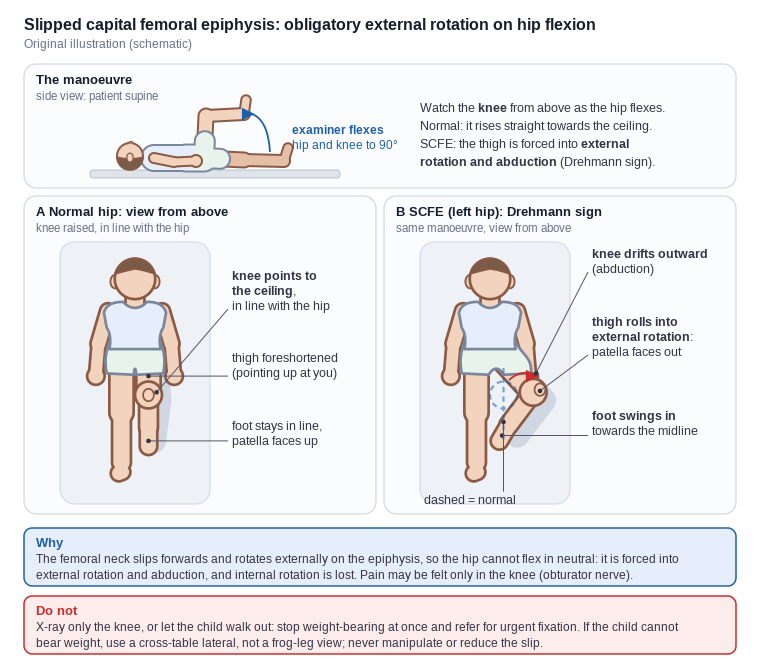
Slipped capital femoral epiphysis (SCFE) is displacement of the femoral neck (metaphysis) anteriorly and upwards relative to the capital epiphysis through a weakened physis during the growth spurt. It typically affects overweight adolescents aged 10–16 years, boys more than girls, with an incidence of about 3 per 100 000 young people a year; up to a quarter have or develop bilateral disease. Atypical slips suggest an endocrine cause. The adolescent presents with hip, groin, thigh or isolated knee pain and a limp; the leg is externally rotated and rolls into external rotation when the hip is flexed. AP and frog-leg lateral radiographs of both hips confirm it, with an abnormal Klein line. Stability guides prognosis: a child who cannot bear weight has an unstable slip with a high risk of avascular necrosis. Treatment is urgent surgical fixation, usually a single cannulated screw in situ; the child must stop weight-bearing at once. Complications include avascular necrosis, chondrolysis, contralateral slip and early osteoarthritis.
Patient case, mechanism, investigations, management, flashcards and exam-style questions.Open the lesson →
Key facts
- Displacement of the femoral metaphysis anterosuperiorly and externally rotated relative to the epiphysis, through the hypertrophic zone of the physis
- Age 10–16 years (girls earlier than boys); male predominance; obesity is the strongest risk factor
- UK incidence about 3.3 per 100 000 aged 6–18 years a year (BOSS 2022); bilateral in up to 20–25% overall
- Presents with limp and hip, groin, thigh or isolated knee pain; obligatory external rotation on hip flexion (Drehmann sign)
- Loder stability: stable (can bear weight, with or without crutches) versus unstable (cannot bear weight); avascular necrosis risk about 47% unstable versus near 0% stable in the original series
- AP and frog-leg lateral pelvis of both hips (cross-table lateral if unstable); Klein line fails to cut the lateral epiphysis
- Atypical slip (under 10 or over 16 years, or weight below the 50th centile) needs endocrine and renal assessment
- Treatment: immediate non-weight-bearing and urgent fixation, usually a single central cannulated screw in situ; never attempt forceful reduction
Differential diagnosis
| Condition | Clues | Key test |
|---|---|---|
| Perthes disease | Younger child (4–8 years), small, insidious limp | Pelvic X-ray: epiphyseal sclerosis and fragmentation |
| Septic arthritis or osteomyelitis | Fever, systemically unwell, raised inflammatory markers | CRP, ESR, blood culture, ultrasound and aspiration |
| Knee pathology (Osgood–Schlatter, patellofemoral pain) | Local knee tenderness, normal hip rotation | Examine the hip; knee X-ray only if indicated |
| Muscle strain or apophyseal avulsion of the pelvis | Sudden pain during sprinting or kicking, focal tenderness at ASIS, AIIS or ischial tuberosity | Pelvic X-ray |
| Femoral neck stress fracture | Athletic adolescent, activity-related groin pain | MRI |
| Bone tumour (osteosarcoma, Ewing sarcoma, osteoid osteoma) | Night pain, swelling, systemic symptoms | X-ray and MRI |
| Juvenile idiopathic arthritis or enthesitis-related arthritis | Morning stiffness, other joints, enthesitis | Examination, inflammatory markers, HLA-B27, ultrasound |
Exam pearls
Guideline
No international guideline: paediatric orthopaedic consensus practice informed by the Loder stability classification (1993) and the British Orthopaedic Surgery Surveillance (BOSS) SCFE cohort (2022)
References
- Perry DC, Arch B, Appelbe D, Francis P, et al.. The British Orthopaedic Surgery Surveillance study: slipped capital femoral epiphysis: the epidemiology and two-year outcomes from a prospective cohort in Great Britain. Bone Joint J 2022.
- Loder RT, Richards BS, Shapiro PS, Reznick LR, Aronson DD.. Acute slipped capital femoral epiphysis: the importance of physeal stability. J Bone Joint Surg Am 1993.
- Peck DM, Voss LM, Voss TT.. Slipped capital femoral epiphysis: diagnosis and management. Am Fam Physician 2017.
- Green DW, Mogekwu N, Scher DM, Handler S, Chalmers P, Widmann RF.. A modification of Klein's line to improve sensitivity of the anterior-posterior radiograph in slipped capital femoral epiphysis. J Pediatr Orthop 2009.
- Southwick WO.. Osteotomy through the lesser trochanter for slipped capital femoral epiphysis. J Bone Joint Surg Am 1967.
- Herman MJ, Martinek M.. The limping child. Pediatr Rev 2015.
Related topics
By Dr Khalid Seidi (B.Sc., M.D.) · MedEd World Clinical Knowledge library. Original teaching content checked against current guidelines (November 2026); confirm the latest local guidance before clinical use. Not a substitute for clinical judgement.