Clinical Knowledge › Paediatrics › Musculoskeletal, rheumatology and dermatology
Transient synovitis of the hip
Transient synovitis ('irritable hip') is a self-limiting, non-specific inflammation of the hip synovium with a small effusion. It is the commonest cause of acute hip pain and limp in children, typically affecting boys aged 3–8 years, often a week or two after a viral upper respiratory infection. The child develops a limp or reluctance to bear weight, with pain in the groin, thigh or knee, but looks well, has no or only low-grade fever and keeps a reasonable range of hip movement apart from mild loss of internal rotation. It is a diagnosis of exclusion: the main danger is missing septic arthritis, which destroys the joint within days, and other causes such as Perthes disease, slipped capital femoral epiphysis, osteomyelitis, fracture, leukaemia and non-accidental injury. Fever above 38.5 °C, refusal to bear weight, raised CRP, ESR or white cell count, age under 3 years or a systemically unwell child need urgent assessment with bloods, ultrasound and often joint aspiration (Kocher and Caird criteria). Typical cases need only rest, ibuprofen and review within 48 hours; symptoms settle within about 1–2 weeks, and persistence or recurrence prompts X-ray for Perthes disease.
Patient case, mechanism, investigations, management, flashcards and exam-style questions.Open the lesson →
Key facts
- Commonest cause of acute limp and hip pain in children; peak age 3–8 years; boys about twice as often as girls
- Often follows a viral upper respiratory infection within the previous 2 weeks; usually unilateral
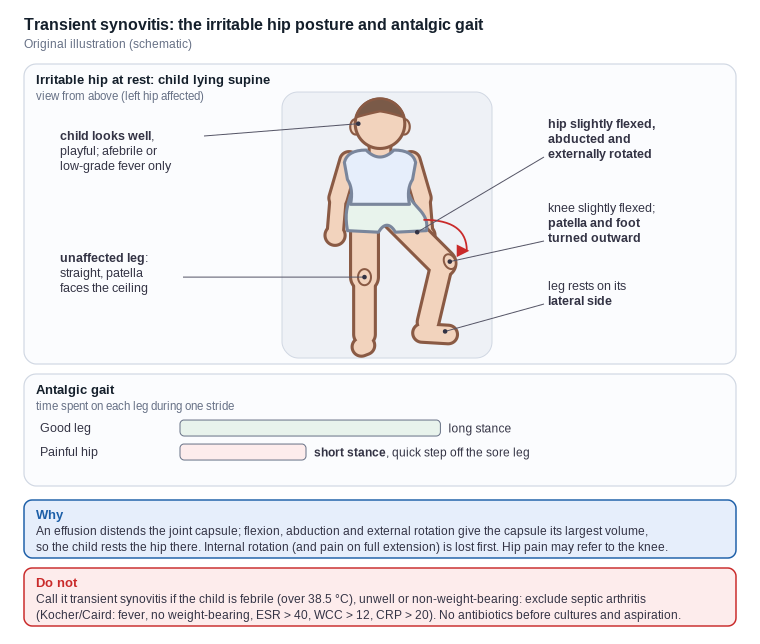
- Child looks well, is afebrile or has low-grade fever, and can usually bear some weight; hip may rest flexed, abducted and externally rotated
- Mild restriction, especially of internal rotation; pain may be referred to the knee, so always examine the hip in a child with knee pain
- Diagnosis of exclusion: septic arthritis must be ruled out; Kocher criteria are fever over 38.5 °C, non-weight-bearing, ESR over 40 mm/h and white cells over 12 × 10^9/L, with CRP over 20 mg/L (Caird)
- Ultrasound shows an effusion in both transient synovitis and septic arthritis, so it cannot distinguish them; aspiration decides when doubt remains
- Treatment: rest and NSAIDs (ibuprofen shortens symptoms), with review within 48 hours and safety-netting
- Resolves in about 1–2 weeks; recurrence in a minority; X-ray if symptoms persist beyond about 2 weeks or recur, to look for Perthes disease
Differential diagnosis
| Condition | Clues | Key test |
|---|---|---|
| Septic arthritis of the hip | Febrile, unwell, refuses to bear weight, severe pain on any movement, raised CRP/ESR/WCC | Ultrasound-guided aspiration: purulent fluid, Gram stain, culture, Kingella PCR |
| Osteomyelitis (proximal femur or pelvis) | Fever, focal bony tenderness, persistent pain; may coexist with septic arthritis | MRI; blood cultures; raised CRP |
| Perthes disease | Age 4–8, insidious or recurrent limp, reduced abduction and internal rotation | Pelvic AP and frog-leg lateral X-ray: dense, fragmented femoral head |
| Slipped capital femoral epiphysis | Age 10–16, often overweight, hip or knee pain, obligatory external rotation on flexion | AP and frog-leg lateral X-ray (Klein line) |
| Toddler's fracture or non-accidental injury | Under 3 years, refusal to walk, possible unwitnessed trauma or inconsistent history | Tibial X-ray; skeletal survey and safeguarding assessment if concern |
| Juvenile idiopathic arthritis or reactive arthritis | Persistent swelling, morning stiffness, other joints, preceding diarrhoea | Clinical course, inflammatory markers, rheumatology review |
| Acute leukaemia or bone tumour | Night pain, pallor, bruising, weight loss, persistent symptoms | FBC and blood film; X-ray; MRI |
| Referred or extra-articular pain | Testicular torsion, inguinal hernia, appendicitis, psoas abscess, discitis | Examine abdomen, genitals and spine; targeted imaging |
Exam pearls
Guideline
No disease-specific international guideline; practice combines the PIDS/IDSA guideline on acute bacterial arthritis in children (2023, published 2024), NICE NG143 fever in under 5s (2019, updated 2021), UK primary-care limping child pathways and the Kocher (1999) and Caird (2006) prediction rules
References
- Kocher MS, Zurakowski D, Kasser JR. Differentiating between septic arthritis and transient synovitis of the hip in children: an evidence-based clinical prediction algorithm. J Bone Joint Surg Am 1999.
- Caird MS, Flynn JM, Leung YL, Millman JE, D'Italia JG, Dormans JP. Factors distinguishing septic arthritis from transient synovitis of the hip in children: a prospective study. J Bone Joint Surg Am 2006.
- Kermond S, Fink M, Graham K, Carlin JB, Barnett P. A randomized clinical trial: should the child with transient synovitis of the hip be treated with nonsteroidal anti-inflammatory drugs?. Ann Emerg Med 2002.
- Woods CR, Bradley JS, Chatterjee A, et al.. Clinical practice guideline by the PIDS and IDSA: 2023 guideline on diagnosis and management of acute bacterial arthritis in pediatrics. J Pediatric Infect Dis Soc 2024.
- Herman MJ, Martinek M. The limping child. Pediatr Rev 2015.
- National Institute for Health and Care Excellence. Fever in under 5s: assessment and initial management (NG143). NICE guideline 2019.
Related topics
By Dr Khalid Seidi (B.Sc., M.D.) · MedEd World Clinical Knowledge library. Original teaching content checked against current guidelines (November 2026); confirm the latest local guidance before clinical use. Not a substitute for clinical judgement.