Clinical Knowledge › Paediatrics › Musculoskeletal, rheumatology and dermatology
Osgood-Schlatter disease
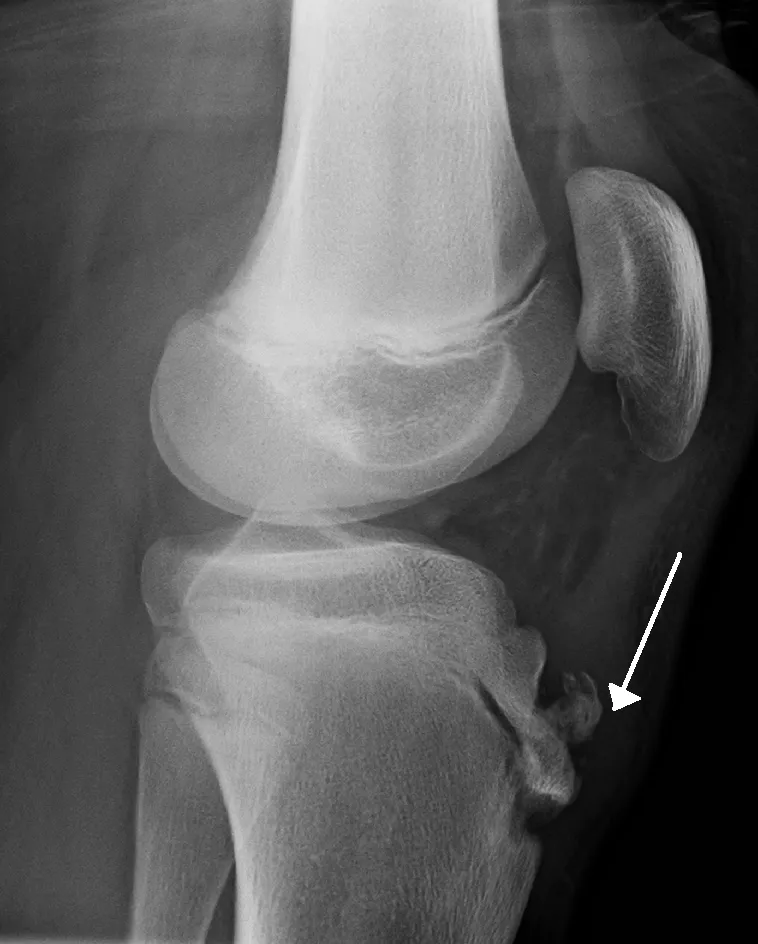
Osgood–Schlatter disease is a traction apophysitis of the tibial tuberosity at the patellar tendon insertion. Repeated pull from the quadriceps during the adolescent growth spurt causes small avulsions, inflammation and new bone formation. It affects about 1 in 10 adolescents, especially those who run, jump and kick, typically boys aged 12–15 and girls aged 10–13, and is bilateral in up to a third. The young person has anterior knee pain just below the patella, worse with sport, kneeling, stairs and jumping, and a tender, swollen, prominent tibial tubercle. Diagnosis is clinical; radiographs are reserved for atypical features (night pain, effusion, systemic symptoms, acute trauma) suggesting tumour, infection or avulsion. Always examine the hip, because slipped capital femoral epiphysis can present with knee pain. Treatment is education, activity modification guided by pain, progressive quadriceps and hip strengthening, ice and short courses of simple analgesia. Most cases resolve when the apophysis fuses; a persistent painful ossicle occasionally needs excision.
Patient case, mechanism, investigations, management, flashcards and exam-style questions.Open the lesson →
Key facts
- Traction apophysitis of the tibial tuberosity at the patellar tendon insertion during the growth spurt
- Affects about 10% of adolescents; boys about 12–15 years, girls about 10–13 years; bilateral in 20–30%
- Risk factors: running, jumping and kicking sports, rapid growth, tight quadriceps and hamstrings
- Pain below the patella with activity, kneeling and stairs; tender, swollen, prominent tibial tubercle
- Diagnosis is clinical; X-ray only if atypical (unilateral severe pain, night pain, effusion, systemic features, acute injury)
- Examine the hip: SCFE can present as knee pain in the same age group
- Treatment: education, activity modification by pain, strengthening and stretching, ice, short-term analgesia; avoid corticosteroid injection
- Usually self-limiting over 12–24 months until apophyseal fusion; a persistent painful ossicle may need excision after skeletal maturity
Differential diagnosis
| Condition | Clues | Key test |
|---|---|---|
| Sinding-Larsen–Johansson syndrome | Tenderness at the inferior pole of the patella, age 10–13 | Clinical; lateral X-ray shows fragmentation at patellar pole |
| Patellar tendinopathy (jumper's knee) | Older adolescent or adult; tenderness in the proximal tendon | Clinical; ultrasound |
| Patellofemoral pain | Diffuse anterior pain around the patella, worse on stairs and sitting | Clinical diagnosis of exclusion |
| Slipped capital femoral epiphysis | Knee pain with limp and restricted hip internal rotation | AP and frog-leg lateral pelvic X-ray |
| Tibial tubercle avulsion fracture | Sudden pain on jumping or landing, cannot extend the knee against gravity | Lateral knee X-ray |
| Osteosarcoma or Ewing sarcoma of the proximal tibia | Night pain, progressive swelling, systemic symptoms | X-ray, MRI, urgent referral |
| Osteomyelitis or septic arthritis | Fever, unwell, raised inflammatory markers, effusion | Bloods, imaging, aspiration |
Exam pearls
Guideline
No international guideline: conservative management informed by systematic reviews (Neuhaus 2021; Ndjonko 2026) and the self-management approach of activity modification and strengthening (Rathleff 2020, 2024)
References
- Neuhaus C, Appenzeller-Herzog C, Faude O.. A systematic review on conservative treatment options for Osgood-Schlatter disease. Phys Ther Sport 2021.
- Ndjonko LCM, Klein JH, Chakraborty Y, Kata S, et al.. Treatments for Osgood Schlatter disease: a systematic review of the literature. Orthop J Sports Med 2026.
- Rathleff MS, Winiarski L, Krommes K, et al.. Activity modification and knee strengthening for Osgood-Schlatter disease: a prospective cohort study. Orthop J Sports Med 2020.
- Lucenti L, Sapienza M, Caldaci A, Cristo C, et al.. The etiology and risk factors of Osgood-Schlatter disease: a systematic review. Children (Basel) 2022.
- Haines M, Pirlo L, Bowles KA, Williams CM.. Describing frequencies of lower-limb apophyseal injuries in children and adolescents: a systematic review. Clin J Sport Med 2022.
- Rhim HC, Bjork LB, Shin J, Park J, et al.. Efficacy of hyperosmolar dextrose injection for Osgood-Schlatter disease: a systematic review with meta-analysis. Diagnostics (Basel) 2025.
Related topics
By Dr Khalid Seidi (B.Sc., M.D.) · MedEd World Clinical Knowledge library. Original teaching content checked against current guidelines (November 2026); confirm the latest local guidance before clinical use. Not a substitute for clinical judgement.