Clinical Knowledge › Dermatology › Clinical problems
Blistering rash: approach to the patient
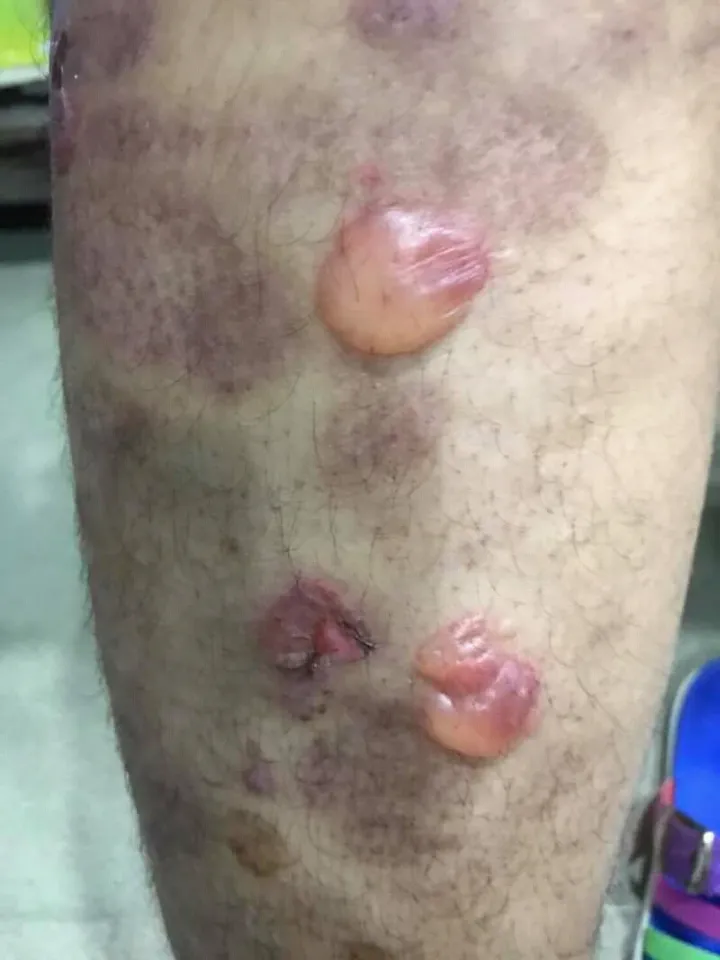
A blister is a fluid-filled cavity in or below the epidermis: a vesicle is under 5 mm (some texts 10 mm) and a bulla larger. The approach starts with stability, because a few blistering diseases kill: Stevens-Johnson syndrome/toxic epidermal necrolysis (SJS/TEN), staphylococcal scalded skin syndrome, eczema herpeticum, disseminated zoster and necrotising infections. Next comes morphology and level of split. Flaccid blisters and erosions with mucosal involvement and a positive Nikolsky sign suggest an intraepidermal split (pemphigus, SSSS, TEN), whereas tense bullae on urticated plaques in an older adult suggest a subepidermal split (bullous pemphigoid). Grouped vesicles point to herpes simplex, zoster or dermatitis herpetiformis; localised blisters to contact dermatitis, bites, burns or friction. Diagnosis rests on history (drugs, age, infection), a lesional biopsy for histology and a perilesional biopsy for direct immunofluorescence, plus serology (BP180/BP230, desmoglein 1 and 3 ELISA, tTG-IgA) and viral PCR. Treatment ranges from stopping a culprit drug and supportive burns-unit care to potent topical steroids, doxycycline or rituximab.
Patient case, mechanism, investigations, management, flashcards and exam-style questions.Open the lesson →
Key facts
- Vesicle under 5 mm; bulla 5 mm or larger (definitions vary; some use 10 mm)
- Flaccid blisters and easy erosion = intraepidermal split (pemphigus, SSSS, TEN); tense blisters = subepidermal split (pemphigoid, DH, linear IgA, EBA, PCT)
- Nikolsky sign positive in pemphigus vulgaris, SSSS and SJS/TEN; usually negative in bullous pemphigoid
- Two biopsies: lesional edge of a fresh blister for H&E; perilesional normal-looking skin for direct immunofluorescence (DIF)
- DIF patterns: intercellular IgG 'chicken-wire' (pemphigus); linear IgG/C3 at BMZ (pemphigoid); granular IgA in dermal papillae (DH); linear IgA (linear IgA disease)
- SJS less than 10% body surface detachment, overlap 10-30%, TEN over 30%; SCORTEN on day 1 and 3 predicts mortality
- Bullous pemphigoid: commonest autoimmune blistering disease, median age about 80; associated with dementia, Parkinson disease, stroke and DPP-4 inhibitors
- Eczema herpeticum (punched-out monomorphic erosions on eczema) is a dermatological emergency - start aciclovir without waiting for PCR
Differential diagnosis
| Condition | Clues | Key test |
|---|---|---|
| Bullous pemphigoid | Older adult, intense itch, tense bullae on urticated plaques; mucosa usually spared | DIF linear IgG/C3 at BMZ; BP180/BP230 ELISA |
| Pemphigus vulgaris | Painful oral erosions first, then flaccid blisters and erosions; Nikolsky positive | DIF intercellular IgG; Dsg3 (+/- Dsg1) ELISA |
| SJS/TEN | New drug 4-28 days before; fever, painful dusky skin, 2 or more mucosal sites | Clinical plus biopsy: full-thickness epidermal necrosis; DIF negative |
| Staphylococcal scalded skin syndrome | Young child, tender erythema, superficial peeling, mucosa spared | Frozen section: split in the granular layer; swab the infective focus |
| Dermatitis herpetiformis | Grouped excoriated vesicles on elbows, knees, buttocks; coeliac disease | DIF granular IgA in dermal papillae; tTG-IgA |
| Herpes simplex / zoster | Grouped vesicles on erythematous base; dermatomal in zoster | Viral PCR swab of vesicle base |
| Bullous impetigo | Flaccid bullae leaving honey or varnish-like crust; children | Swab: S. aureus |
| Porphyria cutanea tarda | Tense blisters, fragility and milia on backs of hands; hepatitis C, alcohol, iron | Urine and plasma porphyrins |
Exam pearls
Guideline
EADV S2k guideline on bullous pemphigoid (2022); EADV S2k guideline on pemphigus (2020); UK (BAD) guidelines for SJS/TEN in adults (2016); EADV S2k guideline on dermatitis herpetiformis (2021)
References
- Borradori L, Van Beek N, Feliciani C, et al.. Updated S2K guidelines for the management of bullous pemphigoid initiated by the European Academy of Dermatology and Venereology (EADV). J Eur Acad Dermatol Venereol 2022.
- Joly P, Horvath B, Patsatsi A, et al.. Updated S2K guidelines on the management of pemphigus vulgaris and foliaceus initiated by the European Academy of Dermatology and Venereology (EADV). J Eur Acad Dermatol Venereol 2020.
- British Association of Dermatologists (Creamer D, Walsh SA, Dziewulski P, et al.). U.K. guidelines for the management of Stevens-Johnson syndrome/toxic epidermal necrolysis in adults 2016. Br J Dermatol 2016.
- Görög A, Antiga E, Caproni M, et al.. S2k guidelines (consensus statement) for diagnosis and therapy of dermatitis herpetiformis initiated by the European Academy of Dermatology and Venereology (EADV). J Eur Acad Dermatol Venereol 2021.
- van Beek N, Holtsche MM, Atefi I, et al.. State-of-the-art diagnosis of autoimmune blistering diseases. Front Immunol 2024.
- Schmidt E, Zillikens D. Pemphigoid diseases. Lancet 2013.
Related topics
By Dr Khalid Seidi (B.Sc., M.D.) · MedEd World Clinical Knowledge library. Original teaching content checked against current guidelines (November 2026); confirm the latest local guidance before clinical use. Not a substitute for clinical judgement.