Clinical Knowledge › Dermatology › Clinical problems
Hair loss: approach to the patient
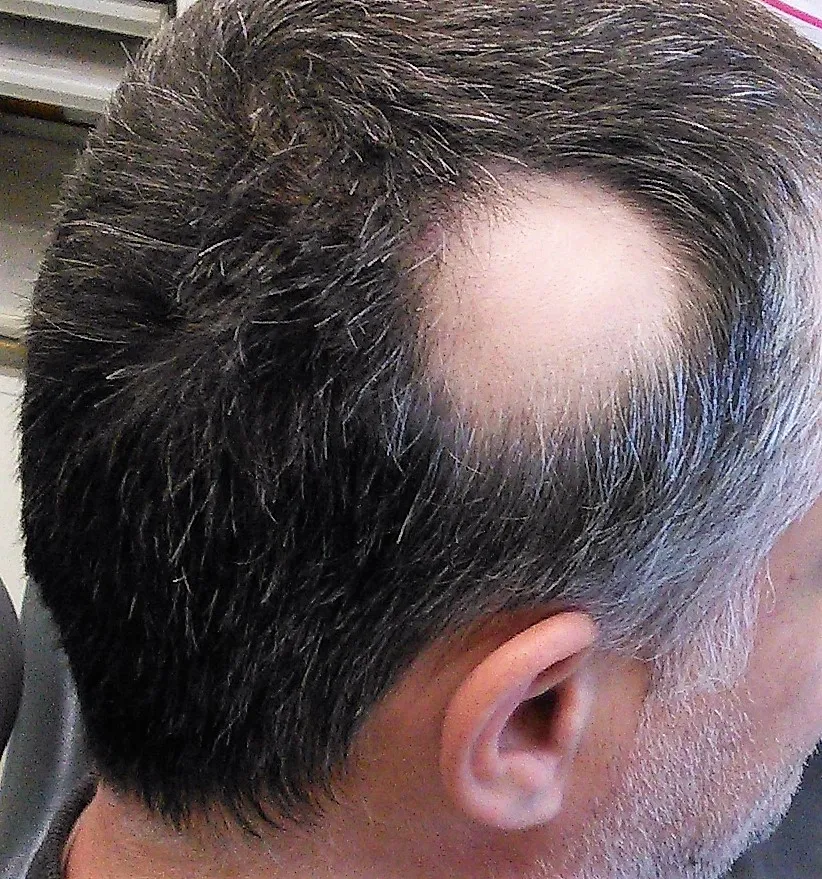
Hair loss (alopecia) is common and often distressing. The approach rests on three questions: is the loss diffuse or patchy, is the scalp scarred or non-scarring, and are hairs being shed or breaking? Non-scarring causes are the majority: androgenetic alopecia (patterned thinning with miniaturised hairs), telogen effluvium (diffuse shedding 2-4 months after a trigger such as illness, childbirth, crash dieting or iron deficiency), alopecia areata (smooth round patches with exclamation-mark hairs), tinea capitis (scaly patches, broken hairs, lymphadenopathy, mainly in children), traction alopecia and trichotillomania. Scarring (cicatricial) alopecias - lichen planopilaris, frontal fibrosing alopecia, discoid lupus, folliculitis decalvans and central centrifugal cicatricial alopecia - destroy follicles, show loss of follicular openings and need early biopsy and treatment to prevent permanent loss. Assessment includes the pull test, trichoscopy, scrapings and plucks for fungi, and targeted bloods (ferritin, TSH, FBC, vitamin D, and androgens in women with virilisation). Treatment is cause-specific: topical or oral minoxidil, finasteride, intralesional steroids, JAK inhibitors for severe alopecia areata, oral antifungals for tinea capitis.
Patient case, mechanism, investigations, management, flashcards and exam-style questions.Open the lesson →
Key facts
- First split: scarring (loss of follicular ostia, smooth shiny skin) versus non-scarring (follicular openings preserved)
- Androgenetic alopecia: commonest cause overall; male vertex/frontotemporal recession (Hamilton-Norwood), female central widening with frontal hairline kept (Ludwig/Sinclair)
- Telogen effluvium: diffuse shedding of club hairs 2-4 months after a trigger; positive pull test; recovers in 6-12 months
- Alopecia areata: autoimmune, smooth patches, exclamation-mark hairs, nail pitting; associated with atopy, thyroid disease and vitiligo
- Tinea capitis (often Trichophyton tonsurans): scaly patches, black dots, kerion, occipital nodes; needs ORAL antifungal - topicals alone fail
- Scarring alopecias need early scalp biopsy (4 mm punch from active edge) for histology
- Pull test: more than about 10% of hairs (over 5-6 of 50-60 grasped) coming out suggests active shedding
- JAK inhibitors (baricitinib, ritlecitinib; deuruxolitinib in the US) are licensed for severe alopecia areata; screen for TB, hepatitis and VTE risk first
Differential diagnosis
| Condition | Clues | Key test |
|---|---|---|
| Androgenetic alopecia | Gradual patterned thinning; family history; miniaturised hairs | Clinical; trichoscopy shows hair-diameter variation over 20% |
| Telogen effluvium | Diffuse shedding 2-4 months after illness, birth, surgery, diet or drug | Positive pull test (club hairs); ferritin, TSH |
| Alopecia areata | Smooth round patches, exclamation-mark hairs, nail pitting | Trichoscopy: yellow dots, black dots, exclamation-mark hairs |
| Tinea capitis | Child, scaly patches, broken hairs, kerion, occipital nodes | Scalp brushings/plucks for microscopy and culture |
| Trichotillomania | Bizarre-shaped patch with hairs of different lengths; anxiety | Trichoscopy: broken hairs at varying lengths, flame hairs |
| Traction alopecia | Marginal loss at frontal/temporal hairline with tight hairstyles; fringe sign | Clinical history |
| Lichen planopilaris / frontal fibrosing alopecia | Perifollicular erythema and scale; receding frontal band and eyebrow loss in postmenopausal women | Scalp biopsy: lichenoid perifollicular infiltrate, fibrosis |
| Discoid lupus erythematosus | Scarring patches with follicular plugging, atrophy, dyspigmentation | Biopsy with DIF; ANA |
Exam pearls
Guideline
BAD living guideline for alopecia areata (2025; published 2026); European S3 guideline for androgenetic alopecia (2018); BAD guideline for tinea capitis (2014)
References
- Harries MJ, Ahmed A, Ascott A, et al.. British Association of Dermatologists living guideline for managing people with alopecia areata 2025. Br J Dermatol 2026.
- Kanti V, Messenger A, Dobos G, et al.. Evidence-based (S3) guideline for the treatment of androgenetic alopecia in women and in men – short version. J Eur Acad Dermatol Venereol 2018.
- King B, Ohyama M, Kwon O, et al.. Two phase 3 trials of baricitinib for alopecia areata. N Engl J Med 2022.
- King B, Zhang X, Harcha WG, et al.. Efficacy and safety of ritlecitinib in adults and adolescents with alopecia areata: a randomised, double-blind, multicentre, phase 2b-3 trial. Lancet 2023.
- Penha MA, Miot HA, Kasprzak M, Müller Ramos P.. Oral minoxidil vs topical minoxidil for male androgenetic alopecia: a randomized clinical trial. JAMA Dermatol 2024.
- Fuller LC, Barton RC, Mohd Mustapa MF, et al.. British Association of Dermatologists' guidelines for the management of tinea capitis 2014. Br J Dermatol 2014.
Related topics
By Dr Khalid Seidi (B.Sc., M.D.) · MedEd World Clinical Knowledge library. Original teaching content checked against current guidelines (November 2026); confirm the latest local guidance before clinical use. Not a substitute for clinical judgement.