Clinical Knowledge › Dermatology › Clinical problems
Nail changes: approach to the patient
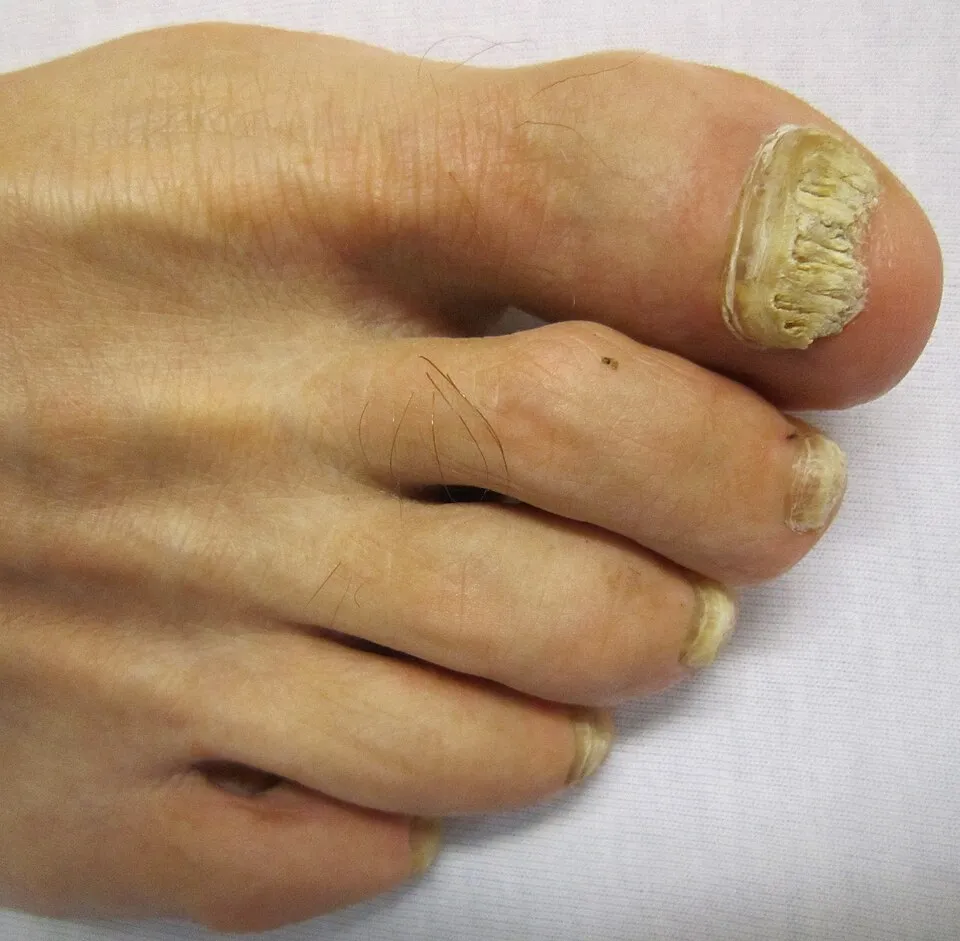
Nail changes are common, often trivial, but can be the first sign of skin disease, systemic illness or malignancy. The nail unit comprises the matrix (which makes the plate), the nail bed, the proximal and lateral folds with the cuticle, and the hyponychium; the site of damage predicts the sign. Matrix disease produces pitting, Beau lines, leukonychia and longitudinal melanonychia; nail-bed disease produces onycholysis, subungual hyperkeratosis, oil-drop discoloration and splinter haemorrhages. The approach asks: one nail or many, fingers or toes, acute or chronic, and are there skin, joint or systemic clues? The commonest causes are onychomycosis, psoriasis, trauma and chronic paronychia. Systemic signs include clubbing, koilonychia (iron deficiency), half-and-half nails (CKD), Terry nails (cirrhosis), Beau lines after severe illness and splinter haemorrhages in endocarditis. A single pigmented band, especially with Hutchinson sign, needs evaluation for subungual melanoma. Mycology (clippings for microscopy, culture or PCR) must confirm onychomycosis before oral terbinafine or itraconazole.
Patient case, mechanism, investigations, management, flashcards and exam-style questions.Open the lesson →
Key facts
- Fingernails grow about 3 mm/month (full regrowth about 6 months); toenails about 1 mm/month (12-18 months)
- Matrix signs: pitting, Beau lines, transverse leukonychia, trachyonychia, longitudinal melanonychia
- Nail-bed signs: onycholysis, subungual hyperkeratosis, oil-drop (salmon patch) discoloration, splinter haemorrhages
- Nail psoriasis affects up to half of people with psoriasis and up to 80% with psoriatic arthritis
- Only about half of thickened, discoloured nails are fungal - confirm onychomycosis with microscopy, culture or PCR before oral treatment
- Terbinafine 250 mg daily: 6 weeks for fingernails, 12 weeks for toenails (teaching dose); check LFTs if risk factors
- Clubbing: loss of Lovibond angle, increased curvature, Schamroth window lost; causes include lung cancer, bronchiectasis, IBD, cyanotic heart disease, endocarditis
- Longitudinal melanonychia that is wide (3 mm or more), changing, irregular or with Hutchinson sign needs nail-matrix biopsy
Differential diagnosis
| Condition | Clues | Key test |
|---|---|---|
| Onychomycosis | Toenails, asymmetric, yellow-white thickening with subungual debris; tinea pedis | Clippings for KOH microscopy and culture (or PCR) |
| Nail psoriasis | Pitting, oil-drop discoloration, onycholysis, symmetrical fingernails; skin plaques, arthritis | Clinical; mycology negative; skin and joint examination |
| Chronic paronychia | Swollen, red proximal fold, lost cuticle, wet work; ridged nail | Clinical; swab if acute pus |
| Lichen planus of nails | Thinning, longitudinal ridging, pterygium (fold fuses to bed) | Nail biopsy |
| Subungual melanoma | Single digit, widening dark band, Hutchinson sign, older adult | Nail-matrix biopsy |
| Subungual haematoma | Trauma, purple-black patch that grows out | Dermoscopy: red-purple globules; follow-up photographs |
| Systemic disease signs | All nails: clubbing, koilonychia, Terry or half-and-half nails, Beau lines | FBC, ferritin, LFTs, renal function, chest imaging as indicated |
Exam pearls
Guideline
BAD guideline for the management of onychomycosis (2014); NICE CKS Fungal nail infection (current 2026); NICE CG153 Psoriasis (2012, updated 2017); NICE NG14 Melanoma (2022)
References
- Ameen M, Lear JT, Madan V, Mohd Mustapa MF, Richardson M. British Association of Dermatologists' guidelines for the management of onychomycosis 2014. Br J Dermatol 2014.
- Lipner SR, Scher RK. Onychomycosis: clinical overview and diagnosis. J Am Acad Dermatol 2019.
- Levit EK, Kagen MH, Scher RK, Grossman M, Altman E. The ABC rule for clinical detection of subungual melanoma. J Am Acad Dermatol 2000.
- Spicknall KE, Zirwas MJ, English JC.. Clubbing: an update on diagnosis, differential diagnosis, pathophysiology, and clinical relevance. J Am Acad Dermatol 2005.
- National Institute for Health and Care Excellence. Psoriasis: assessment and management (CG153). NICE 2012.
- National Institute for Health and Care Excellence. Clinical Knowledge Summaries: Fungal skin infection (body and groin, foot, scalp), Fungal nail infection, Pityriasis versicolor (accessed November 2026). NICE CKS 2026.
Related topics
By Dr Khalid Seidi (B.Sc., M.D.) · MedEd World Clinical Knowledge library. Original teaching content checked against current guidelines (November 2026); confirm the latest local guidance before clinical use. Not a substitute for clinical judgement.