Clinical Knowledge › Neurology › Brain tumours, raised intracranial pressure and neurocutaneous syndromes
Brain metastases
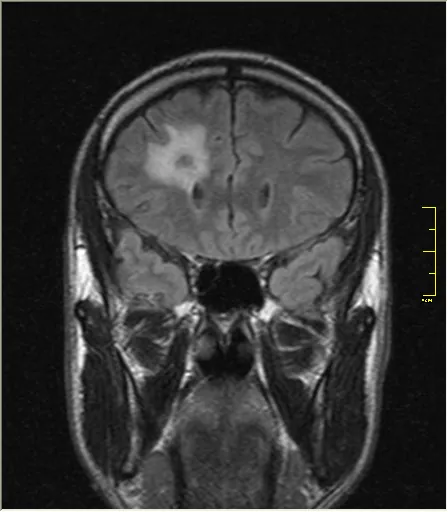
Brain metastases are the commonest intracranial tumours in adults, outnumbering primary brain tumours by about ten to one, and occur in 20–40% of people with cancer. Lung cancer causes about half; breast cancer, melanoma, renal cell and colorectal cancer cause most of the rest. Tumour cells lodge at the grey–white matter junction and arterial border zones, so lesions are often multiple, round and surrounded by oedema out of proportion to their size. Patients present with headache, seizures, focal deficits, cognitive change or raised intracranial pressure; some lesions are found on staging scans. Contrast MRI is the most sensitive test. Management is tailored to prognosis (graded prognostic assessment), number and size of lesions, symptoms and the systemic disease. Dexamethasone treats symptomatic oedema; antiseizure medicines are given only after a seizure. Stereotactic radiosurgery is preferred for limited lesions; surgery suits a large symptomatic or posterior fossa lesion, or doubt about diagnosis. Whole-brain radiotherapy, ideally with hippocampal avoidance and memantine, is kept for many lesions, and brain-penetrant targeted drugs and immunotherapy now control many metastases from lung cancer, melanoma and breast cancer.
Patient case, mechanism, investigations, management, flashcards and exam-style questions.Open the lesson →
Key facts
- Commonest intracranial tumour in adults; about 10 times commoner than primary brain tumours
- Main primaries: lung (about 50%), breast, melanoma (highest propensity), renal cell, colorectal
- Haemorrhagic metastases: melanoma, renal cell, thyroid, choriocarcinoma (and lung because it is common)
- MRI: multiple ring or solid enhancing lesions at the grey–white junction with disproportionate vasogenic oedema
- Dexamethasone only for symptomatic oedema, typically 4–8 mg/day (up to 16 mg/day for severe symptoms); taper as soon as possible
- No prophylactic antiseizure medicines in patients without seizures
- Stereotactic radiosurgery is preferred to whole-brain radiotherapy for 1–4 lesions (and often up to 10): equal survival with less cognitive decline
- Driver-mutated lung cancer (EGFR, ALK), HER2-positive breast cancer and melanoma often respond to CNS-penetrant systemic therapy
Differential diagnosis
| Condition | Clues | Key test |
|---|---|---|
| Glioblastoma | Single irregular necrotic mass, infiltrative, may cross corpus callosum | Staging CT, MR perfusion, biopsy |
| Brain abscess | Fever, smooth thin rim, central restricted diffusion | MRI DWI, blood cultures, aspiration |
| Primary CNS lymphoma | Periventricular, homogeneous enhancement, restricted diffusion | Biopsy before steroids, CSF cytology |
| Toxoplasmosis or other opportunistic infection | Immunosuppression, basal ganglia lesions | Serology, CD4 count, empirical treatment response |
| Radiation necrosis | Previous SRS to the lesion, enhancement months later | Perfusion MRI, amino acid PET, MR spectroscopy |
| Septic emboli or infarcts | Endocarditis, multiple small lesions, DWI restriction | Blood cultures, echocardiography |
Exam pearls
Guideline
ASCO–SNO–ASTRO guideline on treatment of brain metastases (2022) and EANO–ESMO clinical practice guideline (2021)
References
- Vogelbaum MA, Brown PD, Messersmith H, et al.. Treatment for brain metastases: ASCO-SNO-ASTRO guideline. J Clin Oncol 2022.
- Le Rhun E, Guckenberger M, Smits M, et al.. EANO-ESMO Clinical Practice Guidelines for diagnosis, treatment and follow-up of patients with brain metastasis from solid tumours. Ann Oncol 2021.
- Patchell RA, Tibbs PA, Walsh JW, et al.. A randomized trial of surgery in the treatment of single metastases to the brain. N Engl J Med 1990.
- Brown PD, Jaeckle K, Ballman KV, et al.. Effect of radiosurgery alone vs radiosurgery with whole brain radiation therapy on cognitive function in patients with 1 to 3 brain metastases: a randomized clinical trial. JAMA 2016.
- Mulvenna P, Nankivell M, Barton R, et al.. Dexamethasone and supportive care with or without whole brain radiotherapy in treating patients with non-small cell lung cancer with brain metastases unsuitable for resection or stereotactic radiotherapy (QUARTZ). Lancet 2016.
- Brown PD, Gondi V, Pugh S, et al.. Hippocampal avoidance during whole-brain radiotherapy plus memantine for patients with brain metastases: phase III trial NRG Oncology CC001. J Clin Oncol 2020.
Related topics
By Dr Khalid Seidi (B.Sc., M.D.) · MedEd World Clinical Knowledge library. Original teaching content checked against current guidelines (November 2026); confirm the latest local guidance before clinical use. Not a substitute for clinical judgement.