Clinical Knowledge › Neurology › Brain tumours, raised intracranial pressure and neurocutaneous syndromes
Paraneoplastic neurological syndromes
Paraneoplastic neurological syndromes (PNS) are immune-mediated disorders of the nervous system triggered by a cancer that expresses neuronal antigens. They are not caused by invasion, metastasis, treatment toxicity or nutritional deficiency. They affect fewer than 1% of people with cancer but often appear before the tumour is known, so the neurologist may be first to suspect it. The 2021 updated criteria (Graus) group syndromes into high-risk phenotypes (encephalomyelitis, limbic encephalitis, rapidly progressive cerebellar syndrome, opsoclonus–myoclonus, sensory neuronopathy, gastrointestinal pseudo-obstruction and Lambert–Eaton myasthenic syndrome) and intermediate-risk phenotypes, and antibodies into high-risk (more than 70% cancer association: Hu, CV2/CRMP5, SOX1, Ri, Yo, Ma2, amphiphysin, recoverin, KLHL11) and intermediate-risk (for example NMDAR, AMPAR, GABA-B receptor, P/Q-type VGCC). Antibodies against intracellular antigens mark T-cell-mediated neuronal loss that responds poorly to treatment, whereas antibodies to cell-surface antigens are often pathogenic and treatable. Diagnosis combines the phenotype, confirmed antibody testing in serum and CSF, MRI, EEG and an intensive cancer search. Treat the tumour promptly and give immunotherapy early.
Patient case, mechanism, investigations, management, flashcards and exam-style questions.Open the lesson →
Key facts
- PNS are remote immune effects of cancer; neurological symptoms precede tumour diagnosis in most cases
- Commonest associated tumours: small cell lung cancer, thymoma, breast, ovarian (including teratoma), testicular germ cell tumours and Hodgkin lymphoma
- High-risk antibodies (more than 70% cancer risk): Hu, CV2/CRMP5, SOX1, Ri, Yo, Ma2, amphiphysin, recoverin, KLHL11, PCA-2
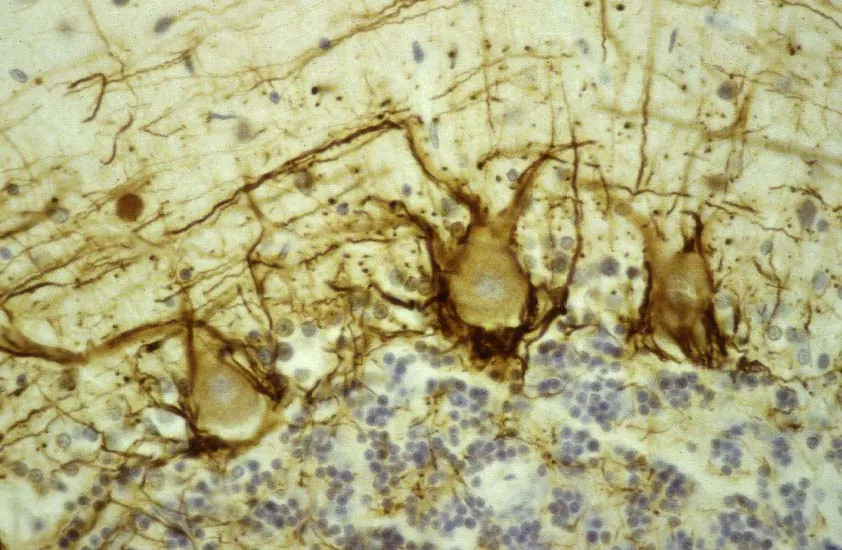
- Anti-Yo: subacute cerebellar degeneration in women with ovarian or breast cancer
- Anti-Hu: sensory neuronopathy, encephalomyelitis and limbic encephalitis with small cell lung cancer
- Anti-NMDAR encephalitis in young women: psychiatric onset, seizures, dyskinesia, autonomic instability; ovarian teratoma in a large proportion
- Intracellular antigen syndromes respond poorly to immunotherapy; surface antigen syndromes often respond well
- Cancer search: CT chest, abdomen and pelvis, then FDG-PET; tumour-specific tests; repeat every 4–6 months for about 2 years if negative
Differential diagnosis
| Condition | Clues | Key test |
|---|---|---|
| Brain or leptomeningeal metastases | Imaging lesions, leptomeningeal enhancement, malignant cells in CSF | MRI with contrast, CSF cytology |
| Chemotherapy neurotoxicity | Temporal link to platinum, taxane, vinca or cytarabine; length-dependent neuropathy | Drug history, nerve conduction studies |
| Wernicke encephalopathy | Malnourished or vomiting patient, ophthalmoplegia, ataxia, confusion | Clinical; give thiamine immediately |
| Herpes simplex encephalitis | Fever, acute temporal lobe syndrome | CSF HSV PCR, MRI |
| Creutzfeldt–Jakob disease | Rapid dementia, myoclonus, cortical ribboning | MRI DWI, CSF RT-QuIC |
| Immune checkpoint inhibitor neurotoxicity | Recent ICI therapy, myasthenia, myositis, encephalitis | Drug history, CK, antibodies |
| Alcohol-related or hereditary cerebellar ataxia | Gradual course, alcohol history, family history | History, MRI, genetic tests |
Exam pearls
Guideline
Updated diagnostic criteria for paraneoplastic neurologic syndromes (Graus et al., 2021) with EFNS cancer screening recommendations (2011)
References
- Graus F, Vogrig A, Muñiz-Castrillo S, et al.. Updated diagnostic criteria for paraneoplastic neurologic syndromes. Neurol Neuroimmunol Neuroinflamm 2021.
- Graus F, Titulaer MJ, Balu R, et al.. A clinical approach to diagnosis of autoimmune encephalitis. Lancet Neurol 2016.
- Titulaer MJ, Soffietti R, Dalmau J, et al.. Screening for tumours in paraneoplastic syndromes: report of an EFNS task force. Eur J Neurol 2011.
- Dalmau J, Rosenfeld MR. Paraneoplastic syndromes of the CNS. Lancet Neurol 2008.
- Darnell RB, Posner JB. Paraneoplastic syndromes involving the nervous system. N Engl J Med 2003.
- Dalmau J, Gleichman AJ, Hughes EG, et al.. Anti-NMDA-receptor encephalitis: case series and analysis of the effects of antibodies. Lancet Neurol 2008.
Related topics
By Dr Khalid Seidi (B.Sc., M.D.) · MedEd World Clinical Knowledge library. Original teaching content checked against current guidelines (November 2026); confirm the latest local guidance before clinical use. Not a substitute for clinical judgement.