Clinical Knowledge › Neurology › Brain tumours, raised intracranial pressure and neurocutaneous syndromes
Von Hippel–Lindau disease
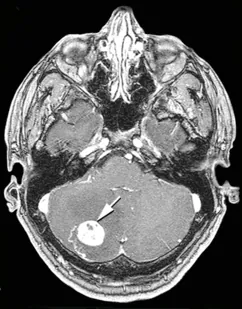
Von Hippel–Lindau (VHL) disease is an autosomal dominant tumour predisposition syndrome caused by germline variants in the VHL tumour suppressor gene on chromosome 3p25. The VHL protein normally targets hypoxia-inducible factor (HIF) for destruction; when both copies are lost, HIF accumulates and drives VEGF, erythropoietin and other growth signals, producing highly vascular tumours. It affects about 1 in 36 000 people. The neurological hallmark is haemangioblastoma of the cerebellum, spinal cord and brainstem, which causes ataxia, headache, hydrocephalus or myelopathy; retinal haemangioblastomas are often the first sign. Other tumours include multiple clear cell renal cell carcinomas (the main cause of death), phaeochromocytomas, pancreatic cysts and neuroendocrine tumours, and endolymphatic sac tumours causing hearing loss. Diagnosis rests on genetic testing and clinical criteria. Lifelong surveillance from early childhood (eye, metanephrines, MRI of brain, spine and abdomen, audiology) allows timely, organ-sparing treatment. Symptomatic haemangioblastomas are resected; small renal tumours are watched until about 3 cm. Belzutifan, an oral HIF-2α inhibitor, shrinks renal, CNS and pancreatic tumours.
Patient case, mechanism, investigations, management, flashcards and exam-style questions.Open the lesson →
Key facts
- Autosomal dominant; germline VHL variant on chromosome 3p25 with somatic second hit (Knudson two-hit)
- Loss of pVHL stabilises HIF, increasing VEGF, PDGF and erythropoietin: vascular tumours and polycythaemia
- CNS haemangioblastomas: cerebellum, spinal cord, brainstem; cyst with enhancing mural nodule on MRI
- Retinal haemangioblastomas are often the earliest manifestation; eye screening starts in infancy
- Clear cell renal cell carcinoma, often multiple and bilateral, is the leading cause of death
- Type 1 lacks phaeochromocytoma; type 2 includes phaeochromocytoma (2A, 2B, 2C)
- Renal tumours: active surveillance until the largest solid lesion reaches about 3 cm, then nephron-sparing surgery
- Belzutifan (HIF-2α inhibitor) treats VHL-associated renal cell carcinoma, CNS haemangioblastoma and pancreatic NET not needing immediate surgery; anaemia is the commonest adverse effect
Differential diagnosis
| Condition | Clues | Key test |
|---|---|---|
| Sporadic haemangioblastoma | Single lesion, older adult, no family history or visceral tumours | Germline VHL testing, eye exam, abdominal MRI |
| Pilocytic astrocytoma | Child, cerebellar cyst with mural nodule, Rosenthal fibres | Histology |
| Cerebellar metastasis | Known cancer, older adult, multiple lesions | Staging, biopsy |
| Multiple endocrine neoplasia type 2 | Phaeochromocytoma with medullary thyroid cancer and hyperparathyroidism (RET) | Calcitonin, calcium, RET testing |
| Neurofibromatosis type 1 | Phaeochromocytoma with café-au-lait macules and neurofibromas | Clinical criteria |
| Hereditary paraganglioma syndromes (SDHx) | Paragangliomas, GIST, renal cancer | SDHB/SDHD testing |
| Tuberous sclerosis | Renal angiomyolipomas and cysts, cortical tubers, skin signs | MRI, TSC testing |
Exam pearls
Guideline
VHL Alliance active surveillance guidelines (2020) and international/Danish updated VHL guideline for diagnosis and surveillance (2022)
References
- Lonser RR, Glenn GM, Walther M, et al.. von Hippel-Lindau disease. Lancet 2003.
- Maher ER, Neumann HP, Richard S. von Hippel-Lindau disease: a clinical and scientific review. Eur J Hum Genet 2011.
- Jonasch E, Donskov F, Iliopoulos O, et al.. Belzutifan for renal cell carcinoma in von Hippel-Lindau disease. N Engl J Med 2021.
- Binderup MLM, Smerdel M, Borgwadt L, et al.. von Hippel-Lindau disease: updated guideline for diagnosis and surveillance. Eur J Med Genet 2022.
- VHL Alliance. VHL Alliance suggested active surveillance guidelines. VHL Alliance 2020.
- Louis DN, Perry A, Wesseling P, et al.. The 2021 WHO Classification of Tumors of the Central Nervous System: a summary. Neuro Oncol 2021.
Related topics
By Dr Khalid Seidi (B.Sc., M.D.) · MedEd World Clinical Knowledge library. Original teaching content checked against current guidelines (November 2026); confirm the latest local guidance before clinical use. Not a substitute for clinical judgement.