Clinical Knowledge › Neurology › Brain tumours, raised intracranial pressure and neurocutaneous syndromes
Vestibular schwannoma (acoustic neuroma)
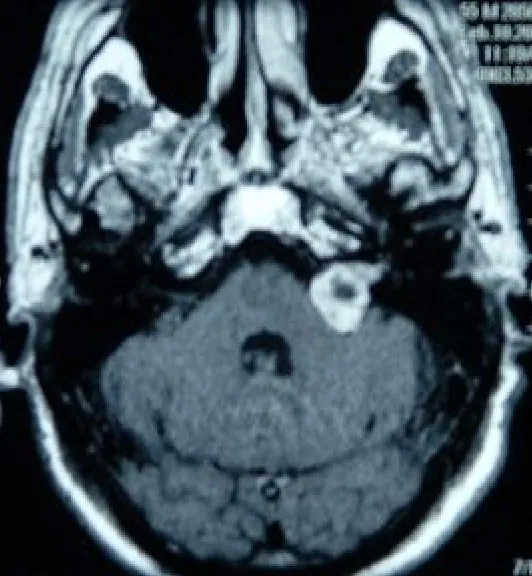
Vestibular schwannoma (acoustic neuroma) is a benign, slow-growing tumour of Schwann cells of the vestibular division of the eighth cranial nerve, arising in the internal acoustic meatus and extending into the cerebellopontine angle. It accounts for about 8% of intracranial tumours and 80% of cerebellopontine angle masses, usually presents at 40–60 years, and is sporadic and unilateral in about 95%. Bilateral tumours define NF2-related schwannomatosis. The cardinal symptom is gradually progressive unilateral sensorineural hearing loss with tinnitus; imbalance is common but true vertigo is unusual because central compensation keeps pace with slow growth. Larger tumours compress the trigeminal nerve (reduced corneal reflex, facial numbness), cerebellum (ipsilateral ataxia) and brainstem, and may cause hydrocephalus; facial weakness is surprisingly late. Asymmetric hearing loss on audiometry should prompt gadolinium-enhanced or high-resolution T2 MRI of the internal acoustic meati. Small tumours are often watched with serial MRI, growing small-to-medium tumours are treated with stereotactic radiosurgery or microsurgery, and large tumours compressing the brainstem need surgery. Preserving facial nerve function and hearing guides choice.
Patient case, mechanism, investigations, management, flashcards and exam-style questions.Open the lesson →
Key facts
- Benign Schwann cell tumour of the vestibular nerve in the internal acoustic meatus and cerebellopontine angle; about 80% of CPA tumours
- Bilateral vestibular schwannomas are diagnostic of NF2-related schwannomatosis (NF2 gene, chromosome 22, merlin)
- Commonest symptom: unilateral progressive sensorineural hearing loss with tinnitus; speech discrimination disproportionately poor
- Weber lateralises to the unaffected ear; Rinne positive (air better than bone) on both sides
- Reduced or absent corneal reflex (trigeminal compression) is an early sign of a medium-sized tumour
- Facial weakness is a late presenting feature but a common risk of surgery
- Investigation of choice: MRI internal acoustic meati with gadolinium or high-resolution T2 ('ice cream cone' enhancing mass)
- Management: wait and scan for small stable tumours; radiosurgery for small–medium growing tumours (usually below about 3 cm); microsurgery for large or brainstem-compressing tumours
Differential diagnosis
| Condition | Clues | Key test |
|---|---|---|
| Meningioma of the CPA | Broad dural base, dural tail, does not widen the internal acoustic meatus, may calcify | MRI with gadolinium |
| Ménière disease | Episodic vertigo lasting hours with fluctuating low-frequency hearing loss, tinnitus, aural fullness | Audiometry over time; MRI normal |
| Sudden sensorineural hearing loss | Hearing loss over hours to 3 days; a minority have an underlying schwannoma | Urgent audiometry, then MRI internal acoustic meati |
| Epidermoid cyst | CPA lesion that does not enhance and shows restricted diffusion | MRI DWI |
| Facial nerve schwannoma | Early facial weakness, geniculate ganglion involvement | MRI and high-resolution CT temporal bone |
| Presbycusis | Bilateral symmetrical high-frequency loss in older adults | Pure tone audiometry |
| Labyrinthitis or vestibular neuritis | Acute severe vertigo for days (with hearing loss in labyrinthitis), recovering | Clinical; MRI if atypical or hearing loss persists |
Exam pearls
Guideline
EANO guideline on vestibular schwannoma (2020), Congress of Neurological Surgeons guideline (2018) and NICE NG98 hearing loss in adults (2018)
References
- Goldbrunner R, Weller M, Regis J, et al.. EANO guideline on the diagnosis and treatment of vestibular schwannoma. Neuro Oncol 2020.
- Carlson ML, Vivas EX, McCracken DJ, et al.. Congress of Neurological Surgeons systematic review and evidence-based guidelines on hearing preservation outcomes in patients with sporadic vestibular schwannomas. Neurosurgery 2018.
- Plotkin SR, Messiaen L, Legius E, et al.. Updated diagnostic criteria and nomenclature for neurofibromatosis type 2 and schwannomatosis: an international consensus recommendation. Genet Med 2022.
- Louis DN, Perry A, Wesseling P, et al.. The 2021 WHO Classification of Tumors of the Central Nervous System: a summary. Neuro Oncol 2021.
- National Institute for Health and Care Excellence. Hearing loss in adults: assessment and management (NG98). NICE guideline 2018.
- Koos WT, Day JD, Matula C, Levy DI. Neurotopographic considerations in the microsurgical treatment of small acoustic neurinomas. J Neurosurg 1998.
Related topics
By Dr Khalid Seidi (B.Sc., M.D.) · MedEd World Clinical Knowledge library. Original teaching content checked against current guidelines (November 2026); confirm the latest local guidance before clinical use. Not a substitute for clinical judgement.