Clinical Knowledge › Neurology › Brain tumours, raised intracranial pressure and neurocutaneous syndromes
Gliomas and glioblastoma
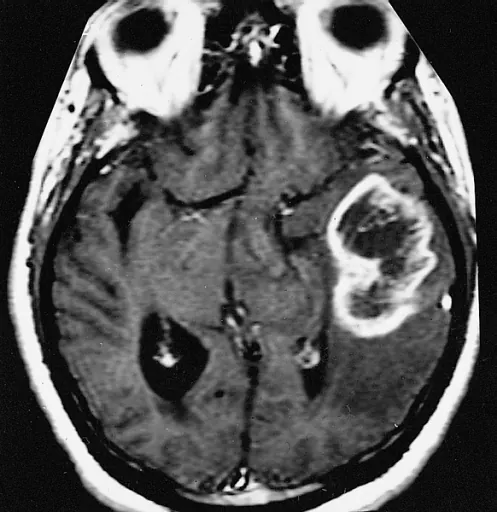
Gliomas are primary brain tumours arising from glial precursor cells and are the commonest malignant primary brain tumours in adults. The WHO CNS5 classification (2021) defines adult diffuse gliomas by molecular markers as well as histology: astrocytoma IDH-mutant (CNS WHO grade 2–4), oligodendroglioma IDH-mutant and 1p/19q-codeleted (grade 2–3), and glioblastoma IDH-wildtype (grade 4). Glioblastoma peaks at 55–75 years and presents with progressive focal deficit, seizures, personality change or headache with features of raised intracranial pressure. MRI typically shows an irregular ring-enhancing mass with central necrosis and surrounding oedema, sometimes crossing the corpus callosum. Management is maximal safe resection followed by radiotherapy 60 Gy with concomitant and adjuvant temozolomide (the Stupp protocol); MGMT promoter methylation predicts benefit. Tumour-treating fields add modest survival. Median survival for glioblastoma remains about 15–20 months. Lower-grade IDH-mutant gliomas cause seizures in young adults and survive for years; vorasidenib, an IDH inhibitor, delays progression after surgery. Dexamethasone for oedema, antiseizure medicines for seizures, VTE vigilance, driving advice and palliative care are core neurological tasks.
Patient case, mechanism, investigations, management, flashcards and exam-style questions.Open the lesson →
Key facts
- WHO CNS5 (2021) integrates histology and molecular markers; IDH status is the first branch point in adult diffuse glioma
- Glioblastoma IDH-wildtype is grade 4 even without necrosis if it has TERT promoter mutation, EGFR amplification or +7/−10
- Oligodendroglioma requires IDH mutation and 1p/19q codeletion; it responds best to radiotherapy plus PCV chemotherapy
- Stupp protocol: radiotherapy 60 Gy in 30 fractions with daily temozolomide 75 mg/m², then 6 cycles of temozolomide 150–200 mg/m² on days 1–5 every 28 days
- MGMT promoter methylation predicts temozolomide benefit and longer survival
- MRI: irregular ring enhancement, central necrosis, mass effect and oedema; 'butterfly' glioma crosses the corpus callosum
- Dexamethasone treats vasogenic oedema; give antiseizure medicine only after a seizure, not prophylactically
- Vorasidenib (INDIGO, 2023) prolonged progression-free survival in residual or recurrent grade 2 IDH-mutant glioma
Differential diagnosis
| Condition | Clues | Key test |
|---|---|---|
| Brain metastasis | Known primary cancer, multiple lesions at grey–white junction, oedema disproportionate to size | CT chest/abdomen/pelvis, PET, biopsy |
| Primary CNS lymphoma | Periventricular homogeneous enhancement, restricted diffusion, melts with steroids | Stereotactic biopsy before steroids; CSF cytology |
| Cerebral abscess | Fever, smooth thin rim, central restricted diffusion on DWI | MRI DWI, blood cultures, aspiration |
| Tumefactive demyelination | Younger patient, incomplete ('open') ring enhancement, little mass effect | MRI spinal cord, CSF oligoclonal bands, biopsy if needed |
| Subacute infarct | Sudden onset, arterial territory, gyriform enhancement at 1–3 weeks | Repeat MRI with DWI; evolution over time |
| Toxoplasmosis (HIV) | CD4 below 100, multiple basal ganglia ring lesions | Toxoplasma serology, empirical therapy response |
| Radiation necrosis | Previous radiotherapy, enhancement months to years later | Perfusion MRI (low rCBV), MR spectroscopy, amino acid PET |
Exam pearls
Guideline
EANO guideline on diffuse gliomas of adulthood (2021) with WHO CNS5 classification (2021) and NICE NG99 brain tumours (2018, updated 2021)
References
- Louis DN, Perry A, Wesseling P, et al.. The 2021 WHO Classification of Tumors of the Central Nervous System: a summary. Neuro Oncol 2021.
- Weller M, van den Bent M, Preusser M, et al.. EANO guidelines on the diagnosis and treatment of diffuse gliomas of adulthood. Nat Rev Clin Oncol 2021.
- Stupp R, Mason WP, van den Bent MJ, et al.. Radiotherapy plus concomitant and adjuvant temozolomide for glioblastoma. N Engl J Med 2005.
- National Institute for Health and Care Excellence. Brain tumours (primary) and brain metastases in over 16s (NG99). NICE guideline 2018.
- Stupp R, Taillibert S, Kanner A, et al.. Effect of tumor-treating fields plus maintenance temozolomide vs maintenance temozolomide alone on survival in patients with glioblastoma: a randomized clinical trial. JAMA 2017.
- Mellinghoff IK, van den Bent MJ, Blumenthal DT, et al.. Vorasidenib in IDH1- or IDH2-mutant low-grade glioma. N Engl J Med 2023.
Related topics
By Dr Khalid Seidi (B.Sc., M.D.) · MedEd World Clinical Knowledge library. Original teaching content checked against current guidelines (November 2026); confirm the latest local guidance before clinical use. Not a substitute for clinical judgement.