Clinical Knowledge › Neurology › Spinal cord disorders
Brown-Séquard syndrome
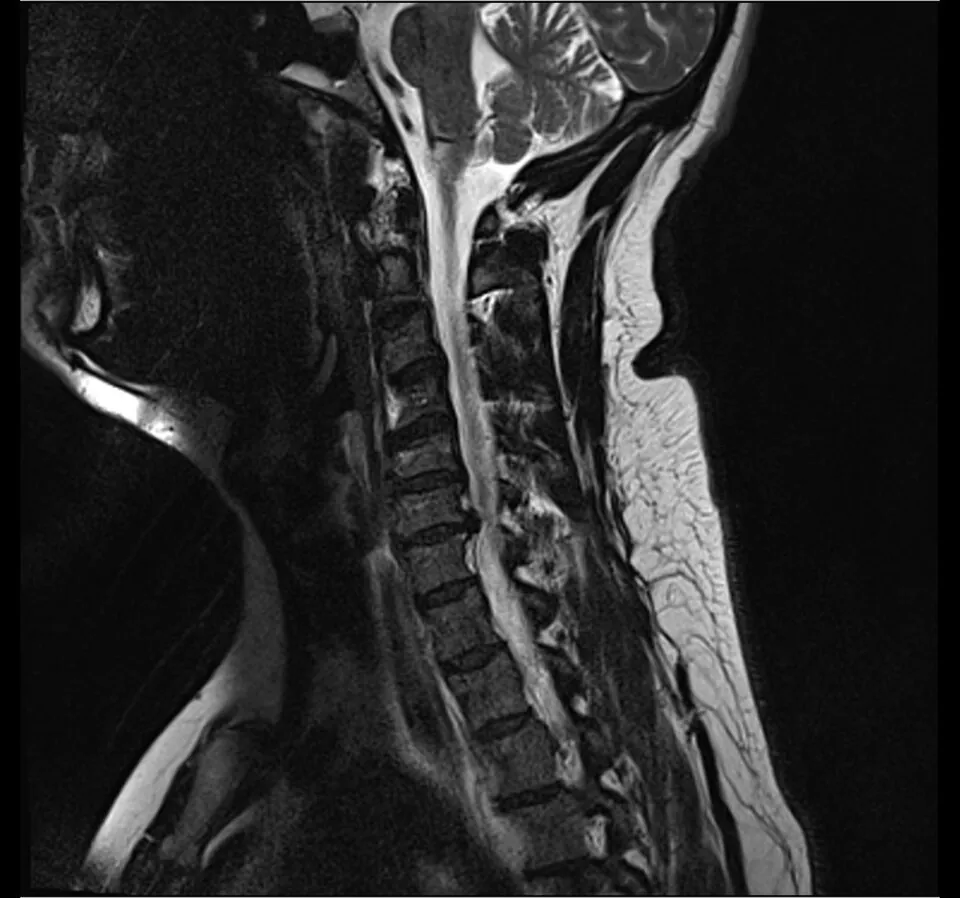
Brown-Séquard syndrome is the clinical picture of a functional hemisection of the spinal cord. Because the corticospinal tract and dorsal columns decussate in the medulla while the spinothalamic tract crosses within one or two segments of entry, a lesion of one half of the cord produces ipsilateral spastic weakness and loss of vibration and joint position sense below the lesion, with contralateral loss of pain and temperature sensation beginning a segment or two below. At the level of the lesion there may be an ipsilateral band of complete sensory loss and lower motor neurone signs, and a cervical lesion above T1 can cause ipsilateral Horner syndrome. Penetrating trauma such as a stab wound is the classic cause, but most cases in practice are incomplete hemisections from blunt trauma, disc herniation, tumours, demyelination, transverse myelitis, epidural haematoma or radiation. MRI of the spine is the key investigation. Management follows acute spinal cord injury principles: immobilisation, airway and haemodynamic support, early decompression where indicated and treatment of the cause. It has the best prognosis of the incomplete cord syndromes; most patients walk again.
Patient case, mechanism, investigations, management, flashcards and exam-style questions.Open the lesson →
Key facts
- Hemisection of the cord: ipsilateral UMN weakness and dorsal column loss below the lesion, contralateral pain and temperature loss
- Contralateral spinothalamic loss starts 1–2 segments below the lesion because fibres ascend before crossing
- At the lesion level: ipsilateral band of all-modality sensory loss and segmental LMN signs
- Ipsilateral Horner syndrome if the lesion is at or above T1
- Classic cause: penetrating injury (stab or gunshot); also disc herniation, tumour, MS, myelitis, epidural haematoma
- MRI of the spine is the investigation of choice; CT first in major trauma for bony injury
- Usually ISNCSCI AIS grade C or D; the best functional prognosis of incomplete cord syndromes (most walk again)
- Routine high-dose methylprednisolone is not standard; maintain mean arterial pressure and decompress early when indicated
Differential diagnosis
| Condition | Clues | Key test |
|---|---|---|
| Central cord syndrome | Older adult, hyperextension injury, arms weaker than legs, sacral sparing | MRI cervical spine; often spondylosis without fracture |
| Anterior cord (anterior spinal artery) syndrome | Bilateral paralysis and pain loss with preserved vibration and proprioception | MRI with diffusion; aortic history |
| Posterior cord syndrome | Isolated loss of vibration and proprioception, sensory ataxia | B12, copper, syphilis serology; MRI |
| Hemispheric stroke | Hemiparesis with face involvement, cortical signs, sensory loss same side as weakness | CT or MRI brain |
| Transverse myelitis | Bilateral weakness, sensory level and sphincter disturbance over hours to days | MRI spine, CSF, AQP4 and MOG antibodies |
| Lateral medullary syndrome | Crossed signs: ipsilateral face and contralateral body pain loss, ataxia, vertigo | MRI brain with diffusion |
Exam pearls
Guideline
AO Spine/Praxis clinical practice guideline for acute spinal cord injury (2017, updated 2024), NICE NG41 Spinal injury: assessment and initial management (2016), and ISNCSCI (ASIA 2019 revision)
References
- Fehlings MG, Tetreault LA, Wilson JR, et al.. A clinical practice guideline for the management of acute spinal cord injury: introduction, rationale, and scope. Global Spine J 2017.
- National Institute for Health and Care Excellence. Spinal injury: assessment and initial management (NG41). NICE 2016.
- American Spinal Injury Association. International Standards for Neurological Classification of Spinal Cord Injury (ISNCSCI), revised 2019. ASIA/ISCoS 2019.
- Ropper AH, Samuels MA, Klein JP, Prasad S.. Adams and Victor's Principles of Neurology. 2023.
- McKinley W, Santos K, Meade M, Brooke K. Incidence and outcomes of spinal cord injury clinical syndromes. J Spinal Cord Med 2007.
- Papadakis MA, Rabow MW, McQuaid KR, eds.. CURRENT Medical Diagnosis & Treatment 2026. 2026.
Related topics
By Dr Khalid Seidi (B.Sc., M.D.) · MedEd World Clinical Knowledge library. Original teaching content checked against current guidelines (November 2026); confirm the latest local guidance before clinical use. Not a substitute for clinical judgement.