Clinical Knowledge › Neurology › Spinal cord disorders
Degenerative cervical myelopathy
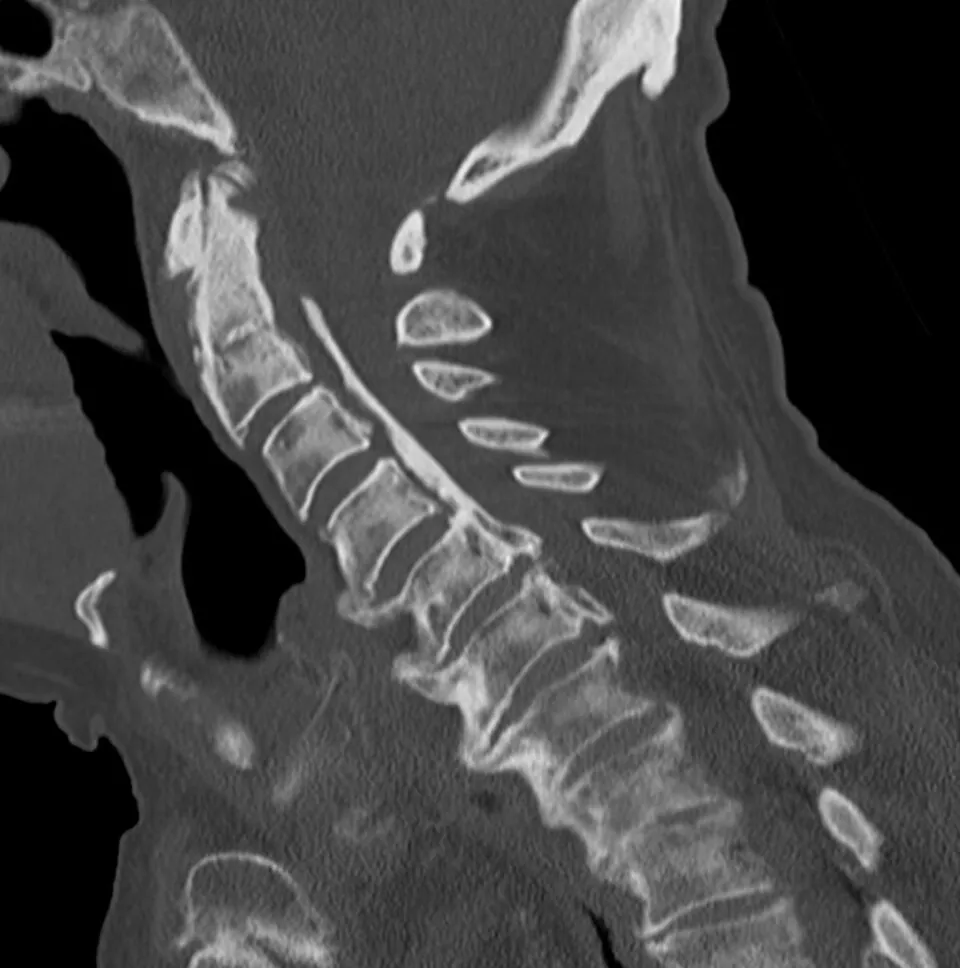
Degenerative cervical myelopathy (DCM) is progressive spinal cord dysfunction caused by age-related narrowing of the cervical canal from disc–osteophyte complexes, ligamentum flavum hypertrophy or ossification of the posterior longitudinal ligament. It is the commonest cause of spinal cord impairment in adults, mainly affecting people over 50, but diagnosis is often delayed for years. Symptoms include clumsy, numb hands, loss of dexterity (buttons, writing), gait imbalance, falls, Lhermitte phenomenon, neck pain and later bladder dysfunction. Examination shows a combination of upper motor neurone signs below the level (hyperreflexia, Hoffmann sign, inverted supinator jerk, clonus, extensor plantars, spastic gait) and lower motor neurone or radicular signs at the level. MRI shows cord compression, often with T2 hyperintensity. Severity is graded with the modified Japanese Orthopaedic Association (mJOA) score. Surgical decompression is recommended for moderate and severe disease and is an option in mild disease; it halts progression and improves function in most.
Patient case, mechanism, investigations, management, flashcards and exam-style questions.Open the lesson →
Key facts
- Commonest cause of adult spinal cord dysfunction; often misdiagnosed as carpal tunnel syndrome or 'old age'
- Causes: disc–osteophyte complexes, ligamentum flavum hypertrophy, OPLL, spondylolisthesis; congenitally narrow canal increases risk
- Symptoms: numb clumsy hands, poor dexterity, imbalance, Lhermitte phenomenon, urinary urgency
- Signs: Hoffmann sign, inverted supinator jerk, hyperreflexia, clonus, extensor plantars, finger escape sign, wasting of hand muscles
- MRI is the investigation of choice; T2 hyperintensity indicates cord oedema or myelomalacia
- mJOA severity: mild 15–17, moderate 12–14, severe 11 or less
- AO Spine 2017: surgery for moderate and severe DCM; surgery or supervised rehabilitation for mild DCM
- Avoid neck manipulation and counsel patients about falls, which can cause acute central cord syndrome
Differential diagnosis
| Condition | Clues | Key test |
|---|---|---|
| Carpal tunnel syndrome | Median distribution symptoms, nocturnal, no UMN signs | Nerve conduction studies |
| Motor neurone disease | Mixed UMN and LMN signs without sensory loss, bulbar and widespread fasciculations | EMG showing widespread denervation; MRI without compression |
| Subacute combined degeneration (B12) | Dorsal column loss, peripheral neuropathy, macrocytosis | Serum B12, MMA; MRI dorsal column signal |
| Multiple sclerosis | Younger, relapsing, multiple lesions | MRI brain and spine; CSF OCBs |
| Spinal cord tumour | Progressive myelopathy, night pain | Contrast MRI |
| Normal pressure hydrocephalus | Gait apraxia with cognitive and urinary symptoms | CT or MRI brain |
| Hereditary spastic paraplegia or copper deficiency | Family history, slowly progressive spasticity, prior gastric surgery or zinc use | Genetics; copper and caeruloplasmin |
Exam pearls
Guideline
AO Spine/Cervical Spine Research Society clinical practice guideline for degenerative cervical myelopathy (Fehlings et al., Global Spine Journal 2017)
References
- Fehlings MG, Tetreault LA, Riew KD, et al.. A Clinical Practice Guideline for the Management of Patients With Degenerative Cervical Myelopathy: Recommendations for Patients With Mild, Moderate, and Severe Disease and Nonmyelopathic Patients With Evidence of Cord Compression. Global Spine J 2017.
- Davies BM, Mowforth OD, Smith EK, et al.. Degenerative cervical myelopathy. BMJ 2018.
- Ropper AH, Samuels MA, Klein JP, Prasad S. Adams and Victor's Principles of Neurology. 2023.
- Penman ID, Ralston SH, Strachan MWJ, Hobson RP, eds.. Davidson's Principles and Practice of Medicine. 2022.
- Loscalzo J, Fauci AS, Kasper DL, et al., eds.. Harrison's Principles of Internal Medicine. 2022.
- Papadakis MA, McPhee SJ, Rabow MW, et al., eds.. Current Medical Diagnosis and Treatment 2026. 2026.
Related topics
By Dr Khalid Seidi (B.Sc., M.D.) · MedEd World Clinical Knowledge library. Original teaching content checked against current guidelines (November 2026); confirm the latest local guidance before clinical use. Not a substitute for clinical judgement.