Clinical Knowledge › Neurology › Spinal cord disorders
Syringomyelia
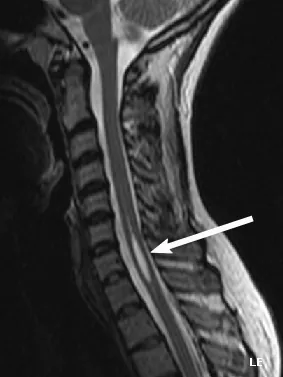
Syringomyelia is a fluid-filled cavity (syrinx) within the spinal cord, most often in the cervical cord, that enlarges slowly over years. Most cases are secondary to obstruction of cerebrospinal fluid (CSF) flow at the foramen magnum by a Chiari I malformation; others follow spinal cord injury, arachnoiditis after meningitis or haemorrhage, or accompany intramedullary tumours such as ependymoma or haemangioblastoma. Because the cavity expands from the centre of the cord, it first interrupts the crossing spinothalamic fibres in the anterior white commissure, producing dissociated, cape-like loss of pain and temperature sensation over the shoulders and arms with preserved light touch, vibration and proprioception. Extension into the anterior horns causes wasting and areflexia of the hands and arms (lower motor neurone signs), while compression of the corticospinal tracts causes spastic paraparesis (upper motor neurone signs in the legs). Painless burns, Charcot joints of the shoulder or elbow, scoliosis and Horner syndrome are typical. MRI of the whole spine and craniocervical junction with gadolinium is diagnostic. Symptomatic Chiari-associated syringomyelia is treated by posterior fossa decompression; shunting is reserved for selected or refractory cases.
Patient case, mechanism, investigations, management, flashcards and exam-style questions.Open the lesson →
Key facts
- A syrinx is a fluid-filled cavity in the spinal cord; hydromyelia is dilatation of the ependyma-lined central canal; syringobulbia is extension into the medulla
- Chiari I malformation (cerebellar tonsils at least 5 mm below the foramen magnum) is the commonest associated cause
- Earliest sign: dissociated loss of pain and temperature in a cape or shawl distribution because crossing spinothalamic fibres are interrupted first
- Dorsal columns are spared early, so vibration, joint position sense and light touch are preserved
- Classic combination: LMN signs in the arms (wasted hands, lost arm reflexes) plus UMN signs in the legs
- Painless burns and cuts, neuropathic (Charcot) shoulder or elbow, and progressive scoliosis are clues
- MRI of the whole spine and brain with gadolinium is the investigation of choice; contrast excludes an intramedullary tumour
- Posterior fossa decompression (with or without duraplasty) is first-line surgery for symptomatic Chiari-related syrinx; direct syrinx shunting is second-line
Differential diagnosis
| Condition | Clues | Key test |
|---|---|---|
| Intramedullary spinal cord tumour (ependymoma, astrocytoma) | Progressive myelopathy, night pain, cavity with enhancing nodule | MRI spine with gadolinium |
| Degenerative cervical myelopathy | Older adult, neck pain, hand clumsiness, global sensory loss, no cape | MRI cervical spine shows canal stenosis |
| Motor neurone disease | Wasting with fasciculations and brisk reflexes but no sensory loss | EMG widespread denervation; normal MRI |
| Hereditary sensory and autonomic neuropathy or leprosy | Painless injuries but glove-and-stocking or patchy loss, thickened nerves in leprosy | Nerve conduction studies; skin smear or biopsy |
| Subacute combined degeneration | Dorsal column loss (vibration, proprioception) with UMN signs | Low B12, raised methylmalonic acid |
| Cervical radiculopathy | Dermatomal pain and weakness in one arm, reflex loss at one level | MRI shows foraminal narrowing |
| Multiple sclerosis | Relapsing deficits, short-segment cord lesions, optic neuritis | MRI brain and spine; CSF oligoclonal bands |
Exam pearls
Guideline
Chiari and Syringomyelia Consortium international consensus on diagnosis and treatment of Chiari malformation and syringomyelia in adults (2022), with ISNCSCI (ASIA 2019 revision) for examination and NICE CG173 neuropathic pain (updated 2020)
References
- Ciaramitaro P, Massimi L, Bertuccio A, et al.. Diagnosis and treatment of Chiari malformation and syringomyelia in adults: international consensus document. Neurol Sci 2022.
- National Institute for Health and Care Excellence. Neuropathic pain in adults: pharmacological management in non-specialist settings (CG173). NICE 2020.
- American Spinal Injury Association. International Standards for Neurological Classification of Spinal Cord Injury (ISNCSCI), revised 2019. ASIA/ISCoS 2019.
- Ropper AH, Samuels MA, Klein JP, Prasad S.. Adams and Victor's Principles of Neurology. 2023.
- Oldfield EH, Muraszko K, Shawker TH, Patronas NJ. Pathophysiology of syringomyelia associated with Chiari I malformation of the cerebellar tonsils. Implications for diagnosis and treatment. J Neurosurg 1994.
- Papadakis MA, Rabow MW, McQuaid KR, eds.. CURRENT Medical Diagnosis & Treatment 2026. 2026.
Related topics
By Dr Khalid Seidi (B.Sc., M.D.) · MedEd World Clinical Knowledge library. Original teaching content checked against current guidelines (November 2026); confirm the latest local guidance before clinical use. Not a substitute for clinical judgement.