Clinical Knowledge › Internal medicine › Rheumatology and immunology › Degenerative and soft-tissue disorders
Bursitis and tendinopathy
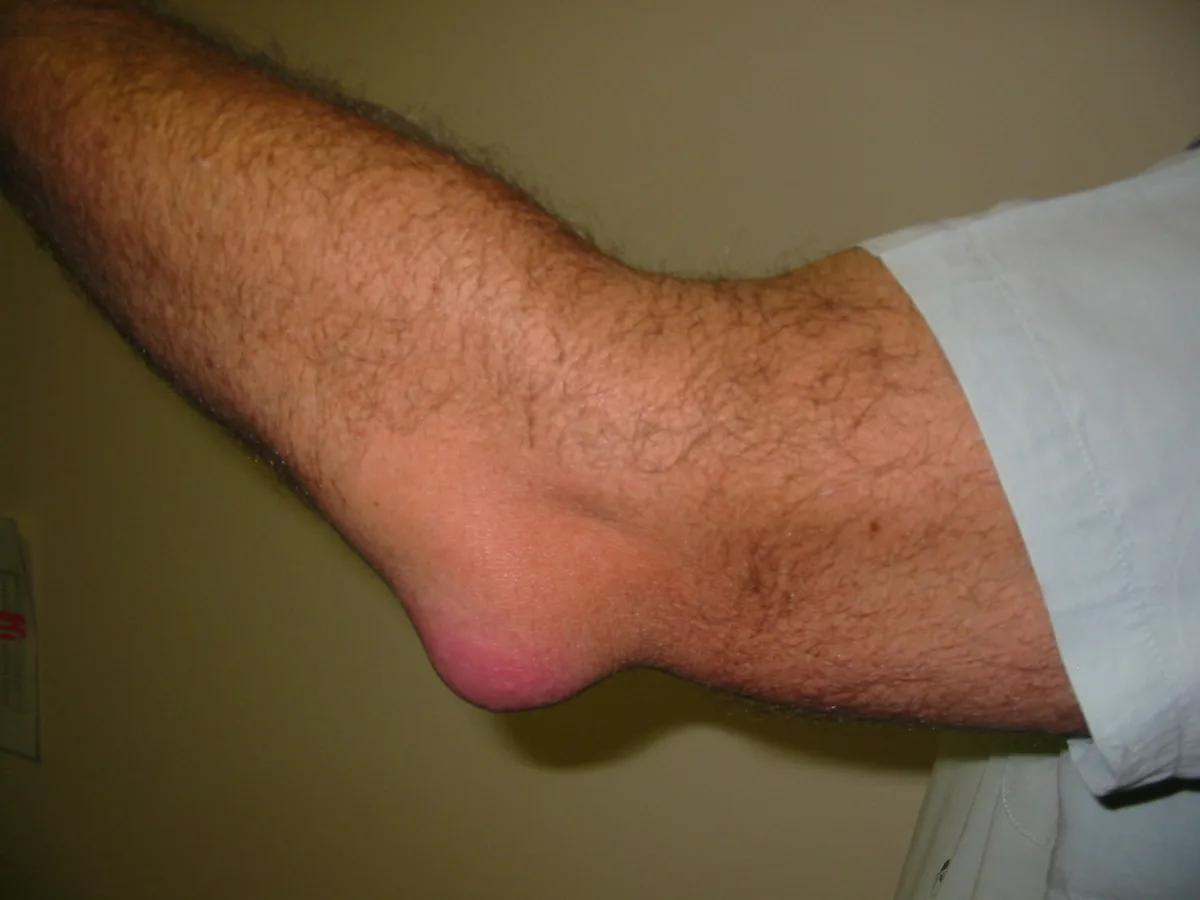
Bursitis and tendinopathy are the commonest soft-tissue (regional) musculoskeletal disorders. Tendinopathy is persistent tendon pain and loss of function related to mechanical loading; it reflects a failed healing response with disorganised collagen and new vessels rather than classic inflammation. Common sites are the rotator cuff, the common extensor origin at the lateral elbow, the gluteal tendons at the greater trochanter, the patellar and Achilles tendons, and the first dorsal compartment of the wrist (de Quervain tenosynovitis). Bursitis is inflammation of a synovium-lined bursa from friction, pressure, trauma, crystals, inflammatory arthritis or infection; the superficial olecranon and prepatellar bursae are most often infected, usually by Staphylococcus aureus. Diagnosis is clinical, supported by ultrasound, and aspiration is essential when a superficial bursa is hot and red. Management is load modification and progressive exercise-based rehabilitation; corticosteroid injection gives short-term relief but may worsen longer-term outcomes in some tendinopathies and should never be given into a possibly infected bursa or the Achilles tendon. Fluoroquinolones, glucocorticoids and older age predispose to tendinopathy and rupture.
Patient case, mechanism, investigations, management, flashcards and exam-style questions.Open the lesson →
Key facts
- Tendinopathy is a degenerative, failed-healing response to load, not primarily an inflammatory 'tendinitis'
- Common sites: rotator cuff, lateral elbow, greater trochanter (gluteal), patellar, Achilles, de Quervain (abductor pollicis longus and extensor pollicis brevis)
- Progressive loading exercise (for example heavy slow resistance or eccentric programmes) is first-line treatment for tendinopathy
- Corticosteroid injection relieves pain short-term but lateral epicondylalgia outcomes at 1 year can be worse than with no injection
- Hot, red olecranon or prepatellar bursa: aspirate for Gram stain, culture and crystals; S. aureus causes about 80% of septic bursitis
- Never inject steroid into a possibly infected bursa or directly into the Achilles tendon
- Fluoroquinolones increase tendinopathy and Achilles rupture risk, especially over 60, with corticosteroids or after transplantation
- Sudden 'kick in the calf' with a positive Simmonds (Thompson) test = Achilles rupture
Differential diagnosis
| Condition | Clues | Key test |
|---|---|---|
| Septic arthritis | Painful restricted joint movement in all directions, effusion | Joint aspiration (bursitis spares joint range) |
| Cellulitis | Spreading erythema without fluctuant swelling over a bursa | Clinical; ultrasound shows no bursal collection |
| Gout or CPPD | Acute bursitis or tenosynovitis, tophi, previous attacks | Bursal fluid crystals; urate |
| Rheumatoid arthritis | Bilateral olecranon bursitis with nodules, polyarthritis | RF, anti-CCP, CRP |
| Cervical radiculopathy | Arm pain with neck pain, dermatomal sensory loss | Neurological examination; MRI if deficit |
| Hip osteoarthritis | Groin pain, loss of internal rotation | Hip examination and X-ray (trochanteric pain spares rotation) |
| Achilles tendon rupture | Sudden pain, weak plantarflexion, palpable gap | Simmonds test; ultrasound |
| Spondyloarthritis enthesitis | Achilles or plantar fascia pain with back stiffness, psoriasis or IBD | HLA-B27, CRP, MRI sacroiliac joints |
Exam pearls
Guideline
ICON 2019 International Scientific Tendinopathy Symposium Consensus, BESS/BOA subacromial shoulder pain pathway (2015) and MHRA fluoroquinolone safety advice (2019; restrictions 2024)
References
- Scott A, Squier K, Alfredson H, et al.. ICON 2019: International Scientific Tendinopathy Symposium Consensus: clinical terminology. Br J Sports Med 2020.
- Millar NL, Silbernagel KG, Thorborg K, et al.. Tendinopathy. Nat Rev Dis Primers 2021.
- Coombes BK, Bisset L, Vicenzino B. Efficacy and safety of corticosteroid injections and other injections for management of tendinopathy: a systematic review of randomised controlled trials. Lancet 2010.
- Medicines and Healthcare products Regulatory Agency. Fluoroquinolone antibiotics: must now only be prescribed when other commonly recommended antibiotics are inappropriate (Drug Safety Update). MHRA 2024.
- Aaron DL, Patel A, Kayiaros S, Calfee R. Four common types of bursitis: diagnosis and management. J Am Acad Orthop Surg 2011.
- Kulkarni R, Gibson J, Brownson P, et al.. Subacromial shoulder pain: BESS/BOA patient care pathways. Shoulder Elbow 2015.
Related topics
By Dr Khalid Seidi (B.Sc., M.D.) · MedEd World Clinical Knowledge library. Original teaching content checked against current guidelines (November 2026); confirm the latest local guidance before clinical use. Not a substitute for clinical judgement.