Clinical Knowledge › Internal medicine › Rheumatology and immunology › Degenerative and soft-tissue disorders
Complex regional pain syndrome
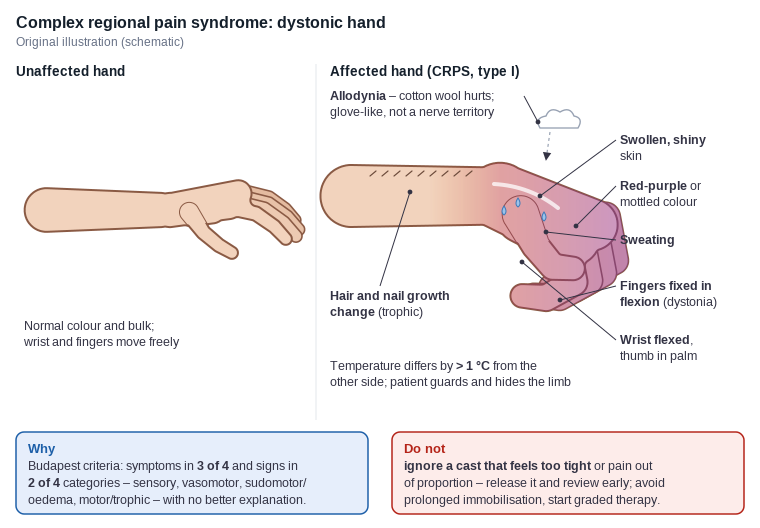
Complex regional pain syndrome (CRPS) is a painful condition of a limb, usually after a fracture, sprain or surgery, in which pain is continuing and out of proportion to the injury and is accompanied by sensory, vasomotor, sudomotor and motor or trophic changes. Type I occurs without, and type II with, a definable major nerve injury. It is commonest in women aged 50–70 and after distal radius fracture. The limb is swollen, discoloured, warm or cold and sweaty, with allodynia, stiffness and later hair, nail and skin changes; mechanisms include neurogenic inflammation, central sensitisation and cortical remapping. Diagnosis is clinical using the Budapest criteria, after excluding infection, thrombosis, arthritis and nerve entrapment; inflammatory markers are normal. Treatment should start early and be multidisciplinary: education, graded physiotherapy and occupational therapy, desensitisation, mirror therapy or graded motor imagery, pain relief, and psychological support. Most patients improve, but some have lasting pain and disability.
Patient case, mechanism, investigations, management, flashcards and exam-style questions.Open the lesson →
Key facts
- Budapest criteria: disproportionate continuing pain; symptoms in at least 3 of 4 categories; signs in at least 2 of 4; no better explanation
- The four categories are sensory, vasomotor, sudomotor or oedema, and motor or trophic
- Type I (about 90%) has no major nerve lesion; type II follows an identifiable major nerve injury
- Commonest triggers: distal radius fracture, ankle fracture or sprain, hand and foot surgery; about 10% have no clear trigger
- Women are affected 3–4 times more often; peak age 50–70 years
- CRP and ESR are normal; investigations exclude mimics such as infection, DVT, arthritis and nerve entrapment
- Early mobilisation and physiotherapy are central; prolonged immobilisation worsens CRPS
- The 2021 Valencia consensus added the subtype 'CRPS with remission of some features' for patients who no longer meet all criteria
Differential diagnosis
| Condition | Clues | Key test |
|---|---|---|
| Cellulitis or septic arthritis | Fever, spreading erythema, raised CRP | CRP, WCC, blood cultures; joint aspiration |
| Deep vein thrombosis | Leg swelling, calf tenderness, risk factors | Compression ultrasound; D-dimer |
| Inflammatory or crystal arthritis | Joint-centred synovitis, raised CRP | CRP, autoantibodies, synovial fluid analysis |
| Peripheral nerve entrapment (e.g. carpal tunnel) | Pain and sensory loss in a nerve territory | Nerve conduction studies |
| Fracture non-union or malunion | Persistent focal bone pain, abnormal X-ray | X-ray or CT |
| Peripheral neuropathy (e.g. diabetic) | Symmetrical glove-and-stocking, both limbs | Nerve conduction studies; HbA1c, B12 |
| Charcot neuroarthropathy | Warm swollen foot in diabetic neuropathy with sensory loss | X-ray and MRI of the foot |
| Functional (dissociative) limb disorder | Inconsistent weakness or posture without autonomic signs | Positive clinical signs (e.g. Hoover sign) |
Exam pearls
Guideline
Royal College of Physicians UK guidelines for CRPS in adults (2nd edition, 2018), IASP Budapest diagnostic criteria with the Valencia consensus adaptation (2021) and CRPS practical diagnostic and treatment guidelines (5th edition, 2022)
References
- Harden RN, Bruehl S, Perez RSGM, et al.. Validation of proposed diagnostic criteria (the 'Budapest Criteria') for Complex Regional Pain Syndrome. Pain 2010.
- Goebel A, Birklein F, Brunner F, et al.. The Valencia consensus-based adaptation of the IASP complex regional pain syndrome diagnostic criteria. Pain 2021.
- Royal College of Physicians. Complex regional pain syndrome in adults: UK guidelines for diagnosis, referral and management in primary and secondary care (2nd edition). RCP, London 2018.
- Harden RN, McCabe CS, Goebel A, et al.. Complex Regional Pain Syndrome: Practical Diagnostic and Treatment Guidelines, 5th Edition. Pain Med 2022.
- Birklein F, Ajit SK, Goebel A, Perez RSGM, Sommer C.. Complex regional pain syndrome - phenotypic characteristics and potential biomarkers. Nat Rev Neurol 2018.
- Varenna M, Adami S, Rossini M, et al.. Treatment of complex regional pain syndrome type I with neridronate: a randomized, double-blind, placebo-controlled study. Rheumatology (Oxford) 2013.
Related topics
By Dr Khalid Seidi (B.Sc., M.D.) · MedEd World Clinical Knowledge library. Original teaching content checked against current guidelines (November 2026); confirm the latest local guidance before clinical use. Not a substitute for clinical judgement.