Clinical Knowledge › Internal medicine › Rheumatology and immunology › Degenerative and soft-tissue disorders
Fibromyalgia
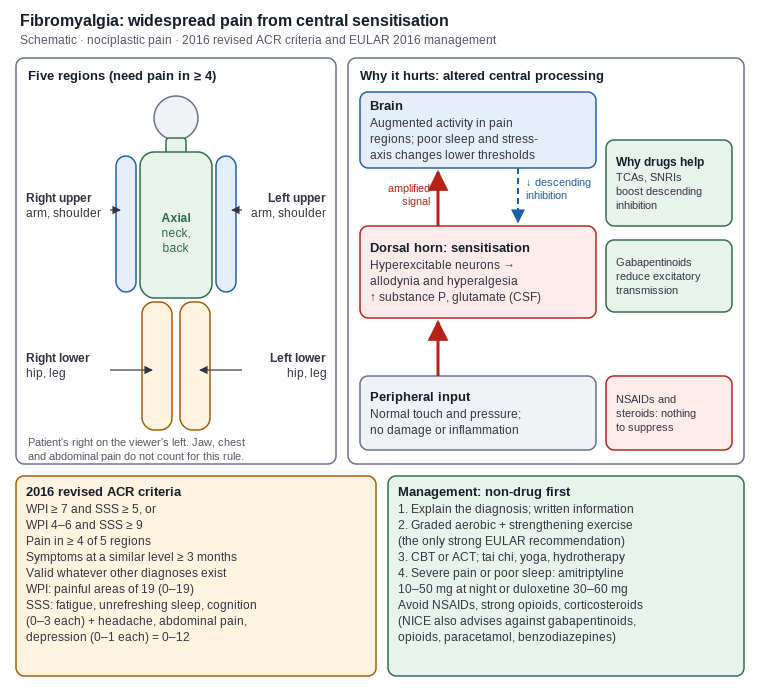
Fibromyalgia is a common chronic widespread pain condition, lasting at least 3 months, accompanied by fatigue, unrefreshing sleep and cognitive difficulties ('fibro fog'). It is the prototype of nociplastic pain: pain arising from altered central processing (central sensitisation and reduced descending inhibition) rather than tissue damage or inflammation. It affects 2–4% of adults, more often women, and frequently coexists with irritable bowel syndrome, headache, depression, anxiety and inflammatory rheumatic diseases. The diagnosis is clinical, using the 2016 revised ACR criteria (widespread pain index and symptom severity scale); tender point counting is no longer required. Investigations are limited to excluding mimics such as hypothyroidism, polymyalgia rheumatica, inflammatory arthritis, myopathy and vitamin D deficiency. Management is non-pharmacological first: a clear explanation, graded aerobic and strengthening exercise (the only strongly recommended treatment in EULAR guidance), sleep measures and psychological therapies. Drugs such as low-dose amitriptyline or duloxetine help some people; NSAIDs, opioids and corticosteroids should be avoided.
Patient case, mechanism, investigations, management, flashcards and exam-style questions.Open the lesson →
Key facts
- Chronic widespread pain for at least 3 months with fatigue, unrefreshing sleep and cognitive symptoms
- Mechanism: central sensitisation (nociplastic pain) with reduced descending inhibitory pain pathways
- 2016 revised ACR criteria: WPI 7 or more and SSS 5 or more (or WPI 4–6 and SSS 9 or more), pain in at least 4 of 5 regions, for 3 months or more
- Tender point examination is no longer needed; fibromyalgia can coexist with other diagnoses
- Bloods (FBC, ESR/CRP, TSH, calcium, CK if relevant) are normal; avoid unnecessary ANA and imaging
- Exercise is the only treatment with a strong EULAR recommendation
- Low-dose amitriptyline or duloxetine may help; avoid NSAIDs, strong opioids and corticosteroids
- Common comorbidities: depression, anxiety, irritable bowel syndrome, migraine, sleep disorders and inflammatory arthritis
Differential diagnosis
| Condition | Clues | Key test |
|---|---|---|
| Hypothyroidism | Fatigue, myalgia, weight gain, cold intolerance | TSH, free T4 |
| Polymyalgia rheumatica | Age over 50, shoulder and hip girdle stiffness, rapid onset | Raised ESR and CRP; rapid steroid response |
| Rheumatoid arthritis or SLE | Joint swelling, rash, systemic features | CRP, RF, anti-CCP, ANA with clinical features |
| Inflammatory or statin myopathy | Proximal weakness rather than pain alone | CK, myositis antibodies, EMG |
| Vitamin D deficiency (osteomalacia) | Bone pain, proximal weakness, low sun exposure | 25-OH vitamin D, calcium, ALP |
| Depression | Low mood, anhedonia, somatic symptoms | Screening questionnaire (PHQ-9); often coexists |
| Hypermobility spectrum disorder | Joint hypermobility, subluxations, widespread pain | Beighton score |
| Myeloma or metastatic malignancy | Older adult, bone pain, weight loss | FBC, calcium, ESR, serum protein electrophoresis |
Exam pearls
Guideline
EULAR revised recommendations for the management of fibromyalgia (2016, published 2017), 2016 revised ACR fibromyalgia diagnostic criteria and NICE NG193 Chronic pain (primary and secondary) in over 16s (2021)
References
- Macfarlane GJ, Kronisch C, Dean LE, et al.. EULAR revised recommendations for the management of fibromyalgia. Ann Rheum Dis 2017.
- Wolfe F, Clauw DJ, Fitzcharles MA, et al.. 2016 revisions to the 2010/2011 fibromyalgia diagnostic criteria. Semin Arthritis Rheum 2016.
- Wolfe F, Clauw DJ, Fitzcharles MA, et al.. The American College of Rheumatology preliminary diagnostic criteria for fibromyalgia and measurement of symptom severity. Arthritis Care Res (Hoboken) 2010.
- National Institute for Health and Care Excellence. Chronic pain (primary and secondary) in over 16s: assessment of all chronic pain and management of chronic primary pain (NG193). NICE 2021.
- Clauw DJ. Fibromyalgia: a clinical review. JAMA 2014.
- Häuser W, Ablin J, Fitzcharles MA, et al.. Fibromyalgia. Nat Rev Dis Primers 2015.
Related topics
By Dr Khalid Seidi (B.Sc., M.D.) · MedEd World Clinical Knowledge library. Original teaching content checked against current guidelines (November 2026); confirm the latest local guidance before clinical use. Not a substitute for clinical judgement.