Clinical Knowledge › Internal medicine › Rheumatology and immunology › Degenerative and soft-tissue disorders
Osteoarthritis
Osteoarthritis (OA) is the commonest joint disease and a leading cause of pain and disability worldwide. It is a disorder of the whole joint, in which mechanical stress and low-grade inflammation lead to focal cartilage loss, subchondral bone remodelling, osteophyte formation and synovitis. It mainly affects the knees, hips, hands (distal and proximal interphalangeal and thumb-base joints), and the cervical and lumbar spine. Risk rises with age, female sex, obesity, previous joint injury, malalignment and genetic factors. Patients describe use-related pain, brief morning stiffness (under 30 minutes) and reduced function; examination shows bony swelling, crepitus and restricted movement, with Heberden and Bouchard nodes in the hands. Current guidelines diagnose OA clinically in people aged 45 or more with typical features, without routine imaging or blood tests. Core treatment for everyone is education, therapeutic exercise and weight loss if overweight, supported by topical NSAIDs, then oral NSAIDs at the lowest effective dose, and intra-articular steroid for flares. Joint replacement is offered when symptoms substantially affect quality of life despite non-surgical care.
Patient case, mechanism, investigations, management, flashcards and exam-style questions.Open the lesson →
Key facts
- OA is a whole-joint disease: cartilage loss, subchondral sclerosis and cysts, osteophytes and synovitis
- Diagnose clinically (NICE) if aged 45 or more with activity-related joint pain and no morning stiffness or stiffness lasting 30 minutes or less
- Typical hand pattern: DIP (Heberden nodes), PIP (Bouchard nodes) and first carpometacarpal joints; MCP joints are usually spared
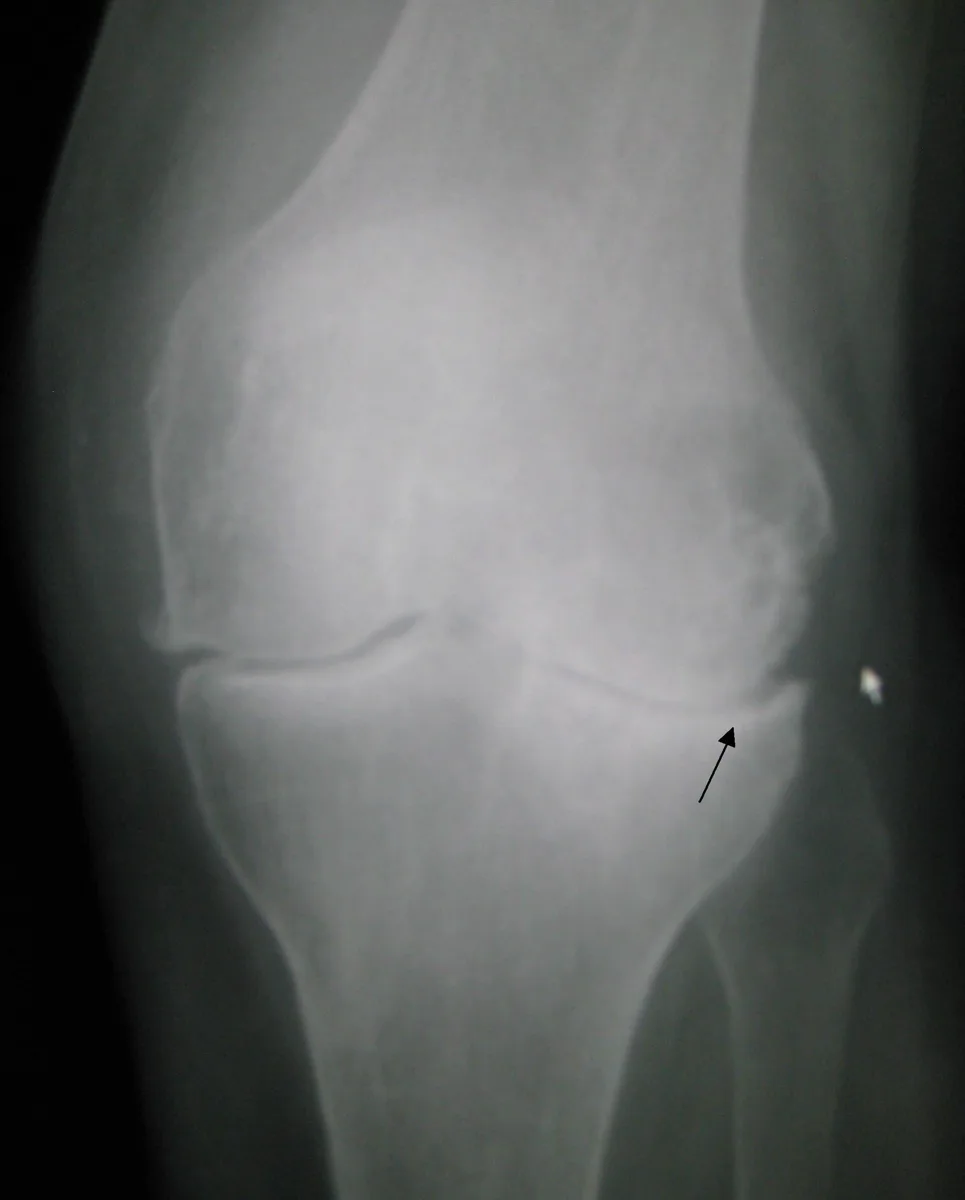
- X-ray features: joint-space narrowing, osteophytes, subchondral sclerosis and subchondral cysts
- Core treatment for all: information, therapeutic exercise and weight loss (aim for at least 5–10% if overweight)
- Topical NSAIDs are first-line drug treatment for knee and hand OA; oral NSAIDs at the lowest dose for the shortest time with a PPI
- NICE NG226 advises against routine paracetamol and weak opioids, glucosamine, hyaluronan injections and arthroscopic lavage or debridement
- Refer for joint replacement when pain and disability substantially affect quality of life despite non-surgical treatment; do not use scores, age or BMI as barriers
Differential diagnosis
| Condition | Clues | Key test |
|---|---|---|
| Rheumatoid arthritis | Symmetrical MCP, PIP and wrist synovitis, morning stiffness over 1 hour | RF, anti-CCP, CRP; periarticular erosions on X-ray |
| Psoriatic arthritis | DIP involvement with nail pitting, dactylitis, psoriasis | Clinical; X-ray pencil-in-cup, new bone formation |
| CPPD disease (pseudogout) | Acute hot knee or wrist in an older adult, OA in atypical joints | Synovial fluid: positively birefringent rhomboid crystals; chondrocalcinosis |
| Gout | Acute hot first MTP joint, tophi | Synovial fluid: negatively birefringent needles; serum urate |
| Haemochromatosis arthropathy | Second and third MCP OA with hook osteophytes | Ferritin, transferrin saturation, HFE genotype |
| Avascular necrosis of the femoral head | Hip pain in steroid or alcohol user, young age | MRI hip |
| Polymyalgia rheumatica | Bilateral shoulder and hip girdle stiffness over 45 minutes in an older adult | ESR and CRP raised; rapid steroid response |
| Referred pain (hip pathology to knee; lumbar spine to hip) | Knee pain with normal knee examination | Examine the hip and spine |
Exam pearls
Guideline
NICE NG226 Osteoarthritis in over 16s (2022), EULAR non-pharmacological core management of hip and knee OA (2023 update), OARSI non-surgical management guideline (2019) and ACR/Arthritis Foundation OA guideline (2019)
References
- National Institute for Health and Care Excellence. Osteoarthritis in over 16s: diagnosis and management (NG226). NICE 2022.
- Bannuru RR, Osani MC, Vaysbrot EE, et al.. OARSI guidelines for the non-surgical management of knee, hip, and polyarticular osteoarthritis. Osteoarthritis Cartilage 2019.
- Kolasinski SL, Neogi T, Hochberg MC, et al.. 2019 American College of Rheumatology/Arthritis Foundation guideline for the management of osteoarthritis of the hand, hip, and knee. Arthritis Rheumatol 2020.
- Moseng T, Vliet Vlieland TPM, Battista S, et al.. EULAR recommendations for the non-pharmacological core management of hip and knee osteoarthritis: 2023 update. Ann Rheum Dis 2024.
- Kloppenburg M, Kroon FP, Blanco FJ, et al.. 2018 update of the EULAR recommendations for the management of hand osteoarthritis. Ann Rheum Dis 2019.
- Hunter DJ, Bierma-Zeinstra S. Osteoarthritis. Lancet 2019.
Related topics
By Dr Khalid Seidi (B.Sc., M.D.) · MedEd World Clinical Knowledge library. Original teaching content checked against current guidelines (November 2026); confirm the latest local guidance before clinical use. Not a substitute for clinical judgement.