Clinical Knowledge › Internal medicine › Rheumatology and immunology › Degenerative and soft-tissue disorders
Diffuse idiopathic skeletal hyperostosis (DISH)
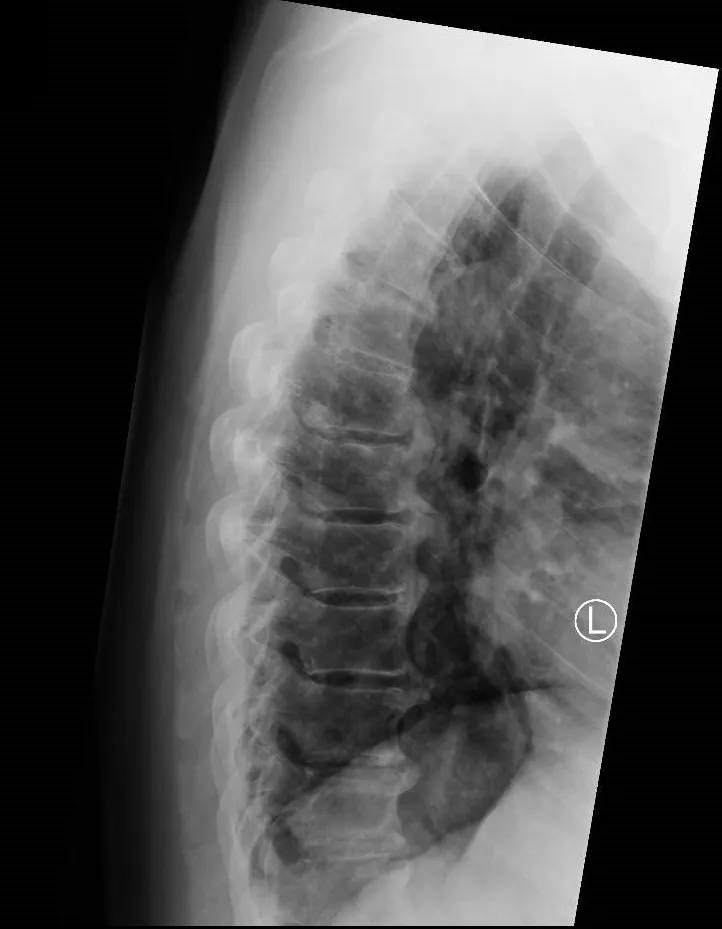
Diffuse idiopathic skeletal hyperostosis (DISH, Forestier disease) is a non-inflammatory condition of older adults in which the anterior longitudinal ligament and entheses calcify and ossify. The classic finding is flowing ossification along the right anterolateral border of at least four contiguous thoracic vertebrae, with preserved disc heights and normal sacroiliac and facet joints. It affects about 10–25% of people over 50, more often men, and is strongly linked to obesity, type 2 diabetes, hypertension and the metabolic syndrome. Many people have no symptoms; others have mild thoracic stiffness, back pain, heel or elbow enthesopathy, or dysphagia and airway problems from large cervical osteophytes. Inflammatory markers and HLA-B27 are normal, separating DISH from ankylosing spondylitis. The rigid spine fractures after minor trauma; these fractures are unstable and easily missed, so CT is needed after even a minor fall. Treatment is supportive: exercise, analgesia, weight loss and control of cardiometabolic risk, with surgery for compressive osteophytes or fractures.
Patient case, mechanism, investigations, management, flashcards and exam-style questions.Open the lesson →
Key facts
- Resnick criteria: flowing ossification along the anterolateral aspect of at least 4 contiguous vertebral bodies, preserved disc height, no sacroiliac erosion or facet ankylosis
- Thoracic spine most affected, usually on the right side (the left is protected by the pulsating descending aorta)
- Prevalence 10–25% over age 50; men about twice as often as women; rises with age
- Strong association with obesity, type 2 diabetes, hyperinsulinaemia, hypertension, dyslipidaemia and hyperuricaemia
- ESR, CRP and HLA-B27 are normal, unlike ankylosing spondylitis
- Large anterior cervical osteophytes cause dysphagia, hoarseness, stridor and difficult intubation
- Ankylosed spines fracture after low-energy trauma; fractures are unstable and often missed: image with CT
- DISH increases the risk of heterotopic ossification after hip replacement
Differential diagnosis
| Condition | Clues | Key test |
|---|---|---|
| Ankylosing spondylitis | Younger (under 45), inflammatory back pain, uveitis | Sacroiliitis on X-ray or MRI, thin marginal syndesmophytes, raised CRP, HLA-B27 |
| Spondylosis (degenerative disc disease) | Mechanical pain, older adult | Disc space narrowing, horizontal osteophytes, end-plate sclerosis |
| Psoriatic spondyloarthritis | Psoriasis, asymmetrical bulky paramarginal syndesmophytes | Skin and nail examination; sacroiliitis often asymmetrical |
| Acromegaly | Coarse features, large hands and feet, sweating | IGF-1, oral glucose tolerance test with GH |
| Skeletal fluorosis | Endemic high-fluoride water, dense bones, ligament calcification | Urine or serum fluoride, dense sclerotic skeleton |
| Retinoid-induced hyperostosis | Long-term isotretinoin or acitretin | Drug history |
| Hypoparathyroidism or X-linked hypophosphataemia | Low calcium or phosphate, enthesopathy at a younger age | Calcium, phosphate, PTH, FGF23 |
| Oesophageal cancer | Progressive dysphagia with weight loss | Endoscopy; do not attribute dysphagia to osteophytes without excluding malignancy |
Exam pearls
Guideline
No dedicated international management guideline: Resnick–Niwayama classification criteria (1976), expert reviews on DISH (2013, 2017) and the 2017 systematic review on lack of consensus on classification criteria
References
- Resnick D, Niwayama G. Radiographic and pathologic features of spinal involvement in diffuse idiopathic skeletal hyperostosis (DISH). Radiology 1976.
- Mader R, Verlaan JJ, Buskila D. Diffuse idiopathic skeletal hyperostosis: clinical features and pathogenic mechanisms. Nat Rev Rheumatol 2013.
- Kuperus JS, de Gendt EEA, Oner FC, et al.. Classification criteria for diffuse idiopathic skeletal hyperostosis: a lack of consensus. Rheumatology (Oxford) 2017.
- Mader R, Verlaan JJ, Eshed I, et al.. Diffuse idiopathic skeletal hyperostosis (DISH): where we are now and where to go next. RMD Open 2017.
- Westerveld LA, Verlaan JJ, Oner FC. Spinal fractures in patients with ankylosing spinal disorders: a systematic review of the literature on treatment, neurological status and complications. Eur Spine J 2009.
- Penman ID, Ralston SH, Strachan MWJ, Hobson RP, eds.. Davidson's Principles and Practice of Medicine. 2022.
Related topics
By Dr Khalid Seidi (B.Sc., M.D.) · MedEd World Clinical Knowledge library. Original teaching content checked against current guidelines (November 2026); confirm the latest local guidance before clinical use. Not a substitute for clinical judgement.